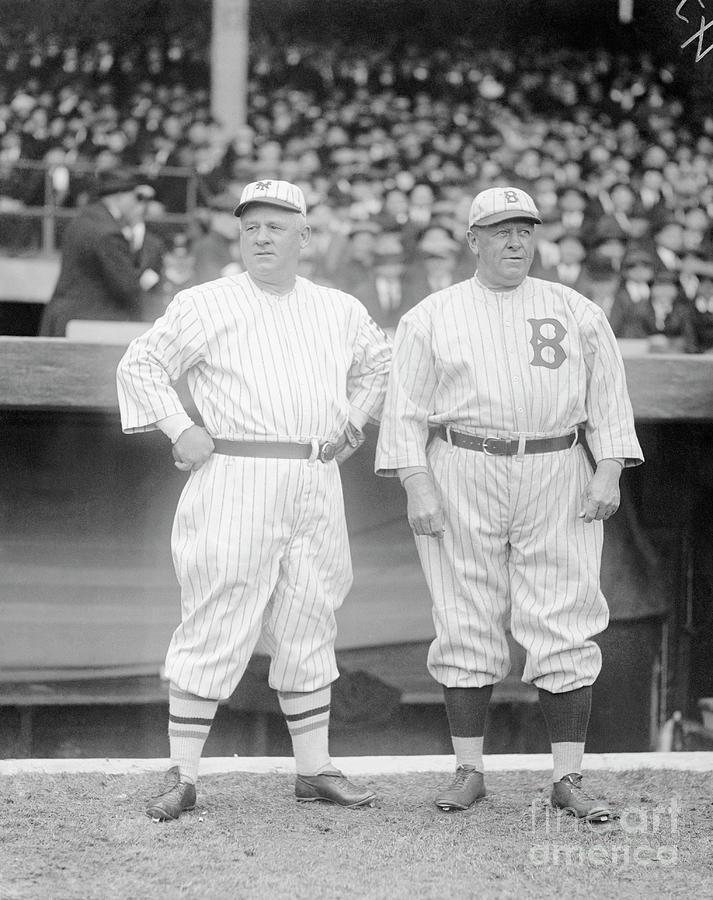
After a night of heavy drinking‚ McGraw blames his longtime friend‚ Giants business partner, and former Oriole teammate Wilbert Robinson, perhaps baseball's 1st great pitching coach, for too many coaching mistakes in the 1913 Series. "Uncle Robbie" replies that McGraw made more mistakes than anybody. McGraw fires him. Eyewitnesses say Robbie doused McGraw with a glass of beer and left.
Six days later, Robbie will begin a legendary 18 years as manager of the crosstown Brooklyn franchise‚ replacing Bill Dahlen. The team will carry the nickname Robins‚ as well as Dodgers‚ during his tenure.
Robbie and Mac won't speak to each other for 17 years, and after winning 3 straight Pennants together, McGraw will win just 1 Pennant in the next 7 years, in 1917; while Robbie will win 2, in 1916 and 1920, the only Pennants the Brooklyn team will win between 1900 and 1941.
This is not the beginning of the rivalry between the Giants and the Dodgers, not by a long shot. That rivalry had its beginning in rivalries between clubs of New York (Manhattan) and Brooklyn when they were separate cities prior to 1898, even going back to the days of amateur baseball in the 1850s and '60s. And the rivalry between Manhattan and Brooklyn would have happened even if baseball had never been invented.
But the McGraw-Robinson bustup is the beginning of a rivalry that ruined one of baseball's great friendships, not resolved until both men were retired and near death, as seen in the photo above. Still, they both ended up in the Hall of Fame – neither lived to see the Hall's establishment, though – and are buried in the same Baltimore cemetery.
Somebody should write a book about it: We've seen books about the Giants, about the Dodgers, about the Dodger-Giant rivalry, about McGraw, and even about the old Orioles -- but the McGraw-Robinson relationship is a fascinating one. They're like the John Adams and Thomas Jefferson of baseball: Great friends in a great cause, then a nasty split and a nastier rivalry, and ultimately the relationship was repaired and the great friendship restored toward the end.
Six days later, Robbie will begin a legendary 18 years as manager of the crosstown Brooklyn franchise‚ replacing Bill Dahlen. The team will carry the nickname Robins‚ as well as Dodgers‚ during his tenure.
Robbie and Mac won't speak to each other for 17 years, and after winning 3 straight Pennants together, McGraw will win just 1 Pennant in the next 7 years, in 1917; while Robbie will win 2, in 1916 and 1920, the only Pennants the Brooklyn team will win between 1900 and 1941.
This is not the beginning of the rivalry between the Giants and the Dodgers, not by a long shot. That rivalry had its beginning in rivalries between clubs of New York (Manhattan) and Brooklyn when they were separate cities prior to 1898, even going back to the days of amateur baseball in the 1850s and '60s. And the rivalry between Manhattan and Brooklyn would have happened even if baseball had never been invented.
But the McGraw-Robinson bustup is the beginning of a rivalry that ruined one of baseball's great friendships, not resolved until both men were retired and near death, as seen in the photo above. Still, they both ended up in the Hall of Fame – neither lived to see the Hall's establishment, though – and are buried in the same Baltimore cemetery.
Somebody should write a book about it: We've seen books about the Giants, about the Dodgers, about the Dodger-Giant rivalry, about McGraw, and even about the old Orioles -- but the McGraw-Robinson relationship is a fascinating one. They're like the John Adams and Thomas Jefferson of baseball: Great friends in a great cause, then a nasty split and a nastier rivalry, and ultimately the relationship was repaired and the great friendship restored toward the end.
October 12, 1913 was a Sunday. Baseball season was over. Pro basketball and pro hockey barely existed, and, in those days, it was considered too early to start their seasons, anyway. Pro football existed, but only on a minor-league level.
But there was one score on this historic day: Despite it being a Sunday, a college football game was played. Georgia Tech beat the University of Chattanooga (now the University of Tennessee at Chattanooga), 71-6 at Chamberlain Field at Chattanooga, Tennessee.


