
June 4, 1913: A demonstration for women's rights takes a tragic turn at one of the world's great sporting events.
Emily Wilding Davison was born on October 11, 1872 in Blackheath, Southeast London. She was an early feminist, fighting for women's right to vote in Britain in the late 19th and early 20th Centuries. She was arrested 9 times, and would lead her fellow suffragettes in hunger strikes. In return, prison officials would force-feed them. American suffragettes would follow the tactics of their British counterparts -- and so would American prison officials.
On June 4, 1913, 40 years old, and never a wife or a mother, she attended the Epsom Derby in Epsom, Surrey, 16 miles southwest of Central London. She had bought a round-trip ticket from London's Victoria Station, indicating that she expected to return to London alive.
Along with the 2,000 Guineas Stakes and the St. Leger Stakes, the Epsom Derby is part of British thoroughbred racing's Triple Crown. Like the Belmont Stakes in America, it is held every 1st Saturday in June. First run in 1780, its length is 1 mile, 4 furlongs, 6 yards -- a shade over a mile and a half, the length of the Belmont Stakes.
In the 1913 Derby, King George V owned one of the competing horses, Anmer. Anmer was ridden by Herbert Jones, who had previously won the Triple Crown in 1900, aboard Diamond Jubilee, a horse so named because it was born in 1897, the year of Queen Victoria's 60th Anniversary on the throne, and owned by her son, then the Prince of Wales, soon to be King Edward VII, father of George V, who kept Jones on to race the royal thoroughbreds after his father died.
Emily Davison ran onto the track, and waited for Anmer to reach her. As newsreel footage examined for the 100th Anniversary of the incident showed, she had a clear view of the oncoming horses, and purposely targeted the King's horse, and attempted to attach a sash to Anmer's bridle. The sash was emblazoned with the colors of the British women's suffrage movement. Had she succeeded, it would not have meant that the King, or even that Jones, supported women's right to vote, but it would have been one strong public statement: That the King should support it.
Instead, she mistimed her action, and Anmer crashed into her. Both she and Jones were thrown and injured. Both suffered concussions. Davison also received a fractured skull, most likely when she hit the ground, but her other injuries may also have killed her. She died 4 days later.
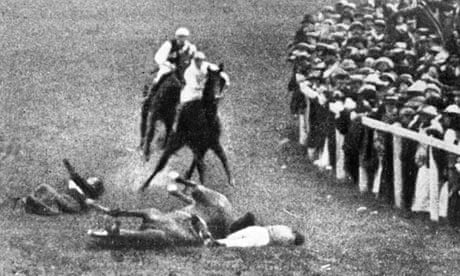
Davidson is at the left, in the dark clothing.
Jones is at the bottom, in white, next to the fallen Anmer.
Jones survived the incident, and continued racing for another 10 years. Anmer also escaped serious injury, and Jones rode him just 2 months later, at England's other great thoroughbred track, Ascot Racecourse in Ascot, Berkshire, 6 miles southwest of Windsor Castle (making it a favorite weekend haunt of the royal family) and 31 miles west of Central London.
In 1928, Jones laid a wreath at the funeral of Emmeline Pankhurst, Britain's leading feminist, in her memory and in that of Emily Davison. When his wife died in 1951, he fell into a deep depression, and, unlike Davison, definitively took his own life. He was 70, and outlived King George V by 15 years and Davison by 38 years. In 2013, on the 100th Anniversary, a plaque was placed at Epsom Downs Racecourse in her memory.
Women age 30 and up got the right to vote in Britain in 1918. At the same time, the voting age for men was lowered to 21. Women age 21 and up got the right to vote in 1928. It has since been reduced to 18. American women got the right to vote in 1920, with the ratification of the 19th Amendment to the Constitution of the United States. Prior to that, only 4 States had given women the right to vote, including New York in 1917.
*
June 4, 1913 was a Saturday. These baseball games were played that day:
* The New York Yankees lost to the Cleveland Naps, 9-5 at the Polo Grounds. Napoleon "Nap" Lajoie, the Cleveland team's 2nd baseman, best hitter, manager and namesake, did not put himself into the game. He did put Joe Jackson in, and "Shoeless Joe" hit a home run. Left fielder Jack Graney, who went on to become the 1st former player to become a broadcaster, also hit a home run.
Shortstop Ray Chapman went 1-for-5 with an RBI. Seven years later, on that same field, Chapman would be hit in the head with a pitch, and become baseball's only fatality from an on-field event. Ed Sweeney homered for the Yankees. The Naps became the Cleveland Indians in 1915, after Lajoie left; and the Cleveland Guardians in 2022.
* The New York Giants lost to the St. Louis Cardinals, 6-4 at Robison Field in St. Louis. Christy Mathewson was in the unusual position of losing the game and only pitching 6 innings.
* The Brooklyn Dodgers lost to the Cincinnati Reds, 4-3 at Redland Field in Cincinnati. (It was renamed Redland Field in 1933.)
* The Chicago White Sox beat the Boston Red Sox, 4-1 at Fenway Park in Boston. Eddie Cicotte, later to be one of the 8 banned "Black Sox" (as was Shoeless Joe) went the distance for the win. For the Red Sox, Tris Speaker went 0-for-3, but had an RBI on a sacrifice fly.
* The Philadelphia Athletics beat the Detroit Tigers, 14-6 at Shibe Park in Philadelphia. Ty Cobb went 2-for-4. Eddie Collins went 3-for-5 with 3 RBIs.
* The Washington Senators beat the St. Louis Browns, 6-2 at National Park in Washington. (It was renamed Griffith Stadium in 1922.)
* The Philadelphia Phillies beat the Pittsburgh Pirates, 4-0 at Forbes Field in Pittsburgh. Honus Wagner went 1-for-4.
* And the Chicago Cubs beat the Boston Braves, 5-0 at West Side Park in Chicago. Orval Overall -- yes, that was his real name -- pitched a 5-hit shutout.


No comments:
Post a Comment