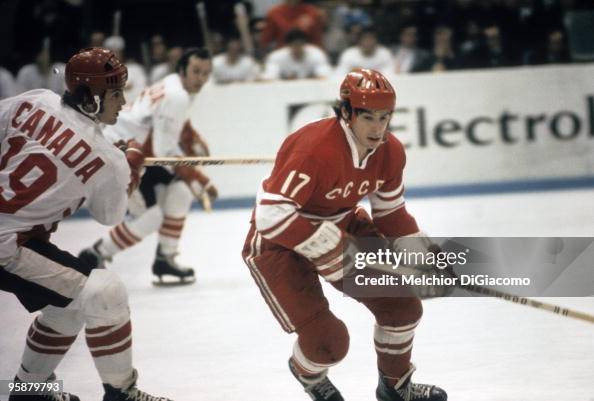
February 22, 1980: The "Miracle On Ice" occurs, as the American national hockey team beats the Soviet Union, 4-3 at what was then named the Olympic Fieldhouse in Lake Placid, New York.
It was considered a miracle because of the records of the teams involved:
* The United States: Won the Gold Medal in 1960; the Silver Medal in 1920, 1924, 1932, 1952, 1956 and 1972; the Bronze Medal in 1936; 5th in 1964 and 1976; 6th in 1968; 9th and last in 1948; and did not compete in 1928.
* The Soviet Union: Beat the U.S. for the Gold Medal in 1956; lost to the U.S. in the Semifinal and won the Bronze Medal in 1960; won the Gold Medal in 1964; won the Gold Medal in 1968; beat the U.S. on the way to winning the Gold Medal in 1972; and beat the U.S. on the way to winning the Gold Medal in 1976.
In addition, the Soviets had taken on professional teams with notable success: They won 3 of the 1st 5 games of a "Summit Series" against a team of NHL All-Stars before losing the last 3 and the series in 1972; easily defeated a team of World Hockey Association All-Stars in 1974; only lost 1 game in a 1976 tour of NHL teams; and embarrassed an NHL All-Star team in a "Challenge Cup" at Madison Square Garden in New York in 1979.
And in the U.S. team's last warmup game before the 1980 Winter Olympics, they lost to the Soviets, 10-3.
This was the U.S. team going into Lake Placid, coached by Herb Brooks of the University of Minnesota:
* From Massachusetts, all from Boston University: Goaltender Jim Craig, right wing and team Captain Mike Eruzione, right wing Dave Silk and defenseman Jack O'Callahan.
* From Michigan, but attending Ohio's Bowling Green State University: Defenseman Ken Morrow and center Mark Wells.
* From Wisconsin, and the University of Wisconsin: Center Mark Johnson and defenseman Bob Suter. UW was coached by later Pittsburgh Penguins coach "Badger Bob" Johnson, Mark's father.
* From Minnesota, and the University of Minnesota, already coached by Brooks: Defensemen Mike Ramsey and Bill Baker, center Neal Broten, right wings Steve Christoff and Eric Strobel, goaltender Steve Janaszak, left wings Rob McClanahan, William "Buzz" Schneider and Phil Verchota. Schneider had also played on the '76 U.S. Olympic team.
* From Minnesota, and the University of Minnesota's Duluth campus and team: Right wing John Harrington and center Mark Pavelich.
* And from Minnesota, but attending the University of North Dakota: Right wing Dave Christian.
Brooks had played on the '64 team, and was the last player cut from the '60 team that won the Gold Medal on home ice at Squaw Valley (since renamed Palisades Tahoe), California, a team that included Christian's father and uncle.
Sports Illustrated didn't have much faith in this team: They called the players "19 fuzzy-cheeked college kids and a tall guy with a beard." The tall guy with the beard was Morrow.
It's important to note that this was before the 1998 rule change that allowed professional hockey players in the Winter Olympics. A player could be drafted by a pro team (and Morrow had been drafted by the New York Islanders), but once he signed a contract with a pro team, even if he'd only played in the minor leagues thus far, he was ineligible.
But since Communist countries had officially outlawed professional sports, but, like an American "semipro" team, had given their players easy or even no-show jobs at places that sponsored teams, the Soviets -- and also the East Germany and Czechoslovakia players -- were essentially professionals playing against amateurs. They were following the letter of the law, but breaking the spirit of the law.
The action got underway on February 12, and the U.S. opened against Sweden. They needed a goal by Baker with 27 seconds left to escape with a tie. (No overtime in those days.) But that tie seemed to give them a lift. On February 14, they beat Czechoslovakia 7-3, with Schneider scoring twice. On February 16, they beat Norway, 5-1, with 5 different scorers.
On February 18, they beat Romania, 7-2, with Schneider again scoring twice. And on February 20, they beat West Germany, 4-2, with 2 goals from McClanahan. This brought them to a record of 4-0-1, and clinched a spot in the medal round.
But the Soviets were playing true to form: 16-0 over Japan, 17-4 over the Netherlands, 8-1 over Poland, 4-2 over Finland, and 6-4 over Canada.
The Final Round was set, and it wasn't strictly 2 Semifinals and a Final. On Friday, February 22, the U.S. would play the U.S.S.R. at 5:00 PM Eastern Time, and Finland would play Sweden at 8:30. On Sunday, February 24, regardless of the Friday results, the U.S. would play Finland at 11:00 AM, and the Soviets would play the Swedes at 2:30 PM.
The Soviets had Vladislav Tretiak, who had been considered perhaps the best goaltender in the world ever since he shut down the Canadian stars in the 1st half of the 1972 Summit Series. They had Valery Kharlamov, whose speed and goals had also stunned Canada in 1972. They had Boris Mikhailov, team Captain and possibly the best leader in the sport. And they had some sensational young players, including defenseman Viacheslav Fetisov and forward Sergei Makarov.
The U.S. team had an average age of 21, the youngest in the tournament, and the youngest U.S. Olympic hockey team ever. And Brooks, then 42, took the Vince Lombardi approach: He figured out how far he could push each player and then, realizing what the limit was, backed off from there. He became known as "the Ayatollah of Hockey."
Which brings up an important point: Where America was at this point. This was 2 months into the Iran Hostage Crisis. Although the economy was not yet in a recession, unemployment was higher than normal; inflation and interest rates were both considerably higher than usual. It was also a few weeks into the Soviets' invasion of Afghanistan. Because of this, President Jimmy Carter announced that the U.S. would boycott the Summer Olympics that would be held in Moscow.
Although this one decision did more to paint the Soviets as "an evil empire" than anything Ronald Reagan would go on to do, it was an incredibly unpopular decision at the time: Conservatives thought it was a show of weakness, not strength; and a sports-mad nation was furious at the inability to show the Soviets we were better, just as we had done to Nazi Germany when the Olympics were held in Berlin in 1936.
So America was in a bad spot. We needed a lift. And here was this game, being played on American soil, albeit about 70 miles south of the Canadian border.
Brooks later said, "The Russians were ready to cut their own throats. But we had to get to the point to be ready to pick up the knife and hand it to them." He told his players, "You were born to be a player. You were meant to be here. This moment is yours."
The Soviets scored first, with Vladimir Krutov deflecting a slap shot from Alexei Kasatonov. About 5 minutes later, Schneider fired from 50 feet out, and Tretiak couldn't stop it. Within 4 minutes, Makarov made it 2-1 Soviets. As the clock ticked down to end the 1st period, Christian shot on Tretiak from 100 feet away. Tretiak could only deflect it, and Johnson put it past him with 1 second left. The teams went into the locker rooms 2-2.
Angry at this, Soviet coach Viktor Tikhonov pulled Tretiak, and put in backup goalie Vladimir Myshkin. Tikhonov later called it "the turning point of the game" and "the biggest mistake of my career." It didn't look like it at first, as Myshkin held the Americans off for the entirety of the 2nd period, while Aleksandr Maltsev scored, and the period ended 3-2 to the Soviets.
At 6:47 of the 3rd period, Krutov was sent to the penalty box for high-sticking. At 8:39, with the power play almost over, Johnson put a shot between Myskin's legs, and the game was tied. Only a minute or so later, Eruzione took a pass from Pavelich and went on a breakaway, and scored on Myshkin. With exactly 10 minutes left, it was USA 4, USSR 3.
The crowd of 8,500 began to sing "God Bless America." There had already been flags waving in the stands, but now, pretty much everybody who had brought one was waving it at once.
There would be no sitting on this lead -- or, in modern soccer parlance, "parking the bus." Brooks kept yelling, "Play your game! Play your game!" And the Americans kept attacking, and even got a few more shots. But the Soviets turned on the jets, and kept shooting. A Maltsev shot hit the post, and the shots kept coming. Craig would stop a shot and immediately pass it to a teammate. He later admitted to telling his teammates, "I don't want it, man, you take it!"
Used to the Canadian version of the game, the Americans expected the Soviets to pull the goaltender for an extra attacker. But Myshkin stayed in their net. Sergei Starikov, who later admitted, "We were panicking," said, "We never did 6-on-5. Tikhonov just didn't believe in it." That's another decision that may have come back to haunt him.
With a minute left, an unguarded Vladimir Petrov fired, but missed. With 33 seconds left, Petrov fired a slap shot, but Craig made a fantastic kick-save. With 20 seconds left, Kharlamov fired, but missed.
The crowd began to count the seconds down. Al Michaels was broadcasting on ABC, with color commentary from the recently retired Montreal Canadiens Hall of Fame goalie, Ken Dryden. Michaels had watched this whole thing for 59 minutes, and acted as though he still wasn't convinced it was actually going to be finished off:
Michaels: "You've got 10 seconds! The countdown going on right now! Morrow, up to Silk. Five seconds left in the game! Do you believe in miracles? Yes!"
Dryden, who'd seen his share of amazing moments in the sport: "Unbelievable!"
Good Guys 4, Bad Guys 3. Ignoring the fact that Russia was part of a larger Soviet Union, the tagline became, "We beat the Russians!" "God Bless America" was sung both inside and outside the arena, all over town. ABC Sports anchor Jim McKay had trouble making his announcements because of the celebrating and singing.
And yet, the Gold Medal had not yet been won. There was still another game to play. And the way it worked out, since games already played against each other in the Divisional rounds were counted in this round-robin:
* If the U.S. could only get a tie with Finland, and the Soviets beat Sweden by at least 3 goals, the Soviets would win the Gold Medal anyway. The U.S. would get the Silver Medal.
* If the U.S. could only get a tie with Finland, and Sweden beat the Soviets by at least 4 goals, then Sweden would get the Gold, and the U.S. would get the Silver.
* If the U.S. lost to Finland, even if it was only by 1 goal, they could still win the Gold Medal if the Soviets and Swedes tied, due to goal difference with the Soviets. But if the Soviets beat Sweden, and Finland beat the U.S., the U.S. would only get the Bronze Medal. And if the goal difference in each game was big enough, theoretically, the U.S. could have walked away having beaten the Soviets, and lost only 1 game in the whole tournament, and come away with no medal at all.
So anyone who says the last game against Finland was anticlimactic doesn't know what they're talking about: It was pretty important. So much so that it became the most-watched hockey game ever with 33 million viewers.
And, as had usually been the case in this tournament, the opposition scored first. Finland led 1-0 after the 1st period. But at 4:39 of the 2nd, Christoff scored. Just 2 minutes later, the Finns retook the lead, and led 2-1 after 2 periods.
But it was all U.S. from then on. Verchota tied it at 2:25 of the 3rd period. McClanahan made it 3-2 at 6:05. And with 3:35 left, Johnson capped the scoring. The U.S. won, 4-2, and the result of the Soviet-Sweden game didn't matter. (Good thing it didn't: The Soviets won, 9-2.)
The U.S. had worn white jerseys for the game against the Soviets, and blue ones for the finale against Finland. The defining image of the Finland game was of goaltender Craig, with an American flag draped over his shoulders, looking for his father, finding him, and hugging him.
At the medal ceremony, the Captains of the medal-winning teams stood in for their entire team. After "The Star-Spangled Banner" was played, Eruzione invited the rest of the team onto the medal stand. They all raised a "We're Number 1" finger.
Sports Illustrated, so unsure of this team at the beginning, put out a cover with no headline, showing the end of the Soviet game. At the end of the year, SI did something it had never done before, though has since: Named an entire team is "Sportsmen of the Year."
Harrington and Verchota played on the U.S. team again in '84, but they only finished 7th, as the Soviets once again took the Gold Medal, in Tretiak's finale.
The 1980 U.S. team wasn't just "20 college kids." The majority of them, 13 out of 20, went on to play in the NHL. That was a record: No previous Olympic team, including Canadian teams, had ever produced 13 future NHL players.
And some of them did rather well in the NHL. Morrow went right to the Islanders, and helped them win the next 4 Stanley Cups. Ramsey became an All-Star defenseman with the Buffalo Sabres. Broten and his brothers Aaron and Paul all played in the NHL, and all for the New Jersey Devils, as did Mark Johnson. Aside from Morrow, Neal Broten would be the only 1980 U.S. Olympian to win a Stanley Cup, with the 1995 Devils. Suter's brother Gary became an NHL star, and Bob's son Ryan played for the 2010 U.S. team, which won the Silver Medal.
(Ramsey was born on December 3, 1960, the same day as Khimik Voskresensk star Igor Larionov. However, while Larionov had played for the Soviet Union at the junior level in 1980, and would star in the Olympics, and for CSKA Moscow, and a few NHL teams, winning 3 Stanley Cups with the Detroit Red Wings and making the Hockey Hall of Fame, he was not on the Soviet roster for the 1980 Winter Olympics.)
It took until 1989 for the Soviet Union to allow its players to play in the NHL. By that point, Tretiak was retired, and Kharlamov had been killed in a car crash. But Fetisov was able to show he was still one of the top defensemen in the game, and Makarov also became a star in North America.
Fetisov helped the Detroit Red Wings win the Stanley Cup in 1997, 1998 and 2002. Before that, he and Johnson were teammates on the Devils. Johnson said he asked Fetisov why Tikhonov had pulled Tretiak. Fetisov shrugged his shoulders, and said, "Coach crazy!"
At the 2002 Winter Olympics in Salt Lake City, Utah, Eruzione was invited to light the Olympic cauldron. All his teammates were still alive at that point, and, pre-planned, he invited them onto the stand with him as he lit it. Brooks was brought back to coach the 2002 U.S. team, but Canada beat them in the Gold Medal Game.
Brooks died in a car crash in Minnesota in 2003. In 2005, on the 25th Anniversary of the event, the Olympic Fieldhouse was renamed the Herb Brooks Arena. Bob Suter died in 2014, Mark Pavelich in 2021. As of February 22, 2022, the rest of the "Miracle On Ice" players are still alive.
To this day, the Miracle On Ice is considered by many to be the greatest upset in the history of sports. And yet, it wasn't that big of an upset.
People call the story of a team or a person that wins when supposedly overmatched a "David vs. Goliath story." The funny thing is, people forget that David didn't kill Goliath with a slingshot, which sounds like a child's toy. He knocked Goliath out with a sling, which can be a very formidable weapon, and then used a sword to hack the giant's head off. David was smart enough to think to use a sling, while Goliath wasn't smart enough to put his shield up and block the stone from the sling. Tactics matter, and Brooks outcoached Tikhonov.
And, as I said, that U.S. team had several solid NHL players. And the Soviets didn't play an 80-or-so-game schedule the way North American players did. We know how Fetisov and a few others adjusted to a full season of NHL competition; we don't know how Tretiak and Kharlamov would have. Besides, Tretiak did allow those 2 1st-period goals. He was great, but he was only human.
It's also worth pointing out that, by February 1980, those Soviet players and their tactics were no longer a mystery. We knew their tendencies, their strengths, their weaknesses. On top of that, the U.S. had already tied a strong Sweden team and beaten a Czech team that was stronger than the Swedes. The Soviets were great, no question about it. But familiarity bred courage. The Americans weren't afraid of the big Red bastards anymore.
Was it a bigger upset than the New York Jets beating the Baltimore Colts in Super Bowl III in 1969? Yes. Was it a bigger upset than Miami beating Nebraska in the 1984 Orange Bowl? Yes. Was it a bigger upset than Buster Douglas knocking Mike Tyson out in 1990? I don't know: Supposedly, Douglas was a 42-1 betting underdog, but that may not have been fair to him.
Still, the U.S. hockey win over the Soviets at the 1980 Winter Olympics is the greatest moment in the history of American sports, maybe sports anywhere on Earth.
One more thing: I'm sure there are many people in this country who think that Ronald Reagan must have been President during this great patriotic moment, that it couldn't possibly have been the weak, inept, soft Jimmy Carter. But it was Carter who was President at the time. While Reagan was President, the U.S. hockey team flopped in 2 Winter Olympics.
*
February 22, 1980 was a Friday. Baseball and football were out of season. There were 2 games played in the NHL that night. The Colorado Rockies beat the Edmonton Oilers, 3-1 at the McNichols Arena in Denver. And the Philadelphia Flyers beat the Vancouver Canucks, 7-3 at the Pacific Coliseum in Denver.
And there were 5 games played in the NBA:
* The New Jersey Nets lost to the Los Angeles Lakers, 132-110 at The Forum outside Los Angeles in Inglewood, California.
* The Washington Bullets beat the San Antonio Spurs, 123-117 at the Capital Centre in the Washington suburb of Landover, Maryland. Elvin Hayes had 30 points and 17 rebounds for the Bullets.
* The Atlanta Hawks beat the Phoenix Suns, 111-104 at The Omni in Atlanta.
* The Houston Rockets beat the Utah Jazz, 94-82 at the Salt Palace in Salt Lake City. Adrian Dantley scored 37 in defeat for the Jazz, but the Rockets got 24 from Moses Malone and 21 from Calvin Murphy.
* And the Denver Nuggets beat the Golden State Warriors, 122-121 in overtime at the Oakland Coliseum Arena.