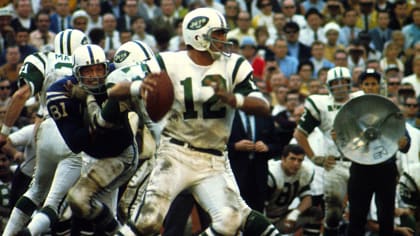
January 12, 1969: Super Bowl III is played at the Orange Bowl in Miami, to decide professional football's World Championship.
When the National Football League and the American Football League began the process of merging in 1966, the NFL was considered to be of far higher quality. Sure enough, the 1st 2 installments of the "AFL-NFL World Championship Game" were easily won by the NFL Champions, the Green Bay Packers -- the game retroactively called "Super Bowl I" 35-10 over the AFL Champion Kansas City Chiefs, and Super Bowl II 33-14 over the Oakland Raiders. The 3rd one was officially renamed the Super Bowl, although the Roman numerals didn't start until Super Bowl V.
 The Orange Bowl
When the National Football League and the American Football League began the process of merging in 1966, the NFL was considered to be of far higher quality. Sure enough, the 1st 2 installments of the "AFL-NFL World Championship Game" were easily won by the NFL Champions, the Green Bay Packers -- the game retroactively called "Super Bowl I" 35-10 over the AFL Champion Kansas City Chiefs, and Super Bowl II 33-14 over the Oakland Raiders. The 3rd one was officially renamed the Super Bowl, although the Roman numerals didn't start until Super Bowl V.
The NFL Champions for Super Bowl III were the Baltimore Colts. They were coached by Don Shula, who had made his name as the defensive coordinator for the Detroit Lions. Despite losing Johnny Unitas, possibly the greatest quarterback the game had yet seen, to a torn muscle in his throwing arm in the last preseason exhibition game, the Colts steamrolled through the NFL, going 13-1 behind backup quarterback Earl Morrall, with such stars as running back Tom Matte, receiver Jimmy Orr, tight end John Mackey, defensive end Bubba Smith, and linebacker and Mike Curtis.
They beat the Minnesota Vikings in the Divisional Playoff. Then, in the NFL Championship Game -- in Cleveland because the NFL then alternated hosting duties between the Division Champions -- they avenged their defeat, beating the Browns 34-0 at Cleveland Municipal Stadium. They looked unstoppable -- even without Johnny U.
The AFL Champions were the New York Jets. They were coached by Wilbur "Weeb" Ewbank, who had been an assistant to Paul Brown on the early 1950s Cleveland Browns, and then coached the Colts to their 1958 and 1959 NFL Championships, with Unitas as their quarterback. By this point, Unitas was just about the only one left, so his familiarity with the Colts wouldn't have helped.
The Jets had a marquee quarterback, too, the long-haired, white-shoed, big-mouthed Joe Namath. They had a running attack with Emerson Boozer and Matt Snell, receivers Don Maynard and George Sauer, and a defense with ends Verlon Biggs and Gerry Philbin, linebacker Larry Grantham, and defensive backs Bill Baird and Johnny Sample.
The Jets went 11-3. They won the AFL Eastern Division, and on December 29, 1968, they hosted the AFL West winners, the Raiders, and won a thriller, 27-23. It was Shea's 1st title, 10 months before the baseball team that called it home.
Still, most football observers thought that the Colts were by far the better team. Mainly because the NFL was by far the better league. By the morning of the game, the Colts were 18-point favorites.
Three days before the game, there was a banquet at the Miami Touchdown Club. Namath was one of the speakers. As he took the podium, someone in the audience yelled out, "Hey, Namath! We're gonna kick your asses!"
Broadway Joe was tired of hearing that, and yelled back, "Let me tell you something: We've got a good team. We're gonna win the game. I guarantee it!"
At the time, Namath also said, "There are 4 or 5 quarterbacks in the AFL that are better than Morrall," he wasn't kidding. There was himself, Len Dawson of Kansas City, Daryle Lamonica of Oakland, John Hadl of San Diego, and Jack Kemp of Buffalo.

The game was scoreless at the end of the 1st quarter. Early in the 2nd quarter, Morrall got the Colts to the Jet 13, but was intercepted by Randy Beverly. Namath then let a touchdown drive, ending in a 4-yard run by Matt Snell.
Late in the half, Morrall looked to pass, and Jimmy Orr was wide open, but Morrall didn't see him. Instead, he saw Willie Richardson, and his pass was intercepted at the 2 by Jim Hudson. The half ended with the Jets still up 7-0.
The Jets kicked off to start the 2nd half, and on the 1st play from scrimmage, Tom Matte of the Colts fumbled. The Jets recovered on the Colt 25, and Jim Turner went on to kick a 32-yard field goal. Jets 10, Colts 0. The Jets again held the Colts to a 3-and-out. Namath drove the Jets to the Colt 23. Turner kicked a 30-yard field goal. Jets 13, Colts 0.
At this point, Shula rolled the dice. He needed 2 touchdowns in 19 minutes and 24 seconds. He decided that a Johnny Unitas who hadn't played a down for the entire regular season gave him a better chance than an Earl Morrall at full strength. Shula would later say he should have brought Unitas on after halftime, when it was still only 7-0 Jets.
Unitas would end up with more passing yards in 19 minutes, 119, than Morrall had in 41 minutes, 71. But his 1st drive led to no 1st downs, and the Colts had to punt. When the 3rd quarter ended, it was still 13-0 Jets, and the Jets were threatening to score again. They got to the Colt 2, and Ewbank called for a field goal. Turner hit from 9 yards out. It was 16-0 Jets.
The Jets kicked off, and with 13:10 left, Johnny U went to work. He got to the Jet 25, and, unlike Morrall, saw Jimmy Orr open. Except Beverly saw Orr open, too, and ran in and intercepted the pass.
With 11:06 left, Namath could afford to eat the clock. He got the Jets to the Colt 35, setting up a 42-yard field goal attempt by Turner, but he missed.
Now, there was just 6:34 to play. Could Unitas possibly lead the Colts to 2 touchdowns and a field goal in that time? He threw 3 incomplete passes, but on 4th and 10 from his own 20, he found Orr to keep the game alive. He got into Jet territory, throwing to Orr, then to Mackey, then to Richardson, getting to the Jet 1. He handed off to Jerry Hill. Touchdown. Michaels kicked the extra point.
Jets 16, Colts 7. The Colts recovered the onside kick. There were 3 minutes and 14 seconds left. Unitas got the Colts to the Jet 24. 1st down: Pass to Richardson, gains 5 yards. 2nd and 5 on the Jet 19: Pass to Richardson, incomplete. 3rd and 5: Pass to Orr, incomplete. 4th and 5 on the 19. 2:44 left.
A field goal would make it 16-10, and the Colts would need a touchdown. They had all their timeouts, plus the 2-minute warning, and had already recovered an onside kick a moment ago. But Shula decided to go for it. Unitas looked for Orr, and threw, but Orr couldn't catch it. It was, for all intents and purposes, over.
The Jets ate as much of the clock as they could, and there were 15 seconds left when Curley Johnson punted to the Colt 34. Unitas threw 2 passes to Richardson. The 1st was incomplete. The 2nd was caught, and he ran 15 yards, but the clock ran out.
Final score: New York Jets 16, Baltimore Colts 7. The Jets were World Champions. The AFL had proven itself, on the biggest stage, to be not only the NFL's equal, but, for the moment, its superior.
It had gotten dark over the course of the game. And in that darkness, under the Orange Bowl's floodlights, Namath stuck his index finger over his head and waved it to the fans. As far as I can tell, this was the 1st time anybody had done that in order to say, "We're Number 1!"

"I just know that when I was running off that field after the game," Namath says now, "I swear I saw those AFL people up there in the stands, and they were so happy. And it was just the finality of it. It seemed like a struggle, such a struggle for we as individuals and teams in the AFL."
William Wallace (not the legendary Scottish hero) in The New York Times: "Because of what Joe Namath accomplished in the Super Bowl yesterday, pro football will never quite be the same again."
Bill Mazer, opening the football section of his book The Answer Book of Sports, published later in the year: "For those of you who are younger readers, something should be made clear: Football was not invented by Joe Namath on January 12, 1969 at the Orange Bowl in Miami."
And one of my favorite sports trivia questions is, "How many touchdown passes did Joe Namath throw in Super Bowl III?" The answer is, "None." The Jets only scored one touchdown, on Snell's run. Namath was better 2 weeks earlier in the Jets' win over the Raiders in the AFC Championship Game. That was a better game overall, too.
It could even be argued that Namath, with a career completion percentage of just 50.1 percent, more interceptions than touchdowns (220-173), a career losing record as a starting quarterback (62-63-4, plus 2-1 in the postseason to make him exactly .500, 64-64-4), and with injuries leaving him with his last productive season at age 32 and his last game at 34, would not have been elected to the Pro Football Hall of Fame if the Jets had lost this game.
But Namath did lead the Jets to victory in that game, and was elevated to sports idolhood. Along with the Mets' Tom Seaver 9 months later, and the Knicks' Walt "Clyde" Frazier 8 months after that, he became part of New York's holy trinity of sports icons for a generation, as Mickey Mantle and Frank Gifford had been in the generation before, and Reggie Jackson and Lawrence Taylor, and then Derek Jeter and Eli Manning, would later become.
It's been 53 years -- my entire lifetime, and almost another full year. The Jets have never been to the Super Bowl again. They reached the AFC Championship Game in the 1982, 1998, 2009 and 2010 seasons, but lost all 4. In fact, in the 53 years since, they have been to just 23 Playoff games, none since the 2010 AFC Championship Game, and won just 10 of them.
The Colts rebounded to win Super Bowl V 2 years later, but moved to Indianapolis in 1984. They won Super Bowl XLI, but lost Super Bowl XLIV. They were replaced by the Baltimore Ravens in 1996, and the Ravens have won Super Bowls XXXV and XLVII.
In 1981, John Thorn left his comfort zone, baseball, and published Pro Football's 10 Greatest Games. He included this game as one of them. In 2019, a poll ranked this game 6th on a list of the 100 Greatest Games of the NFL's 1st 100 years.
Namath was also ranked at exactly Number 100 -- perhaps symbolically, in both cases -- on the 100 Greatest lists compiled by both The Sporting News in 1999 and the NFL Network in 2010.
Like his contemporaries Frazier and Muhammad Ali, Broadway Joe was a perfect mix of man, method and moment in sports. As a rebellious young player at the glamour position in what had become the glamour sport, in the biggest city in the country, at a time when television had become not just the big thing (as it was for his hero Johnny Unitas) but everything, he was the right man doing the right thing in the right place at the right time.
Because of those circumstances, there might one day be another quarterback leading the Jets to a Super Bowl win -- stop laughing -- but there can never be another Joe Namath.
*
January 12, 1969 was, naturally, a Sunday. Just as naturally, there were no other pro football games that day. And it was the off-season for Major League Baseball.
There were 3 games played in the NBA that day:
* The New York Knicks beat the San Diego Rockets, 105-102 at the San Diego Sports Arena. Willis Reed scored 36 points for the Knicks. The Rockets moved to Houston in 1971. Their former home is now named the Pechanga Arena.
* The Detroit Pistons beat the Cincinnati Royals, 113-111 at the Cincinnati Gardens. Oscar Robertson scored 36 points in defeat.
* And the Milwaukee Bucks beat the Boston Celtics, 114-110 at the Milwaukee Arena. In 1974, it was renamed the Milwaukee Exposition, Convention Center and Arena, or "The MECCA." Since 2014, it has been named the UW-Panther Arena.
There were also 2 games played in the American Basketball Association:
* The Minnesota Pipers beat the Dallas Chaparrals, 116-105 at the Metropolitan Sports Center in the Minneapolis suburb of Bloomington, Minnesota. The Pipers no longer exist. The Chaps do: In 1973, they moved, and became the San Antonio Spurs.
* And the Denver Rockets beat the Houston Mavericks, 124-117 at the Auditorium Arena in Denver. The Mavs no longer exist, and bear no connection to the Dallas Mavericks. The Rockets bear no connection to the San Diego/Houston Rockets, but they do still exist: In 1974, they became the Denver Nuggets. In 1976, the Nuggets, the Spurs, the Indiana Pacers and the New York (later New Jersey, now Brooklyn) Nets were invited to join the NBA.
There were 4 games played in the NHL that day. The New York Rangers, then the only NHL team in the New York Tri-State Area, were not involved in any of them:
* The Boston Bruins beat the Pittsburgh Penguins, 8-4 at the Boston Garden.
* The Detroit Red Wings beat the Oakland Seals, 5-1 at the Olympia Stadium in Detroit. This would be the only time that the Oakland Seals, later the California Golden Seals, would make the Playoffs. In 1976, they became the Cleveland Barons. In 1978, they became the last team in the "Big Four" North American sports leagues to go out of business, merging with the Minnesota North Stars.
* The Chicago Black Hawks beat the Los Angeles Kings, 4-2 at the Chicago Stadium.
* And the St. Louis Blues beat the Minnesota North Stars, 2-0, also at the Met Center in Bloomington.


No comments:
Post a Comment