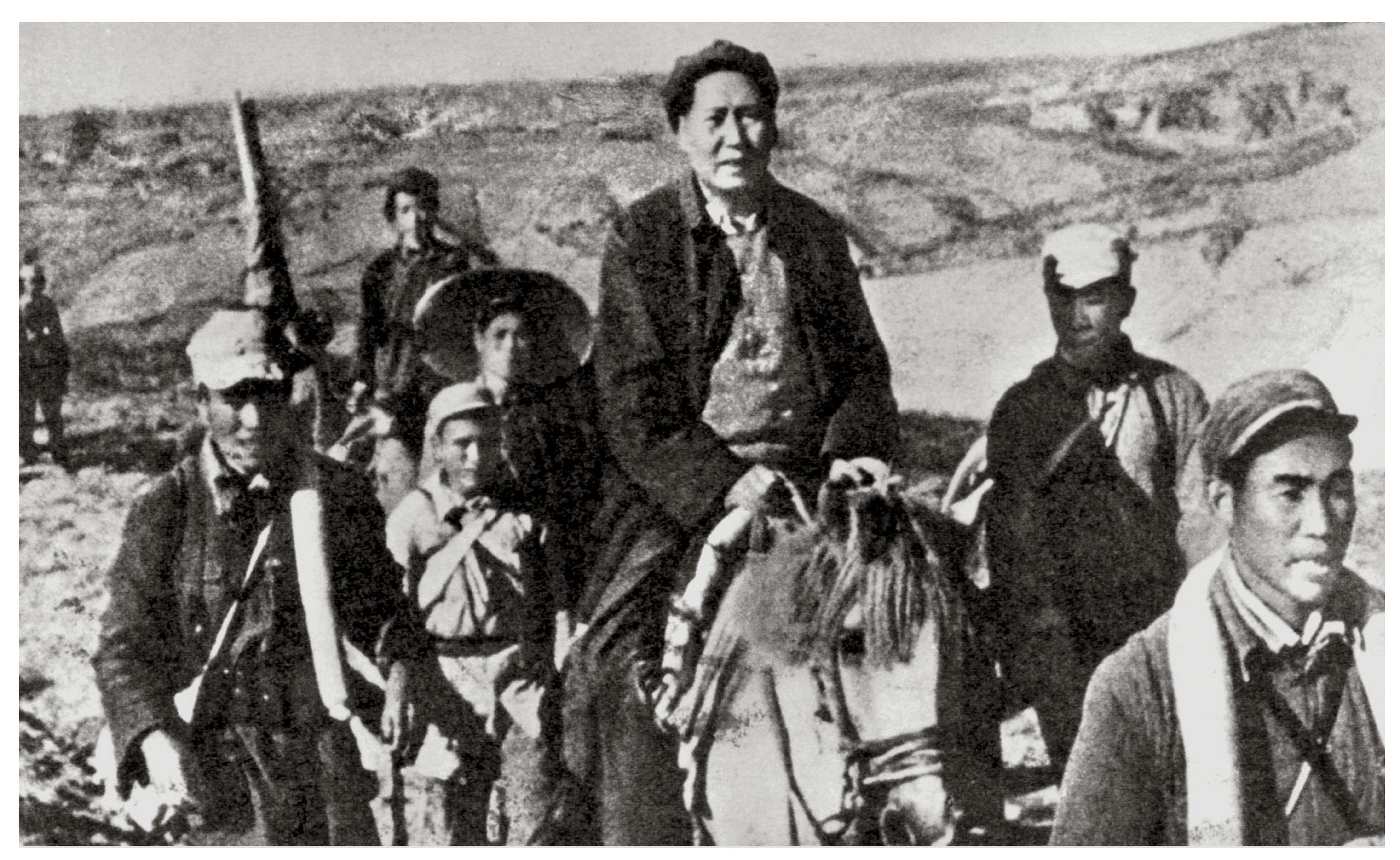
October 19, 1935: Mao Zedong's troops unite, ending their "Long March." It had lasted over a year.
The Long March was a military retreat during the Chinese Civil War, undertaken by the Communist Red Army, in order to evade continuous pursuit by advancing Nationalist forces. Several different Red Army forces took different routes from different Chinese Communist Party (CCP) strongholds being encircled by the Kuotmintang (KMT) National Revolutionary Army, with their concurrent retreats taking place over more than a year, traveling thousands of miles through western and central China, in order to convene at the new Communist base of operations in Yan'an, located in the northwestern province of Shaanxi.
The most famous of these marches was undertaken by the First Red Army, under Mao himself: Departing from their headquarters in the southern province of Jiangxi on October 16, 1934, the First Army marched over 5,600 miles in a large clockwise arc through the western frontiers of the country, ultimately meeting with Communist forces in Yan'an on October 19, 1935.
The circuitous route required the First Army to pass through some of the most difficult terrain in the country while avoiding destruction by the Nationalists: At first, the NRA under Chiang Kai-Shek, and later by local cliques of Nationalist-aligned warlords. Ultimately, fewer than 8,000 people traveling with the First Red Army would survive the march, out of a force of more than 65,000 that had set out the year prior. It was an attrition rate more devastating than Napoleon Bonaparte's retreat from Moscow in 1812. Over the following year, the Second and Fourth Red Armies would continue to navigate and face resistance, with the meeting of the three armies in Yan'an only taking place on October 22, 1936.
Upon arrival, the leadership that Mao, 40 years old when the March began, had demonstrated during the retreat, with the troops seeing that he had shared their suffering, afforded him immense prestige and support among many within the otherwise-shattered Communist Party.
The March would achieve mythical status in China and throughout the world as one of the most famous events of the war, for its immense hardship and implausible perseverance in the face of what appeared to be near-certain annihilation. It ultimately marked the beginning of Mao's long ascent to primacy within the CCP, and would be featured heavily in his public image, through the founding of the People's Republic in 1949.
*
October 19, 1935 was a Saturday. Baseball season had ended 12 days earlier, when the Detroit Tigers beat the Chicago Cubs in the World Series. The NBA had not been founded yet. The NHL season didn't start for another 19 days. But there were college football games, including these:
* Minnesota beat Tulane, 20-0 at Memorial Stadium in Minneapolis. Minnesota went 8-0, and won the Big Ten Conference title. They did not however, go to a bowl game. Then again, bowl games were still a new thing: The Orange and Sugar Bowls were in only their 2nd season, and the Cotton Bowl did not debut until the following season.
* Louisiana State University beat Arkansas, 13-7 at State Fair Stadium (now Independence Stadium) in Shreveport, Louisiana. LSU went on to win the Southeastern Conference title.
* Nebraska and Kansas State played to a tie, 0-0 at Memorial Stadium in Manhattan, Kansas. Not to be confused with many other Memorial Stadiums, including Nebraska's own, KSU's version would be replaced in 1968 by what's now known as Bill Snyder Family Stadium, although it is still used. In spite of this tie, Nebraska went on to win the Big Six Conference title.
* UCLA beat Stanford, 7-6 at Stanford Stadium in the San Francisco suburb of Palo Alto, California. This was the only game Stanford lost that season, as they won the Pacific Coast Conference title.
* Southern Methodist University beat Rice University, 10-0 at Ownby Stadium in Dallas.
* Texas Christian University beat Texas A&M, 19-14 at Amon G. Carter Stadium in Fort Worth, Texas. TCU lost to their Dallas arch-rivals, Southern Methodist University, thus losing the Southwest Conference title to SMU. But TCU were invited to play LSU in the Sugar Bowl, and won. In contrast, SMU were invited to play Stanford in the Rose Bowl, and lost.
* The Catholic University of America beat the University of Detroit, 13-7 at Titan Stadium in Detroit.
* The University of Mississippi beat the University of Florida, 27-6 at Hemingway Stadium (now Vaught-Hemingway Stadium) in Oxford, Mississippi. "Ole Miss" were invited to play in the Orange Bowl, but lost to Catholic University.
* Army beat Harvard, 13-0 at Michie Stadium in West Point, New York.
* Navy lost to Yale, 7-6 at the Yale Bowl in New Haven, Connecticut.
* At a time when all of Philadelphia's later-named "Big Five" schools had football programs, Villanova beat La Salle, 20-0 at Villanova Stadium in Villanova, Pennsylvania.
* Rivalry: Washington beat Washington State, 21-0 at Rogers Field in Pullman, Washington.
* Rivalry: Princeton beat Rutgers, 29-6 at Palmer Stadium in Princeton.
And in English soccer, North London team Arsenal went to Hampshire, and lost to Portsmouth, 2-1 at Fratton Park.


No comments:
Post a Comment