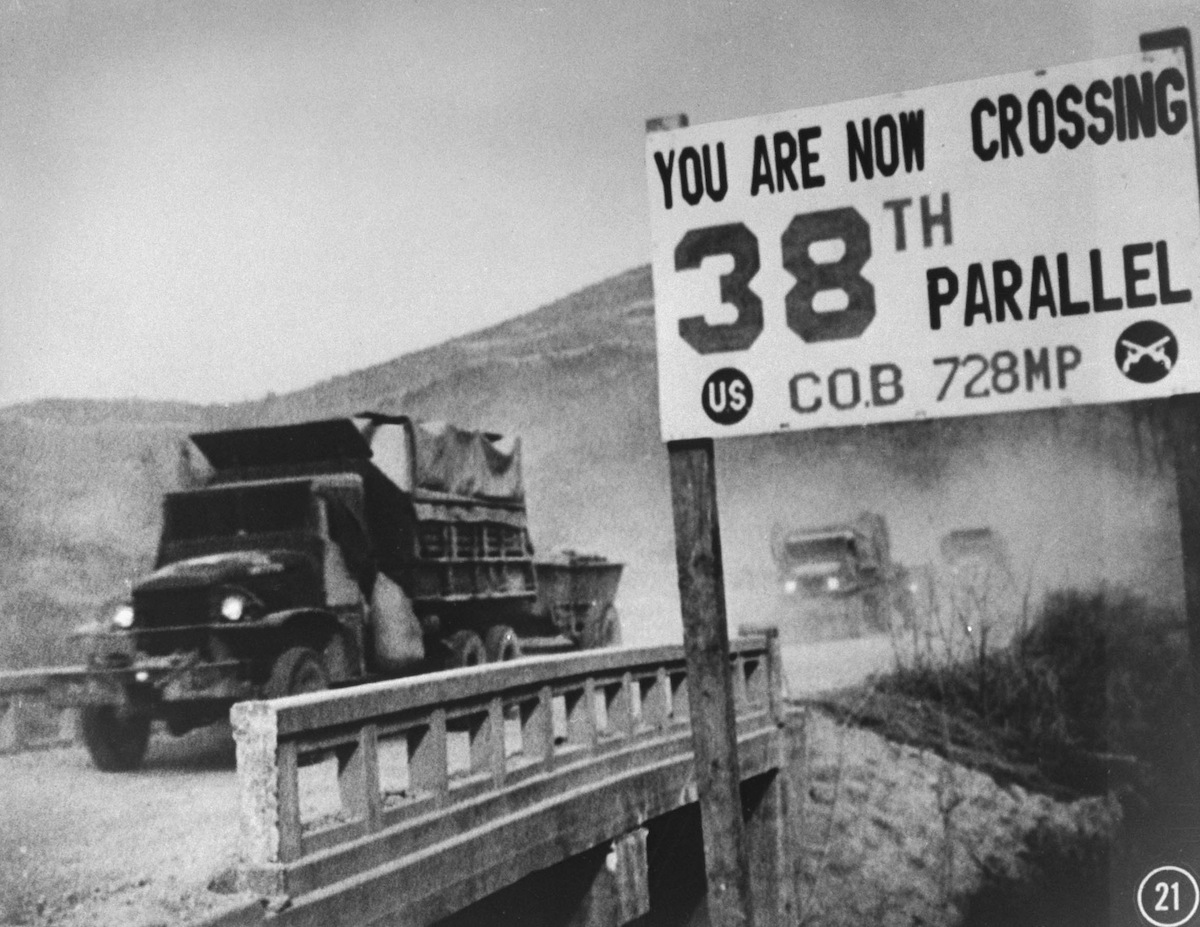
June 25, 1950: Troops of the Democratic People's Republic of Korea -- a.k.a. North Korea, a Communist nation, and by no means was it democratic or a republic -- cross the parallel of 38th degrees north latitude, and invade the Republic of Korea -- a.k.a. South Korea, which is capitalist, but hardly free.
Two days later, President Harry S Truman announced that American and other NATO forces would come to the aid of South Korea. The next day, North Korean troops took the South Korean capital of Seoul. A total of 15 United Nations countries came to the South's aid: America, Canada, Britain, France, Belgium, the Netherlands, Luxembourg, Greece, Turkey, Colombia, Ethiopia, South Africa, the Philippines, Thailand, Australia and New Zealand.
On September 15, Korea had its "D-Day," as General of the Army Douglas MacArthur, despite being 70 years old, personally led an amphibious landing at Inchon. Within weeks, not only was Seoul liberated, but the North's troops were backed up to the Yalu River, separating the Korean peninsula from the People's Republic of China.
That country then intervened on behalf of its Communist "little brother." The war became a stalemate, lasting 3 years. Truman ended up relieving MacArthur of duty in April 1951, for disobeying orders, replacing him with Matthew Ridgeway. He commanded UN troops in Korea until May 1952, when he was transferred to command U.S. troops in Europe. He was replaced as UN commander by Mark Clark, who held that role until the Armistice was signed on July 27, 1953.
About 327,000 Americans served in the conflict, and 36,574 were killed, with another 103,000 wounded but surviving.
Kim Il-Sung, the founder of the DPRK, remained in power until his death in 1994. His son, Kim Jong-Il, was then in charge until his own death in 2011. And his son, Kim Jong-Un, is now in charge, and is every bit as bad as his father and his grandfather. The military is well-supplied, but the civilians are poor, and many are starving.
Not that Syngman Rhee, the founder of the ROK, was a saint. South Korea may have been capitalist, but it was hardly democratic. He remained in power until being deposed in 1960, and died in 1965. South Korea's path to democracy has been difficult, including the assassination of President Park Chung-hee over fears he was bringing dictatorship back in 1979; and the impeachment and removal of his daughter, President Park Geun-hye, on corruption charges in 2017.
MacArthur died in 1964, Eisenhower in 1969, Truman in 1972, Clark in 1984, and Ridgeway in 1993. South Korea's leading General, Chung Il-kwon, served as Prime Minister from 1964 to 1970, and lived until 1994. Kim Il-Sung operated as his own commanding General.
Coming between the epic of World War II and the more recent national trauma of the Vietnam War, Korea became "the forgotten war." Even the TV series M*A*S*H, running on CBS from 1972 to 1983, didn't help much, as details were frequently gotten wrong.
A memorial to the American troops of the Korean War opened in 1995 on the National Mall in Washington, across from a counterpart to the Vietnam War, between the Washington Monument and the Lincoln Memorial. Surviving veterans are now age 87 and up.

The Korean War Veterans Memorial, Washington
U.S. forces remain on South Korean soil. These included an engineering unit to which my father was assigned in 1967 and 1968.
*
June 25, 1950 was a Sunday. It was the off-season for the NFL, the NBA and the NHL. But, being a Sunday, not only was a full slate of Major League Baseball games played, but there were some doubleheaders:
* The New York Yankees split a doubleheader with the Detroit Tigers at Briggs Stadium in Detroit, which was renamed Tiger Stadium in 1961. In the opener, Joe DiMaggio and Hank Bauer supported Eddie Lopat with home runs, allowing him to beat Hal Newhouser, and the Yankees won, 8-2. In the nightcap, Tommy Henrich hit a home run, but Vic Raschi allowed a 3-run homer by Hoot Evers in the 8th inning, and the Tigers won, 6-3.
* The New York Giants got swept by the Cincinnati Reds in a doubleheader at the Polo Grounds. The Reds won the 1st game 6-3, and the 2nd game 6-4.
* The Brooklyn Dodgers played only 1 game, and, apparently, it was a football game. They lost to the Pittsburgh Pirates, 16-11 at Ebbets Field. Don Newcombe didn't get out of the 3rd inning for the Brooks, and Vernon Law, winner of the Cy Young Award and the World Series 10 years later, only went 4. Gil Hodges hit a home run for Dem Bums, but Ralph Kiner hit 2 and Ted Beard 1 for the Buccos.
* The Boston Braves beat the St. Louis Cardinals, 4-0 at Braves Field. Vern Bickford pitched a 5-hit shutout.
* A doubleheader was split at Shibe Park in Philadelphia. The Chicago Cubs won the 1st game 11-8, and the Philadelphia Phillies won the 2nd game 2-1.
* A doubleheader was split at Cleveland Municipal Stadium. The Cleveland Indians won the 1st game 7-6, and the Washington Senators won the 2nd game 5-3.
* A doubleheader was split at Comiskey Park in Chicago. The Chicago White Sox won the 1st game 7-6, and the Philadelphia Athletics won the 2nd game 13-4.
* And the Boston Red Sox swept a doubleheader from the St. Louis Browns at Sportsman's Park in St. Louis. The Sox won the 1st game 11-5, and the 2nd game 8-2.
This invasion took place during the World Cup in Brazil. In Group Stage games:
* America lost to Spain, 3-1 at Estádio Vila Capanema in Curitiba.
* England beat Chile, 2-0 at Estádio Maracanã in Rio de Janeiro.
* Sweden beat Italy, 3-2 at Estádio do Pacaembu in São Paulo.
* And Yugoslavia beat Switerland, 3-0 at Estádio Independência in Belo Horizonte.


No comments:
Post a Comment