
Major General Enoch Crowder
May 23, 1918: With U.S. troops now in combat in World War I, the U.S. Department of War issues what becomes known as the "Work or Fight" order. It was ordered by the Secretary of War, Newton D. Baker, and implemented by the Provost Marshal of the Army, Major General Enoch Crowder.
As of July 1, those of draft age engaged in unproductive industries, or found "loafing around a poolroom," would be liable to be called up for military service, even if they had previously been exempted for other reasons.
The categories of "unproductive industries" included restaurant staff, doormen and elevator operators, the entire entertainment industry excluding actors, servants, and store clerks.
Exemptions could be provided for night shift workers, if it were found that the only replacements available for their jobs would be women. Notably not exempted were baseball players. The 1918 season would ultimately be cut short by several weeks as a result.
More importantly, the Work Or Fight order had clear racial implications. One circuit court clerk in Maryland estimated that 90 percent of those who ran afoul of the "anti-loafing" laws were black. Throughout the South, States eagerly enforced the Work or Fight rule to supplement existing Jim Crow vagrancy laws. Throughout the country, many of the occupations specifically targeted by the rule were predominantly black.
And since, with limited exceptions, black soldiers were not allowed to fight, the Work or Fight rule essentially amounted to a forced labor program for black men -- what became known as "slavery by another name." In some cases, however, particularly among hotel waitstaff, young white men were replaced with black men outside of draft age.
Back to baseball. The season was cut short, but the War Department (renamed the Department of Defense in 1947) allowed them to play the World Series in September, with nobody having any idea of when they would start again. In World War II, it would be different: There was a Commissioner, a former federal Judge, who asked the President what he should do: Play the 1942 season and beyond, or suspend operations. The President wrote what became known as "The Green Light Letter." But there was no such letter in 1918.
Some players served. The great pitcher Grover Cleveland Alexander was already a heavy drinker, and the heavy shelling damaged his hearing, instigated the epilepsy that would plague him for the rest of his life, and accelerated his alcoholism.
Christy Mathewson, Ty Cobb and George Sisler were made officers -- Captain, Captain and Lieutenant, respectively -- and assigned to the Army's Chemical Warfare Service (now the Chemical Corps), under the command of Major Branch Rickey, not yet the man who invented the farm system and reintegrated the game, but already having served as a major league catcher, head coach at the University of Michigan, and the general manager of both St. Louis teams, the Cardinals and the Browns.
Big Six, the Georgia Peach and Gorgeous George were training soldiers in preparation for the war's notorious chemical attacks by exposing them to gas chambers in a controlled environment. But it wasn't "controlled" well enough: Mathewson got a lungful of gas, and it damaged his lungs. Strike one. Then he got hit with the Spanish Flu. Strike two.
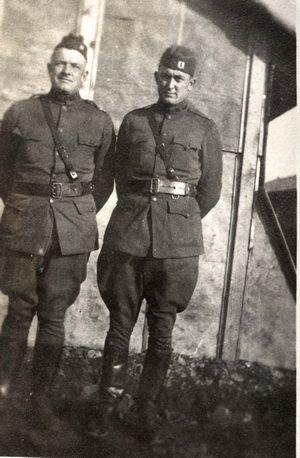
Captain Christopher Mathewson and Captain Tyrus R. Cobb,
U.S. Army, Chemical Warfare Division
His lungs already weakened twice over, in an age before antibiotics, he contracted tuberculosis. He was treated at the famed Adirondack Cottage Sanitarium at Saranac Lake in upper New York State, tried to return to baseball as a coach with the Giants and an executive with the Braves, but had to go back. After years of "fouling pitches off," it was strike three. He died in 1925, just 45 years old.
Failure to join up, or resisting the draft, made you a "slacker," and that was worse, at the time, than being called a Communist. Bernie Morris, who had helped the Seattle Metropolitans become the 1st U.S.-based Stanley Cup winners in 1917, was arrested on the eve of the 1919 Finals for draft dodging. He was convicted, and sentenced to 2 years in prison. He appealed, and got the charges dropped in time for him to be allowed to play for the Metropolitans in the 1920 Playoffs.
Jack Dempsey won the Heavyweight Championship of the World in 1919, but he hadn't served in World War I. In 1920, a photo was produced showing Dempsey working in a shipyard, which should have ended the controversy right there. But someone noticed that he was wearing patent leather shoes in the photo, making some people think the photo was staged to take the curse off him.
Soon, evidence came to light that he had tried to enlist, but, despite being a very strong man for his size (he'd be classified as a cruiserweight today), the Army had classified him "4-F": "Registrant not acceptable for military service." This classification is nearly always applied to a person who fails either the physical or the psychological examination upon enlistment or reporting for the draft.
But some people still weren't satisfied. This became especially controversial in 1921, when he defended his title against the Light Heavyweight Champion, Georges Carpentier, a French pilot who had been awarded the Croix de Guerre and the Médaille Militaire. The contrast between the much-decorated Carpentier and the "slacker" Dempsey was staggering. Dempsey knocked Carpentier out in the 2nd round. It wasn't until Dempsey was "robbed" in the "Long Count" fight of 1927 that he became a near-universal hero.
What about Babe Ruth? He played for the Red Sox all the way through that 1918 World Series. Indeed, the war has been credited with moving him from the position of pitcher to right field, because the manpower drain had taken Sox pitchers. This made him an everyday player and an everyday hitter, setting him up to become the greatest baseball player who ever lived.
Soon, evidence came to light that he had tried to enlist, but, despite being a very strong man for his size (he'd be classified as a cruiserweight today), the Army had classified him "4-F": "Registrant not acceptable for military service." This classification is nearly always applied to a person who fails either the physical or the psychological examination upon enlistment or reporting for the draft.
But some people still weren't satisfied. This became especially controversial in 1921, when he defended his title against the Light Heavyweight Champion, Georges Carpentier, a French pilot who had been awarded the Croix de Guerre and the Médaille Militaire. The contrast between the much-decorated Carpentier and the "slacker" Dempsey was staggering. Dempsey knocked Carpentier out in the 2nd round. It wasn't until Dempsey was "robbed" in the "Long Count" fight of 1927 that he became a near-universal hero.
What about Babe Ruth? He played for the Red Sox all the way through that 1918 World Series. Indeed, the war has been credited with moving him from the position of pitcher to right field, because the manpower drain had taken Sox pitchers. This made him an everyday player and an everyday hitter, setting him up to become the greatest baseball player who ever lived.
How did he respond to the Work Or Fight order? Until the World Series was over, he didn't respond to it at all. He kept on playing, exposing himself to the draft -- which he had every legal right to do. Once it ended, he gained exemption from the draft by accepting a nominal position with a Pennsylvania steel mill. The end of the war in November set Ruth free to play baseball without such contrivances.
I will leave it to the individual reader to decide whether Ruth's method of avoiding military service, while completely legal, was moral. However, unlike with what Dempsey did in 1917 and 1918, and unlike Mickey Mantle, who was exempt from service in the Korean War of the early 1950s because of his osteomyelitis, nobody ever called Ruth a "slacker" or a "coward."
Alvin Crowder, later to be an All-Star pitcher for the Washington Senators and the Detroit Tigers, was nicknamed "General" Crowder in remembrance of Enoch, who lived until 1932. Newton Baker died in 1937.
*
May 23, 1918 was a Thursday. These baseball games were played that day:
* The New York Giants beat the St. Louis Cardinals, 6-4 at Robison Field in St. Louis. Art Fletcher doubled home the winning run in the top of the 14th inning. Ross Youngs, George Burns (not the entertainer), Heinie Zimmerman and Lew McCarty each got 3 hits for the Giants. Rogers Hornsby singled as a pinch-hitter.
* The Brooklyn Robins (as the Dodgers were known while Wilbert Robinson managed them from 1914 to 1931) lost to the Chicago Cubs, 5-0 at Weeghman Park in Chicago. (It was renamed Cubs Park in 1920 and Wrigley Field in 1926.) Harry Weaver pitched a 4-hit shutout. Zack Wheat went 0-for-4.
* The Cleveland Indians beat the Boston Red Sox, 1-0 at Fenway Park in Boston. The Indians; Tris Speaker went 1-for-4 against his former team. The only run came in the top of the 4th inning, when Robert "Braggo" Roth doubled Ray Chapman home off Sad Sam Jones. Guy Morton allowed just 1 hit, a single by Amos Strunk in the bottom of the 7th.
* The St. Louis Browns beat the Washington Senators, 3-2 at American League Park (later Griffith Stadium) in Washington. An Earl Smith triple and a Les Nunamaker single in the top of the 9th inning gave the Browns a come-from-behind win. George Sisler went 2-for-4.
* The Philadelphia Phillies beat the Pittsburgh Pirates, 3-2 at Forbes Field in Pittsburgh.
* The Boston Braves beat the Cincinnati Reds, 4-3 at Redland Field in Cincinnati. (It was renamed Crosley Field in 1934.)
* The New York Yankees and the Chicago White Sox were rained out at the Polo Grounds. The game was made up as part of a doubleheader on July 9. The Yankees won the opener, 6-4. The White Sox won the nightcap, 4-3, when John "Shano" Collins singled Charles "Swede" Risberg home with the winning run in the top of the 10th inning.
Over the 2 games, Eddie Collins -- Hall of Fame 2nd baseman, and no relation to Shano -- went 2-for-7 with a walk, a stolen base and 2 RBIs. "Shoeless" Joe Jackson was observing the Work Or Fight order by working in a shipyard.
* And the Philadelphia Athletics and the Detroit Tigers were rained out at Shibe Park in Philadelphia. The game was also made up as part of a doubleheader on July 9. The A's won the 1st game, 3-1. The Tigers won the 2nd game, 5-4. Over the 2 games, Ty Cobb went 4-for-8 with a stolen base.


No comments:
Post a Comment