
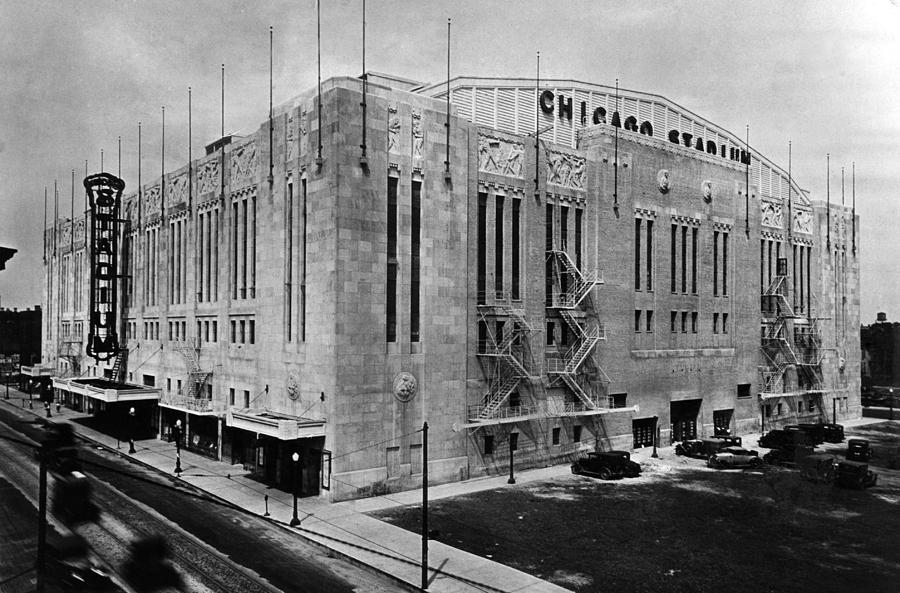
July 2, 1932: The Democratic National Convention, meeting at Chicago Stadium, home of the NHL's Blackhawks (and later the NBA's Bulls), almost blows a golden opportunity. With incumbent Republican President Herbert Hoover saddled with the Great Depression, the Democratic nominee could win -- if he could draw a contrast with the failed conservatism of the Republicans.
But so many people are opposed to the front-runner, Governor Franklin D. Roosevelt of New York, because they think either that he's too liberal, or that his health will be an issue. They knew he'd had polio, and it was not widely known how much it had affected him.
Four years earlier, at the Convention, in Houston, FDR had given the nomination speech for his predecessor as Governor, Alfred E. Smith. Smith was nominated, but lost badly. Someone asked Smith if he was worried that he was raising a rival in FDR. He said, "No, he will be dead within a year."
Instead, within 6 months, FDR was Governor of what was then the nation's largest and strongest State, and Smith was out of a job. He was asked to run the company that was building the Empire State Building. That done, he thought the Democratic Party owed him the nomination again, but even New York's Democrats were behind FDR. Smith thought he could count on the national Catholic vote, but that wouldn't be enough to help him at the Convention.
Also running were the Speaker of the House of Representatives, John Nance Garner of Texas, a.k.a. Cactus Jack; former Governor Harry Byrd of Virginia, who went on to be elected to the U.S. Senate, eventually succeeded by his son, Harry Jr.; Governors Albert Ritchie of Maryland, George White of Ohio, and William H. "Alfalfa Bill" Murry of Oklahoma; James A. Reed, Senator from Missouri and former Mayor of Kansas City; and Newton D. Baker, who had served as Secretary of War and Mayor of Cleveland.
The rule requiring that a nominee receive two-thirds of the delegates to be nominated -- a rule designed to give the racist South a veto over any candidate that is too liberal on civil rights -- nearly derails FDR, as other, more conservative candidates try to wait him out, ballot after ballot, to become the nominee.
It took 769 1/2 Delegates to be nominated. On the 1st ballot, FDR had 666 1/4, Smith had 201 3/4, and Garner had 90 1/2. On the 2nd, FDR gained to 677 3/4, Smith dropped to 194 1/4, and Garner remained at 90 1/4. On the 3rd, FDR gained to 682 3/4, Smith dropped to 190 1/4, and Garner gained to 101 1/4, with 180.25 votes scattered among others. FDR was still 87 1/4 short of the nomination, so he needed about half the Delegates not already with himself, Smith or Garner -- and it looked like none of them would budge, each of them hoping to be the one to benefit from FDR's dropoff, whenever it would happen.
If Roosevelt had dropped off, and the Democrats had nominated anybody else, he would have beaten Hoover, simply because the people were pissed at the Republicans. But it's hard to imagine any of them, except maybe Al Smith, who had already instituted a precursor to the New Deal in New York State, doing it nationally. Whether he would have gone as far as FDR ended up going, no one can be sure. But it is impossible to imagine Garner, Byrd or Ritchie going even as far as Smith. Baker had been in the Cabinet of President Woodrow Wilson, who was progressive on many issues -- but terribly regressive on race.
A Democrat other than Roosevelt as President in 1933, '34, '35 and '36 would have faced an electorate who would have considered him a failure for not doing enough. In Canada, in the early stages of the Depression, the Liberal Party were defeated by the Conservative Party in the 1930 election, with a net loss of 36 seats. William Lyon Mackenzie King was out as Prime Minister, and Richard B. Bennett was in. But, like Hoover, Bennett did very little to ease the Depression, and held off calling a new election as long as the law allowed. In 1935, the Liberals gained a net 91 seats, Mackenzie King was back in, and Bennett actually left the country. He's the only Prime Minister of Canada not buried in the country.
But if the Republicans had regained control in the 1936 election, they could have gone into the 1940 vote saying, "We're the only party that can be trusted, because the Democrats' answer is Communism." They likely would have supported the Nazis against the Soviets in 1941. There certainly wouldn't have been Lend-Lease for Britain. A Republican Secretary of State might have negotiated a separate peace between Chancellor Adolf Hitler and a Prime Minister other than Winston Churchill, and the Nazis would have won the war.
There would have been no argument for African-Americans to say, "If we can stop bullets, why not baseballs?" Professional sports would not have been integrated. The Supreme Court would not have had Hugo Black, Felix Frankfurter or William O. Douglas appointed in the 1930s, or Robert H. Jackson in the 1940s, or Earl Warren or William J. Brennan in the 1950s. Some of the civil rights gains of the 1940s, '50s and '60s would have been delayed; and some would not have happened at all.
The Democratic Party would have remained divided between big-city liberals and Southern conservatives. Harry Truman, Adlai Stevenson, John F. Kennedy and Hubert Humphrey might have been elected Senators or Governors; none of them would have been nominated for President. Lyndon B. Johnson might have been, but he would not have won on his own.
The Republicans would have remained divided between Eastern liberals and Western conservatives. But without FDR winning 4 straight elections, and Truman, JFK and LBJ running as his political heirs, the split would not have been as nasty. The turn toward evangelicalism in the wake of civil rights would not have happened, but the Grand Old Party would still have been guided by greed.
Without America getting into World War II, Dwight D. Eisenhower would never have become President; but Richard Nixon, Ronald Reagan and the George Bushes could have been. Then again, it's unlikely that Donald Trump would have. And the gains made under Democratic Presidents from Roosevelt to Biden are almost impossible to imagine.
And the Democrats almost threw this chance away, because some of them were scared of FDR's health, and some of them were scared of his liberalism. We may never know how many ballots they came to blowing it, and making the next 90 years incredibly different.
After the 3rd ballot, FDR offered the Vice Presidential nomination to Garner. He accepted, and brought the South with him. On the 4th ballot, FDR had 945, Smith 190.5, and everybody else combined had 17.5. They had a nominee.
Once nominated, Roosevelt was taken to an airport, and flew a rather rickety plane in bad weather from New York to Chicago, a perilous journey even 5 years after Charles Lindbergh flew across an ocean.
And, up until then, a potential Presidential nominee -- unless he was already a Delegate, and thus a surprise choice -- never even attended the Convention. Being publicly seen as actually seeking the nomination was considered to be wrong, and so they would go through the motions of sending a messenger to his home, and formerly informing him of his nomination there.
Instead, FDR gives his acceptance speech in person. He tells a nationwide radio audience, "I pledge you, I pledge myself, to a new deal for the American people. Let us all here assembled constitute ourselves prophets of a new order of competence and of courage. This is more than a political campaign; it is a call to arms. Give me your help, not to win votes alone, but to win in this crusade to restore America to its own people."
The phrase "New Deal" evoked the "Square Deal" of his distant cousin, Theodore Roosevelt, who had been President from 1901 to 1909. No one, not even FDR, yet knew what specific measures would be involved. But the phrase "New Deal" sticks.
So does a song played during the Convention, written right before the stock market crash of 1929, and it becomes the Democratic Party’s theme song for decades to come: "Happy Days Are Here Again."
After this Convention, at FDR's direction, the Democratic Party junked its 2/3rds rule. From 1936 onward, as the Republicans were already doing, the Democrats would have a nominee as soon as a candidate had a simple majority of the Delegates.
*
July 2, 1932 was a Saturday. These baseball games were played:
* The New York Yankees split a doubleheader with the Boston Red Sox at Fenway Park in Boston. The Yanks won the opener, 8-5. Herb Pennock went the distance for the win, and went 2-for-5 with 2 RBIs in his own cause. The Red Sox won the nightcap, 6-5. John Michaels outpitches Red Ruffing. Over the 2 games, Babe Ruth went 1-for-8 with a walk and an RBI, and Lou Gehrig went 1-for-7 with 2 RBIs.
* The New York Giants lost to the Boston Braves, 7-4 at the Polo Grounds. Billy Urbanski and Wally Berger hit home runs for the Braves. "Fat Freddie" Fitzsimmons was the losing pitcher for the Giants, but he and James "Shanty" Hogan both him home runs. 1st baseman and manager Bill Terry went 0-for-4. Mel Ott went 1-for-4 with an RBI.
* The Brooklyn Dodgers lost to the Philadelphia Phillies, 6-3 at Ebbets Field.
* The Philadelphia Athletics swept the Washington Senators, 2-1 and 5-4 at Shibe Park in Philadelphia. In the 1st game, George "Mule" Haas led off the bottom of the 11th with a triple, and Eric McNair hit a sacrifice fly to bring him home with the winning run. George Earnshaw went the distance for the win.
Mickey Cochrane went 0-for-5 in the 1st game, and did not play in the 2nd. Over the 2 games, Haas went 3-for-8; McNair went 3-for-8 with a home run, a walk, and 3 RBIs; Doc Cramer went 4-for-9; Al Simmons went 3-for-9; and Jimmie Foxx went 2-for-7 with 2 walks and an RBI.
* The St. Louis Cardinals beat the Pittsburgh Pirates, 5-4 at Forbes Field in Pittsburgh. For the Cards, George Watkins went 1-for-4 with 3 RBIs. For the Bucs, Paul Waner went 1-for-4, and Lloyd Waner went 1-for-5.
* The Detroit Tigers beat the Cleveland Indians, 5-4 at Navin Field (later Briggs Stadium and Tiger Stadium) in Detroit.
* The Cincinnati Reds beat the Chicago Cubs, 6-3 at Wrigley Field in Chicago.
* And the Chicago White Sox beat the St. Louis Browns, 15-5 at Sportsman's Park in St. Louis.


No comments:
Post a Comment