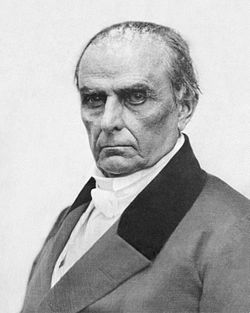
Daniel Webster
October 24, 1936: The Devil and Daniel Webster, written by Stephen Vincent Benét, is published in The Saturday Evening Post.
Benét was born on July 22, 1898 in Fountain Hill, in the Lehigh Valley in northeastern Pennsylvania. He graduated from Yale University, where he and Our Town writer Thornton Wilder were fellow members of the Elizabethan Club and fellow staff members of The Yale Literary Magazine. He became famous in 1928 with the publication of the short story John Brown's Body.
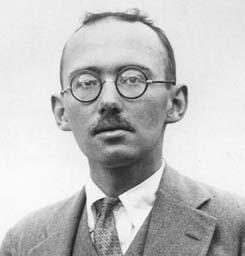
Stephen Vincent Benét
Short stories were his milieu, and, 3 times, he won the O. Henry Award for the best short story of the year. One of these would come in 1937, for The Devil and Daniel Webster. He died of a heart attack on March 13, 1943, only 44 years old.
The Devil and Daniel Webster is a variation on the German story of Faust, a man highly successful yet dissatisfied with his life, which leads him to make a deal with the Devil at a crossroads, exchanging his soul for unlimited knowledge and worldly pleasures. It has been told by English writer Christopher Marlowe in The Tragical History of Doctor Faustus in 1594, by German writer Johann Wolfgang von Goethe in Faust in 1808, and Charles Gounod's 1859 opera based directly on Goethe's work.
In Benét's story, farmer Jabez Stone, from the small town of Cross Corners, New Hampshire, is plagued with unending bad luck. He finally says, "It's enough to make a man want to sell his soul to the devil!" The next day, he is visited by a stranger, identified as "Mr. Scratch," who offers to give him 7 years of prosperity in exchange for his soul. Stone agrees.
Scratch comes for Stone's soul at the appointed time, and Stone bargains for more years. Scratch refuses. To get him out of the deal, Stone hires the greatest American lawyer of his time: Daniel Webster, longtime U.S. Senator from New Hampshire.
Webster has to get around the fact that the contract, and Stone's signature thereon, are clear. He says, "Mr. Stone is an American citizen, and no American citizen may be forced into the service of a foreign prince." Scratch insists on his own American citizenship, citing his presence at the worst events in the history of the U.S., concluding, "Though I don't like to boast of it, my name is older in this country than yours."
Webster demands a trial, as the right of every American. Mr. Scratch agrees after Webster says that he can select the judge and jury, "So long as it is an American judge and an American jury."
A jury of evil men enters. They had all played a part in the formation of the United States, including the Wampanoag chief known to settlers as King Philip, Royal Governor Thomas Dale of the Virginia Colony, and Edward Teach, a.k.a. the pirate Blackbeard. Benedict Arnold is said to be out "on other business." The judge is the one who presided at the Salem witch trials of 1692, John Hathorne. It seems the trial is rigged.
Webster speaks passionately of how wonderful it is to be human and to be an American. He admits the wrongs done throughout the course of American history, but points out that something new and good had grown from them and that "everybody had played a part in it, even the traitors.". Humankind "got tricked and trapped and bamboozled, but it was a great journey," something that no demon could ever understand.
Thus is the jury swayed: "We find for the defendant, Jabez Stone." Scratch tears up the contract, having agreed to a jury trial, and thus put his contract within the reach of the Common Law used in the United States, under which a jury can enter whatever verdict it likes, regardless of the law.
In real life, Webster was not just one of his era's greatest lawyers, but one of its greatest politicians and public speakers. He was one of the few members of Congress to have been elected from 2 different States: At-large from New Hampshire in 1812 and 1814, and from the 1st District of Massachusetts in 1822, 1824 and 1826. He served in the Senate from Massachusetts from 1827 to 1841, and again from 1845 to 1850. He was U.S. Secretary of State from 1841 to 1843, under Presidents William Henry Harrison and John Tyler; and again from 1850 until his death in 1852, under President Millard Fillmore.
His verbal sparring with Senator John Hayne of South Carolina over the issue of slavery in 1830 has gone down in legend. His defense of the Compromise of 1850, which allowed a Fugitive Slave Law but probably held the Civil War off for 10 years, earned him vitriol at the time, but praise over a century later from another Senator from Massachusetts, future President John F. Kennedy, in his book Profiles in Courage.
In 1957, Kennedy headed a committee to name the 5 greatest Senators in history, and Webster was chosen. The others were 2 contemporaries of Webster's, Henry Clay of Kentucky and John C. Calhoun of South Carolina; and 2 from the 20th Century, Robert La Follette of Wisconsin and Robert Taft of Ohio. Portraits of these "Famous Five" were hung in the Senate Reception Room.
Daniel Webster was not related to Noah Webster, who in 1828 published An American Dictionary of the English Language, despite being contemporaries and fellow New Englanders. (Noah was from Connecticut.)
The story has been filmed twice, sort-of. In 1941, a film was released under the title All That Money Can Buy, before reverting to the story's original title. James Craig played Stone, Edward Arnold played Webster, and Walter Huston was nominated for an Academy Award for playing Mr. Scratch.

Arnold as Webster (left) and Huston as Scratch
In 2001, a version set in the present day was made with Alec Baldwin as a struggling author named Jabez Stone, Anthony Hopkins as a publisher named Daniel Webster, and Jennifer Love Hewitt as a female Devil. (Perhaps borrowing from Elizabeth Hurley in the 2000 remake of Bedazzled.) This version, with some linguistic irony, "got stuck in development hell," before being released in 2007 as Shortcut to Happiness.
The story was also adapted for a 1968 episode of The Monkees, "The Devil and Peter Tork."
*
October 24, 1936 was a Saturday. Bill Wyman, longtime bass guitarist for The Rolling Stones, was born.
Among the college football games played that day, in this 1st season of the Associated Press poll rankings, were these:
* Number 1 Minnesota beat Number 5 Purdue, 33-0 at Memorial Stadium in Minneapolis.
* Number 2 Duke lost to Tennessee, 15-13 at Shields-Watkins Field (renamed Neyland Stadium in 1962) in Knoxville, Tennessee.
* Number 3 Army beat Springfield College, 33-0 at Michie Stadium in West Point, New York. Springfield, site of the invention of basketball in 1891, now play in NCAA Division III.
* Number 4 Northwestern beat their arch-rivals, Illinois, 13-2 at Memorial Stadium in Champaign, Illinois.
* Number 6 University of Southern California beat Stanford, 14-7 at the old Stanford Stadium in the San Francisco suburb of Palo Alto, California.
* Number 7 Notre Dame lost to Number 9 University of Pittsburgh, 26-0 at Pitt Stadium in Pittsburgh.
* Number 8 Washington beat the University of California, 13-0 at University of Washington Stadium (renamed Husky Stadium in 1970) in Seattle.
* Number 10 Yale beat Rutgers, 28-0 at the Yale Bowl in New Haven, Connecticut.
* Navy lost to Princeton, 7-0 at Palmer Stadium in Princeton.
* In what would eventually become a major rivalry game, Nebraska beat Oklahoma, 14-0 at Memorial Stadium in Norman, Oklahoma.
* In what was already a major rivalry game, Colorado beat Colorado A&M, 9-7 at Colorado Field in Fort Collins, Colorado. A&M became Colorado State University in 1957.
* In another rivalry game, Utah State beat Utah, 12-0 at Aggie Stadium in Logan, Utah.
* Among New York City teams, Number 16 Fordham mildly upset Number 12 Saint Mary's of the San Francisco Bay Area, 7-6 before 50,000 at the Polo Grounds; New York University (NYU) played Georgetown to a tie, 7-7 before 16,000 at Yankee Stadium; Manhattan College lost to the University of Detroit, 20-0 before 15,000, not in Manhattan but at Ebbets Field in Brooklyn; City College of New York (CCNY) beat Drexel, 6-0 at Drexel Field in Philadelphia; and Columbia lost 13-0 to Michigan, 13-0 at Michigan Stadium in Ann Arbor;
The baseball season had ended 18 days earlier, when the New York Yankees beat the New York Giants in the World Series. The NBA hadn't been founded yet. The NHL season began 12 days later.
In English soccer, Arsenal and Grimsby Town played to a 0-0 draw at the Arsenal Stadium, a.k.a. Highbury, in North London.


No comments:
Post a Comment