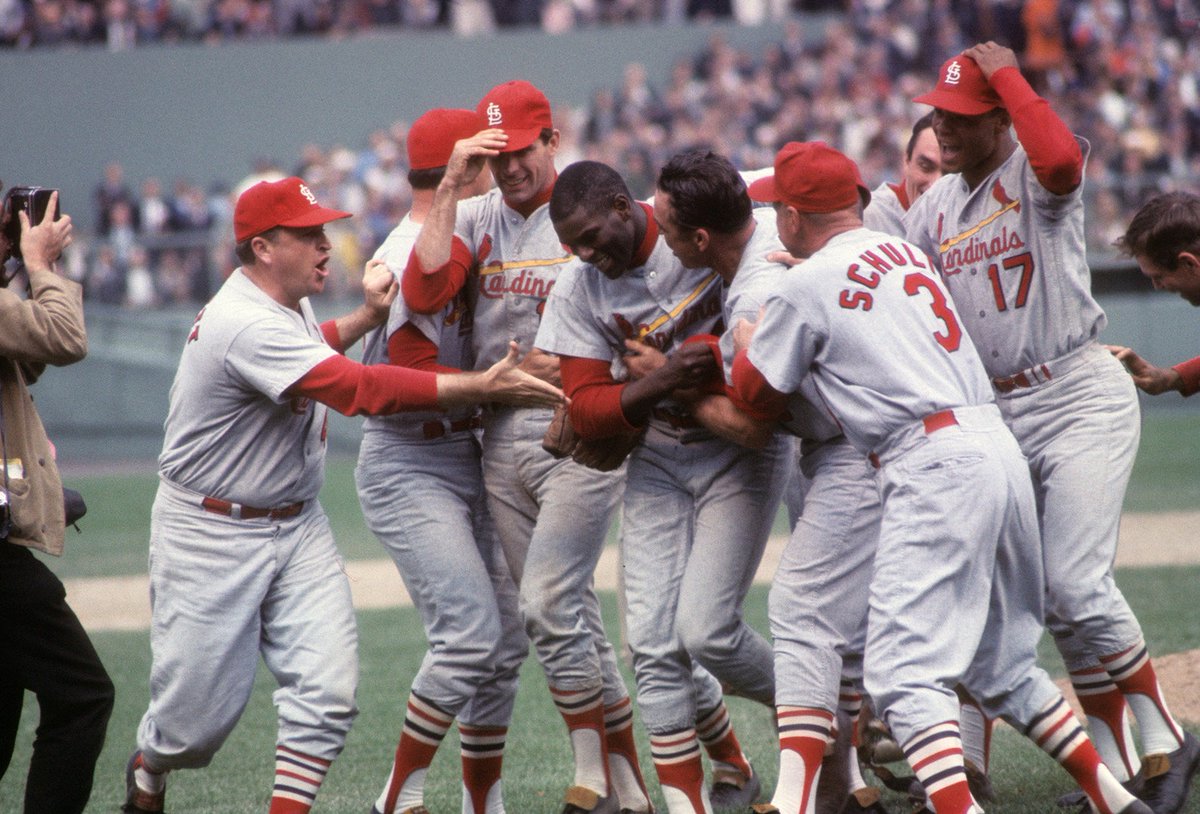
Ball Four fans, take note: Number 3 here is Joe Schultz,
then the Cardinals' 3rd base coach,
who would manage the Seattle Pilots 2 years later.
Working for Gussie Busch on the Cardinals explains
his frequent mentions of Budweiser in that book.
October 12, 1967: Baseball and the Summer of Love converge on Fenway Park in Boston for Game 7 of the World Series, as a fan holds up a sign saying, "THE RED SOX ARE VERY BEAUTIFUL PEOPLE."
Fenway Park, earlier in 1967
Because the Boston Red Sox were in such a tight race for the American League Pennant, they had to use their ace, Jim Lonborg, on the final day of the regular season, a 5-3 win over the Minnesota Twins which, combined with the Detroit Tigers only splitting a doubleheader, clinched the flag for the Sox.
The St. Louis Cardinals had clinched the National League Pennant earlier, and their manager, Red Schoendienst, who had played on their 1940s dynasty and also with the 1957 World Champion Milwaukee Braves, was able to set up his pitching rotation just the way he wanted: Bob Gibson, who won Games 5 and 7 for the Cardinals in the 1964 World Series, would pitch Games 1 and 4, and, if necessary, Game 7 this time.
Red Sox manager Dick Williams, who had won a Pennant in his 1st season as a major league manager, would have to wait until Game 2 to use Lonborg again. With Gibson on the mound, the Cards won Game 1 in Boston, but the Sox won Game 2, as Lonborg took a perfect game into the 7th inning and a no-hitter into the 8th.
The Series moved to St. Louis, and the Cards won Games 3 and 4, the latter behind Gibson, and were 1 win away. But Lonborg again pitched well in Game 5. In Game 6 at Fenway, the Sox won, thanks to a home run by Triple Crown winner Carl Yastrzemski, one by Reggie Smith, and 2 by their slick-fielding but not especially powerful shortstop, Rico Petrocelli.
So Game 7 would be Gibson on 3 days' rest, against Lonborg on 2 days' rest. If either one felt tired, he had until the following March to regain his strength. With his ace, and with home-field advantage, Williams makes a bold prediction made the day before, after a Game 6 win, by Sox manager Dick Williams, of "Lonborg and champagne." It's put on the front page of the Boston Record-American.

It does not happen: Gentleman Jim has nothing, and gets shelled. Gibson not only had plenty left, he hit a home run off Lonborg. Lou Brock stole 2 bases, raising his total to 7, a new World Series record. In the 6th, a Julián Javier home run ended Lonborg's day. In contrast, Gibson was still going in the 9th, when he struck George Scott out for the last out. The Cardinals won, 7-2, for Gibson's 3rd win of the Series, the team's 2nd title in 4 seasons, and their 7th World Championship.
If only... If only Tony Conigliaro, the hometown hero who got off to as good as career start as any slugger ever had, before or since, hadn't been beaned in August and missed the rest of the season, and all of 1968... If only Lonborg had just 1 more day of rest before Game 7... If only general manager Dick O'Connell had gotten manager Dick Williams one more good starting pitcher, thus giving Lonborg that extra day of rest...
No, it was, "If only Bob Gibson had not been, in 1967 and 1968, as good as any pitcher has ever been." A fully-rested Jim Lonborg was not going to beat Gibson on October 12, 1967.
For the Red Sox, what had become known as "the Impossible Dream" came to an end a game too soon, but the season did revitalize the franchise, restoring its profitability and its place of veneration among the people of New England. They lost the World Series, but they cannot be called a failure. Without this season, the Red Sox might have ended up leaving Fenway Park, sharing a stadium out in Foxborough with the NFL's New England Patriots. Or owner Tom Yawkey, who really wanted out of Fenway, might have moved them out of Boston entirely.
So, even more than 2004, this is the most important season in Red Sox history. Years later, after the Red Sox failures of 1975, 1978 and 1986, but before the tainted triumphs of 2004, 2007 and 2013, Boston Globe columnist Dan Shaughnessy would write that, of all Red Sox teams, this one is absolved from criticism by "Red Sox Nation" -- which, he says, essentially began that summer.
By the same -- pardon my choice of words here -- token, this was an incredibly important season in St. Louis. The holdovers from the 1964 season proved it was no fluke, and, much more so than the '64 team, the '67 team, with its mixture of white stars (Tim McCarver, Dal Maxvill and an aging but still power-hitting Roger Maris), black stars (Gibson, Brock and Curt Flood) and Hispanic stars (Javier and Orlando Cepeda) showed St. Louis, still thinking of itself as a Southern city, what integration could really do. Fans in Brooklyn had learned that 20 years earlier.
Yet, somehow, the 1964-68 Cards, as good as they were, have not been celebrated by Baby Boomers as much as have the 1950s and '60s New York Yankees, the 1950s Brooklyn Dodgers, the '60 and '71 Pittsburgh Pirates, the 1962-66 Los Angeles Dodgers, the 1962-66 San Francisco Giants, the 1966-71 Baltimore Orioles, the '67 Red Sox, the '68 Tigers and the '69 New York Mets. Hopefully, that's mainly because St. Louis was, and is, one of baseball's smallest markets. Still, the Cardinals were then, and are now, one of baseball's most profitable and most admired franchises.
This title was the 1st and only one for Cepeda, who was named the National League's Most Valuable Player; and the 3rd and last for Maris. It was something of a redemption for both.
This was also the 5th title, and the last game, for Elston Howard, who had been traded by the Yankees to the Red Sox in midseason. In his last at-bat, against Gibson, he flied to left field in the 5th inning, being removed for a pinch-hitter.
Instead of Lonborg, it was Gibson and champagne.
The 1967 World Series was also the 1st one with a trophy awarded to the winner. It was probably to match the NFL's new World Championship Trophy, which was named for Vince Lombardi after his death in 1970. The World Series trophy didn't get a name until 1985: The Commissioner's Trophy.

The 1967 version. I couldn't find a photo
of it being presented to the Cardinals.
With each new expansion, new flags were added to the trophy: From 20 in 1967 to 24 in 1969, to 26 in 1977, to 28 in 1993, to 30 in 1998. In 2000, it was redesigned to its current form.

The 2000 version
Through the 2021 World Series, the New York Yankees have won it the most times, 7. For their previous 20 titles, there was no trophy. But even with their most dynastic teams before the trophy, they've still won the most. Other teams:
The Cardinals, the Red Sox and the Oakland Athletics, 4;
the Cincinnati Reds, the Los Angeles Dodgers and the San Francisco Giants, 3;
the Detroit Tigers, the New York Mets, the Baltimore Orioles, the Pittsburgh Pirates, the Philadelphia Phillies, the Los Angeles Dodgers, the Kansas City Royals, the Minnesota Twins, the Toronto Blue Jays, the Atlanta Braves and the Miami Marlins, 2; and the Arizona Diamondbacks, the Los Angeles Angels, the Chicago White Sox, the Chicago Cubs, the Houston Astros and the Washington Nationals, 1.
UPDATE: The Astros made it 2 in 2022, the Texas Rangers 1 in 2023, and the Dodgers 5 with their 2024 and 2025 titles.
UPDATE: The Cardinals have a team Hall of Fame. From their 1967 World Champions and their 1968 National League Pennant winners, they have inducted team owner August "Gussie" Busch, manager Albert "Red" Schoendienst, scout George Kissell, left fielder Lou Brock, center fielder Curt Flood, right fielder Mike Shannon, 2nd baseman Julián Javier, catcher Tim McCarver, pitcher Bob Gibson, and broadcaster Jack Buck. Through the 2025 season, general manager Vaughan "Bing" Devine, 1st baseman Orlando Cepeda (only 3 seasons with the Cardinals), right fielder Roger Maris (only 2 seasons) and broadcaster Harry Caray (once every bit as identified with the Cardinals as he now is with their arch-rivals, the Chicago Cubs) have not yet been inducted.
The Cardinals fell apart after their 1968 Pennant. From between their 1968 and 1982 Pennants, their Hall of Fame has inducted catcher Ted Simmons, 1st baseman Joe Torre, and pitcher Al Hrabosky, "The Mad Hungarian."
Busch, Schoendienst, Gibson, Flood, Brock, Cepeda, Simmons, Torre, Reuss, and 2nd baseman Ted Sizemore were elected to the St. Louis Sports Hall of Fame. Busch, Schoendienst, Kissell, Gibson, Brock, Cepeda, Simmons, Reuss and Hrabosky were elected to the Missouri Sports Hall of Fame.
The Red Sox also have a team Hall of Fame. From their 1967 American League Pennant winners, they have inducted left fielder Carl Yastrzemski, right fielder Tony Conigliaro, center fielder Reggie Smith, 1st baesman George Scott, shortstop Rico Petrocelli, pitcher Jim Lonborg; team owner Tom Yawkey, manager Dick Williams, general manager Dick O'Connell, scout George Digby, executive Edward Kenney; public address announcer Sherm Feller, and broadcasters Ken Coleman and Ned Martin.
Busch, Schoendienst, McCarver, Shannon, Brock, Flood, Gibson, Maris, Cepeda, Kissell, Buck, Devine, Simmons, Hrabosky, pitcher Jerry Reuss, 3rd baseman Ken Reitz, and team scorekeeper Lou Adamie were elected to the Missouri Sports Hall of Fame.
*
October 12, 1967 was a Thursday. The NBA began its season, and the American Basketball Association began its history, the next day. And the NHL season had begun the day before, but no games were scheduled for this day.
But there was one other score on this historic day, in the Southwest Conference in college football: Texas A&M beat Texas Tech, 28-24 at Clifford B. & Audrey Jones Stadium, Tech's home, in Lubbock. A&M went on to win the SWC Championship, and beat Alabama in the Cotton Bowl.


No comments:
Post a Comment