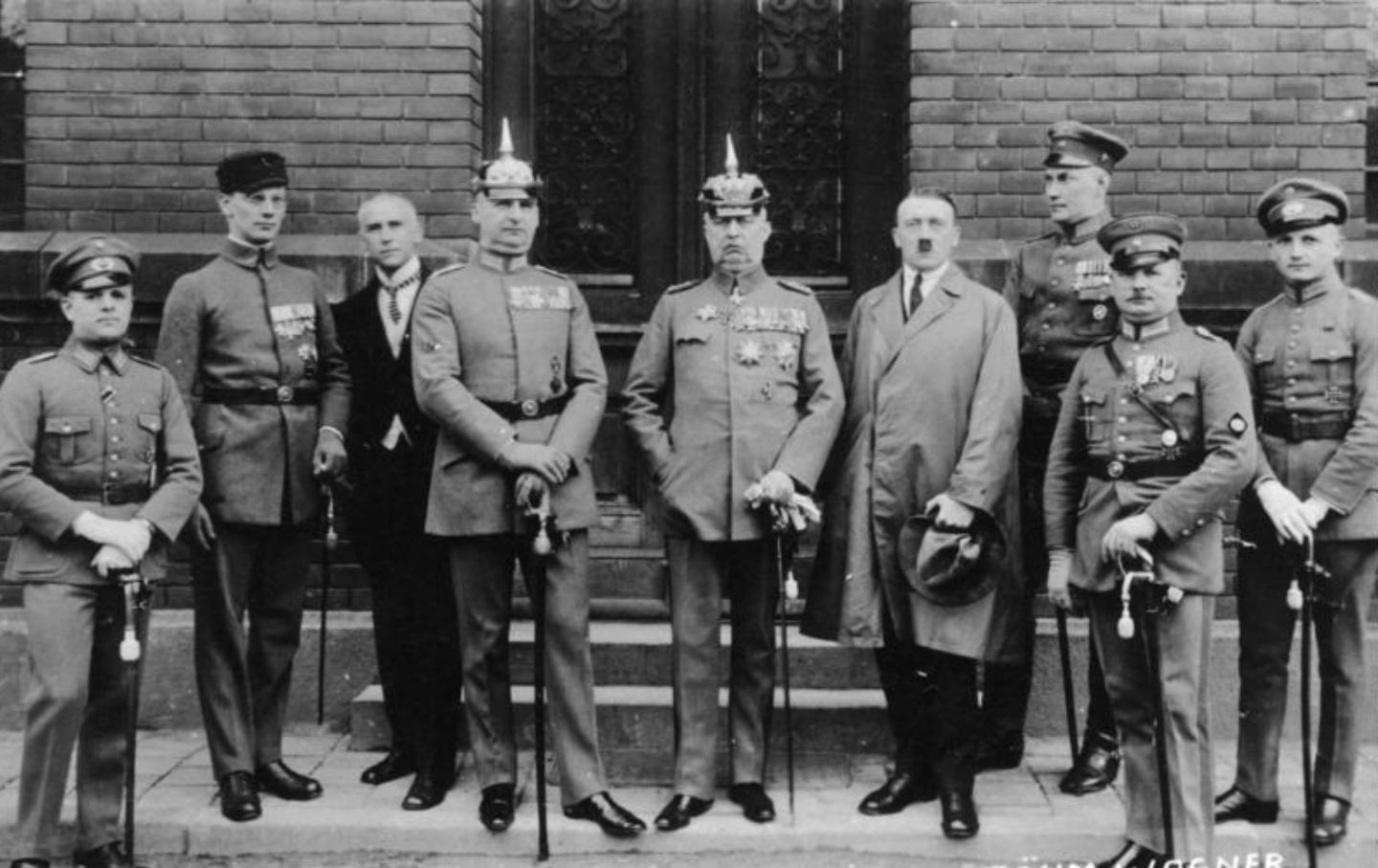
Center: Ludendorff. To the immediate right: Hitler.
November 9, 1923: An attempt is made to overthrow the government of the German state of Bavaria. It doesn't go so well. The man behind it doesn't truly pay for it, and gets to try again. He succeeds, on a far larger scale.
After its defeat in what is now known as World War I, Germany fell into chaos. The Weimar Republic straightened things out for a while, but by 1923, the payments of reparations to the countries that Germany had attacked in the war, and payments due on the borrowing done to finance their part in the war, had become so hard to make, the currency fell into hyperinflation, becoming just about worthless.
For much of the year, Germany, one of the largest countries in the world, with more people than any other on the European continent (except Russia, which straddled Europe and Asia), essentially had no economy. The Republic had to scrap the old currency: On October 15, 1923, the parliament, the Reichstag, issued a decree that the Reichsmark would be replaced by the Rentenmark on November 16.
That stabilized the German economy, until the worldwide stock market crashes of 1929. But on November 8, nobody knew for sure that the stabilization would happen. People were still worried. Many believed more drastic measures needed to be taken.
Many of those belonged to the National Socialist German Workers' Party -- Nationalsozialistische Deutsche Arbeiterpartei, or NSDAP. Or, "Nationalsozialistische" shortened to "Nazi." They were led by Adolf Hitler, a 34-year-old World War I veteran and failed painter; and a former General, Erich Ludendorff.
Note: If you saw the 2017 film Wonder Woman, in which the titular superheroine killed Ludendorff in the closing days of World War I, keep in mind that the film is a work of fiction. They didn't use the heroine as a stand-in for how he really died. In real life, Ludendorff survived that war, and lived on until 1937, having seen the Nazis come to power.
On November 8, inspired by the previous year's fascist March On Rome, about 600 Nazi Party members marched into the Bürgerbräukeller (Citizen brew cellar) in Munich, the capital of the state of Bavaria. Hitler fired a shot into the ceiling, and jumped on a chair, yelling: "The national revolution has broken out! The hall is surrounded by six hundred men. Nobody is allowed to leave." He went on to state that the Bavarian government was deposed, and declared the formation of a new government with Ludendorff. He got a big cheer from the people who were already inside.
At around 3:00 AM on November 9, some of Hitler's men left the beer hall, in an attempt to reach the nearby barracks, and thus get some weapons, of the Reichswehr (Army). Except the army was waiting for them, and fired some shots. No one was killed, but it was a sign that the putsch was doomed to fail.
In the morning, Hitler ordered the seizure of the Munich City Council as hostages. It didn't happen. By mid-morning, it was clear that the putsch was going nowhere. Ludendorff cried out, "We will march!" Now having about 2,000 men, they did: Ludendorff led them to the Bavarian Defense Ministry. But the army was in the way, and fire was exchanged, killing 16 Nazis and 4 state police officers.
Hitler escaped immediate arrest, and was spirited off to safety in the countryside. After 2 days, he was found, arrested, and charged with treason. He was found guilty, and, on April 1, 1924, he was sentenced to 5 years in Landsberg Prison.
Five years. For treason.
While there, he dictated what became his book, Mein Kampf (My Struggle) to fellow prisoners. On December 20, 1924, having served only 9 months, he was released. This turned out to be a very bad idea. Once released, Hitler redirected his focus towards obtaining power through legal means, rather than by revolution or force, and accordingly changed his tactics.
On January 30, 1933, with the Great Depression at its lowest point, Adolf Hitler was appointed Chancellor of Germany by President Paul von Hindenburg, and proclaimed the Third Reich -- as he put it, "The Thousand Year Reich." It lasted 12 years, and caused a war that killed 75 million people.
November 9 has become Germany's "Day of Destiny": On that date, in 1918, the Kaiser abdicated and the 1st German Republic was proclaimed; in 1923, the Beer Hall Putsch failed; in 1938, Kristallnacht was carried out by the Nazis; and in 1989, the Berlin Wall was rendered legally moot.
*
November 9, 1923 was a Friday. Baseball was out of season. The NBA hadn't been founded yet. And the NHL season didn't start until December 15. There was 1 college football game on this day: Clemson beat Davidson, 12-0 at Riggs Field in Calhoun, South Carolina.


No comments:
Post a Comment