Showing posts with label warner brothers. Show all posts

Saturday, September 17, 2022

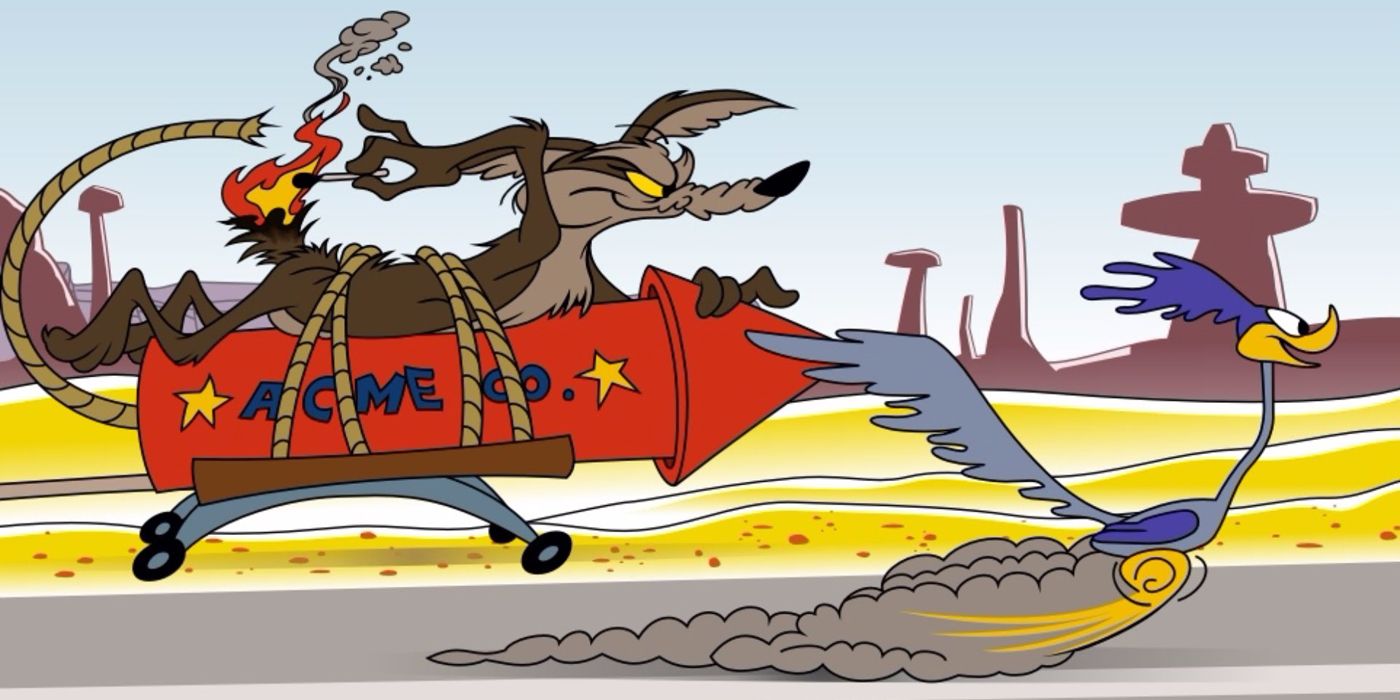
September 17, 1949: Wile E. Coyote & the Road Runner Debut

September 17, 1949: Warner Brothers releases the cartoon Fast and Furry-ous, introducing the characters of Wile E. Coyote and the Road Runner.

The Road Runner cartoons started out as a parody of Metro-Goldwyn-Mayer's Tom & Jerry, because animator Chuck Jones and writer Michael Maltese thought Tom and Jerry were generic characters who just engaged in the slightest of variations on the same conflict over and over again.
Jones (left) and Maltese

But Fast and Furry-ous backfired: It turned out that nobody got the joke, they just loved it, probably because it was so much like Tom & Jerry. It turned out that people liked the mindless violence, and didn't care about story or dialogue. So Jones and Maltese decided to go with it, and make money. And they made a lot of it.

In his book Chuck Amuck: The Life and Times of an Animated Cartoonist, Jones claimed that he and the artists behind the Road Runner and Wile E. Coyote cartoons adhered to some simple but strict rules:

  1. "The Road Runner cannot harm the Coyote, except by going, 'Beep-Beep!'" (Which ended up sounding more like "Meep-Meep!" which is how the impression has usually been done.)
  2. "No outside force can harm the Coyote, only his own ineptitude, or the failure of the Acme products." (In other words, "cartoon physics.")
  3. "The Coyote could stop anytime, if he were not a fanatic. (Repeat: 'A fanatic is one who redoubles his effort when he has forgotten his aim.' – George Santayana)."
  4. "No dialogue, ever, except 'Beep-Beep!'" (In cartoons not involving the Road Runner, the Coyote spoke. For example, telling Bugs Bunny that he was a genius. Which he was not.)
  5. "The Road Runner must stay on the road, otherwise, logically, he would not be called a Road Runner."
  6. "All action must be confined to the natural environment of the two characters, the Southwest American desert."
  7. "All materials, tools, weapons, or mechanical conveniences must be obtained from the Acme Corporation."
  8. "Whenever possible, make gravity the Coyote's greatest enemy." (Sometimes, something would fall on top of the Coyote. My father called that a "Coyote Sandwich.")
  9. "The Coyote is always more humiliated than harmed by his failures."
One running gag involves the coyote trying, in vain, to shield himself with a little parasol against a great falling boulder that is about to crush him. Another involves him falling from high cliffs, after momentarily being suspended in midair, as if the law of gravity is delayed until he realizes that there is nothing below him. (Again: Cartoon physics. This would later be used on The Flintstones.) The rest of the scene, shot from a bird’s-eye view, shows him falling into a canyon so deep that his figure is eventually lost to sight, with only a small puff of dust indicating his impact on the ground below.

The Coyote is notably a brilliant artist, capable of quickly painting incredibly lifelike renderings of such things as tunnels and roadside scenes, in further (and equally futile) attempts to deceive the bird. However, the Road Runner would run into this fake tunnel, as if it were real. When the Coyote tried it himself, he would crash into it with a SPLAT! and end up flattened.

On September 14, 1968, The Bugs Bunny/Road Runner Hour debuted on CBS. It moved to ABC in 1971, and back to CBS in 1975. It had a vaudeville-type opening, with Bugs and Daffy Duck wearing straw hats and dancing with canes, singing a theme song, "This Is It." The same old reruns were aired on CBS until 1996.

From the "My Entire Childhood Was a Lie" Department: In real life, coyotes are faster than roadrunners. The top speed of a coyote is 43 miles per hour; that of a roadrunner, 26. Also, "roadrunner" is always one word, not two like with the cartoon character.
A real roadrunner

From 1967 to 1974, the Western Hockey League had a team named the Phoenix Roadrunners. From 1974 to 1977, a team with that name played in the World Hockey Association. In 1997, the NHL gave Phoenix a team, which would eventually named the Arizona Coyotes. (UPDATE: They moved to Salt Lake City in 2024, becoming the Utah Mammoth).

*

September 17, 1949 was a Saturday. These baseball games were played:

* The New York Yankees beat the Detroit Tigers, 5-4 at Yankee Stadium. Fred Sanford -- not to be confused with the later Sanford and Son character -- was the winning pitcher. Charlie Keller hit a home run, and Joe DiMaggio went 1-for-4 with an RBI.

* The New York Giants lost to the Chicago Cubs, 4-2 at Wrigley Field in Chicago.

* The Brooklyn Dodgers lost to the Pittsburgh Pirates, 7-2 at Forbes Field in Pittsburgh. Jackie Robinson went 1-for-3.

* The Boston Red Sox beat the St. Louis Browns, 3-2 at Fenway Park in Boston. Ted Williams went 0-for-2 with 2 walks.

* The Chicago White Sox beat the Philadelphia Athletics, 8-5 at Shibe Park in Philadelphia.

* The Cleveland Indians beat the Washington Senators, 8-3 at Griffith Stadium in Washington.

* The Philadelphia Phillies beat the Cincinnati Reds, 4-0 at Crosley Field in Cincinnati. Russ Meyer pitched a 3-hit shutout.

* And the Boston Braves beat the St. Louis Cardinals, 4-2 at Sportsman's Park in St. Louis. Stan Musial went 0-for-4.

Among the college football games played that day were these:

* The University of California beat Santa Clara, 21-7 at California Memorial Stadium in Berkeley. Cal went on to win the Pacific Coast Conference title. Santa Clara, an independent, bounced back, and were invited to the Orange Bowl.

* Kentucky beat Mississippi Southern College (now the University of Southern Mississippi), 71-7 at McLean Stadium in Lexington, Kentucky. Kentucky finished 2nd in the Southeastern Conference, and were invited to the Orange Bowl, where Santa Clara beat them.

* Ohio State opened its season the next week. They went on to win the Big Nine Conference title. (The Big Ten was a Big Nine from 1940, when the University of Chicago left, until 1950, when Michigan State joined.) They beat Cal in the Rose Bowl.

* Louisiana State opened its season the next week. Despite finishing 5th in the SEC, they were 8-3 overall, and beat SEC Champions Tulane, then considered LSU's arch-rivals. So they were invited to the Sugar Bowl, back at Tulane Stadium in New Orleans.

* Oklahoma opened its season the next week. They went on to win the Big Seven Conference title. (It became the Big Eight when Oklahoma State joined in 1960.) Oklahoma beat LSU in the Sugar Bowl, to finish an undefeated season. They should have been awarded the National Championship, but weren't.

* Rice University opened its season the next week. They went on to win the Southwest Conference title.

* North Carolina opened its season the next week. They went on to win the Southern Conference title. Rice beat them in the Cotton Bowl.

* The service academies, Army and Navy, started their season the next week.

* Notre Dame started its season the next week. They went undefeated. They never accepted a bowl bid between the 1924 and 1969 seasons. Nevertheless, they were awarded the National Championship.

* Among New York City schools, Columbia and City College of New York (CCNY) started their seasons the next week; New York University (NYU) and Brooklyn College started their seasons 2 weeks later, on October 1; and Fordham started their season 3 weeks later, on October 8.

* And the New Jersey schools, Rutgers, Princeton, both started their seasons the next week.

And in English soccer, North London team Arsenal went to the Manchester area, and played Bolton Wanderers to a draw, 2-2 at Burnden Park in Bolton.

Friday, July 1, 2022

July 1, 1923: The Rise of Rin Tin Tin

July 1, 1923: The silent film Where the North Begins, about fur trappers in early Canada, premieres. It is the 1st starring vehicle for Rin Tin Tin, "the Dog That Saved Hollywood."

"Rinty" wasn't the 1st dog, or even the 1st European-born German shepherd, to star in films. Starting with The Silent Call in 1921, the German-born Strongheart was a star, peaking in 1925 with a film version of Jack London's story White Fang. An on-set accident led to his death in 1929, at the age of 12.

On September 15, 1918, U.S. troops in Flirey, France found a kennel, but the only surviving adult dog was a German shepherd which had just given birth to 5 puppies. Corporal Lee Duncan raised the puppies, and gave 3 of them to his buddies, keeping 2 for himself, one of each gender, naming the male "Rin Tin Tin" and the female "Nanette," after a pair of dolls representing lovers that French children considered to be a good luck charm.

Duncan took the dogs back to America with him in 1919, but Nanette died shortly after arrival. Duncan taught Rin Tin Tin tricks, thinking he could be the next Strongheart. In 1922, Rin Tin Tin was "cast" in the Western The Man From Hell's River. It was a hit, and he was written as the centerpiece of Where the North Begins, premiering on July 1, 1923. 

Rin Tin Tin was responsible for greatly increasing the popularity of German Shepherd dogs as family pets. (My family had 2 when I was growing up.) The immense profitability of his films contributed to the success of Warner Bros. studios, and helped advance the career of Darryl F. Zanuck from screenwriter to producer and studio executive.

Rin Tin Tin was much sought after and was signed for endorsement deals, especially for dog food makers Ken-L Ration. Warner Bros. fielded fan letters by the thousands, sending back a glossy portrait signed with a paw print and a message written by Duncan: "Most faithfully, Rin Tin Tin."

Given that the film industry, like so many others, is a monkey-see-monkey-do industry, and that Rinty himself wasn't the original, of course there were, if you'll pardon my mixing of metaphors, copycats. RKO found its own German shepherd, Ace the Wonder Dog. Paramount had one, too, named Thunder the Marvel Dog. Universal had Silver Streak, and then Dynamite the Dog. Metro-Goldwyn-Mayer had Pete the Pup for its Our Gang films. Warner Bros. even hired Strongheart's grandson, Lightning, for films in the 1930s.

Rin Tin Tin presaged such later dog stars as Asta from the Thin Man films (first film, 1934), Toto from The Wizard of Oz (1939), Lassie (1943), Benji (1974), and Buddy from the Air Bud films (1997).

Film historian Jan-Christopher Horak wrote that by 1927, Rin Tin Tin was the most popular actor with the very sophisticated film audience in Berlin. There is also a persistent rumor in Hollywood that, in 1929, Rin Tin Tin may have received the most votes for the first Academy Award for Best Actor, but the Academy determined that a human had to win. (It was given to Emil Jannings.)

After Rin Tin Tin died on August 10, 1932, from undetermined causes, shortly before he would have turned 14, the name was given to several related German Shepherd dogs featured in fictional stories on film, radio, and television. Rin Tin Tin Jr. appeared in some serialized films, but was not as talented as his father. Rin Tin Tin III, said to be Rin Tin Tin's grandson, but was probably only distantly related, helped promote the military use of dogs during World War II.

Duncan groomed Rin Tin Tin IV for the television series The Adventures of Rin Tin Tin. However, the dog performed poorly in a screen test, and was replaced in the TV show by trainer Frank Barnes' dogs, primarily one named Flame Jr., with the public led to believe that the "actor" was still a descendant of the original Rinty. The show ran on ABC from 1954 to 1959.

After Duncan died in 1960, the screen property of Rin Tin Tin passed to his business partner Bert Leonard, who worked on further adaptations, such as the 1988–1993 Canadian-made TV show Katts and Dog, which was called Rin Tin Tin: K-9 Cop in the U.S. and Rintintin Junior in France.

Leonard died in 2006, and control of the intellectual property.surrounding Rin Tin Tin now rests with Dorothy Yanchak, whose family has been breeding descendants of the original dog since the 1950s. The dog Rin Tin Tin XII, owned by Yanchak, takes part in public events to represent the Rin Tin Tin legacy.

In 1960, Rin Tin Tin, Strongheart and Lassie became the 1st 3 animals to receive stars on the Hollywood Walk of Fame. As of July 1, 2022, no other real animal has, not even a horse like Roy Rogers' Trigger or Mister Ed. (Some fictional characters have, like Kermit the Frog.)

In 1976, Bruce Dern and Madeline Kahn starred in Won Ton Ton, the Dog Who Saved Hollywood. It was an obvious tribute to Rin Tin Tin.

*

July 1, 1923 was a Sunday. In Massachusetts and Pennsylvania, it was still illegal to host professional sporting events on Sundays. As a result, the Boston Braves and the Philadelphia Phillies did not play. Still, there was nearly a full slate of baseball games:

* The New York Yankees beat the Philadelphia Athletics, 4-0 at Yankee Stadium, the original version, in its 1st season of operation. Sad Sam Jones outpitched Eddie Rommel. Babe Ruth went 1-for-4.

* The Brooklyn Robins (as the Dodgers were known while Wilbert Robinson managed them from 1914 to 1931) beat their arch-rivals, the New York Giants, 2-1 at Ebbets Field. Dutch Reuther outpitched Hugh McQuillan. Jack Fournier drove in both Brooklyn runs with a home run.

* The Washington Senators beat the Boston Red Sox, 8-1 at Griffith Stadium in Washington.

* The Chicago White Sox beat the Cleveland Indians, 6-2 at League Park in Cleveland. Tris Speaker went 1-for-4.

* The Cincinnati Reds beat the Pittsburgh Pirates, 3-2 at Redland Field (later renamed Crosley Field) in Cincinnati.

* The St. Louis Cardinals beat their arch-rivals, the Chicago Cubs, 8-7 at Cubs Park (later renamed Wrigley Field) in Chicago. Rogers Hornsby went 2-for-5.

* And the St. Louis Browns beat the Detroit Tigers, 8-0 at Sportsman's Park in St. Louis. Frank "Dixie" Davis pitched a 5-hit shutout.

Friday, May 6, 2022

May 6, 1939: Hollywood's 1st Anti-Nazi Film

May 6, 1939: Confessions of a Nazi Spy premieres. It is the 1st Hollywood film to attack the policies of Nazi Germany, 7 months after Britain and France betrayed Czechoslovakia by handing the Sudetenland over to the Nazis, 9 weeks after the Nazis took all of Czechoslovakia, and 4 months before the invasion of Poland that officially started the European Theater of World War II.

In his memoir My First Hundred Years in Hollywood, published in 1964, studio chief Jack L. Warner recalled how, in 1936, he learned "the sickening news that Joe Kauffman, our Warner Brothers man in Germany, had been murdered by Nazi killers in Berlin. Like many another outnumbered Jew, he was trapped in an alley. They hit him with fists and clubs, and kicked the life out of him with their boots, and left him lying there."

The film's story is based on a series of articles by FBI Agent Leon G. Turrou, recounting his investigation of Nazi spy rings in the United States. Anatole Litvak, Jewish, directed. Edward G. Robinson, Jewish, played an FBI Agent investigating the eponymous spy ring. George Sanders, a British actor of German descent, played a German naval officer.

Warners went on to produce such anti-Nazi films as You're In the Army Now in 1941; Captains of the Clouds, This Was Paris, Spy Ship, Secret Enemies, Desperate Journey, Casablanca and Flying Fortress in 1942; Action in the North Atlantic, This Is the Army, Watch On the Rhine and Northern Pursuit in 1943; In Our Time, passage to Marseille, Uncertain Glory, Between Two Worlds, To Have and Have Not, The Conspirators and Hollywood Canteen in 1944; Hotel Berlin and Escape in the Desert in 1945. There were also anti-Imperial Japan films, including Across the Pacific in 1942; Air Force, Pledge to Bataan and Destination Tokyo in 1943; Objective, Burma! God Is My Co-Pilot and Pride of the Marines in 1945.

Unfortunately, after The War, Jack Warner voluntarily cooperated with the House Un-American Activities Committee, naming names of those he "suspected" of being Communists; fired 12 scriptwriters, for the same reason, all without a shred of evidence or any change to defend themselves; and contributed heavily to the anti-Communist propaganda that infected the nation during the 1950s. I leave it to the reader to decide whether, on balance, his political sins far outweigh his political virtues.

*

May 6, 1939 was a Saturday. These baseball games were played:

* The New York Yankees beat the Cleveland Indians, 5-1 at League Park in Cleveland. Monte Pearson was the winning pitcher, and went 2-for-4 with 2 RBIs in his own cause. Lou Gehrig had just retired 4 days earlier, and Joe DiMaggio did not play due to injury.

* The New York Giants beat the St. Louis Cardinals, 6-2 at the Polo Grounds. Harry "the Horse" Danning went 4-for-5 with a home run and 3 RBIs. Mel Ott went 1-for-5.

* The Brooklyn Dodgers lost to the Chicago Cubs, 4-3 at Ebbets Field. Cubs catcher-manager Charles "Gabby" Hartnett hit a home run.

* The Cincinnati Reds beat the Boston Bees, 6-4 at National League Park in Boston. This was during the 1936-40 experiment of having renamed the Boston Braves and Braves Field, which didn't catch on. Ernie Lombardi went 2-for-5 with a homerun and 3 RBIs.

* The Philadelphia Phillies beat the Pittsburgh Pirates, 1-0 at Shibe Park in Philadelphia. The only run came on the last play, in the bottom of the 9th inning, when LeGrant Scott singled Merrill May home. Claude Passeau allowed 8 hits, but kept the shutout. Oddly, opposing starter Joe Bowman got 2 of those hits. Lloyd Waner got 1, but his brother Paul Waner did not.

* The Chicago White Sox beat the Washington Senators, 14-12 at Comiskey Park in Chicago. For the Pale Hose: Gerald "Gee" Walker went 4-for-5 with 3 RBIs, including the only home run in this slugfest; and Eric McNair went 3-for-5 with 2 RBIs. For the Nats: Cecil Travis went 4-for-4 with a walk and 3 RBIs, and Taft "Taffy" Wright went 4-for-5 with 2 RBIs.

* The Boston Red Sox beat the Detroit Tigers, 5-4 at Briggs Stadium (later Tiger Stadium) in Detroit. Lefty Grove went the distance for the win. Joe Vosmik went 3-for-4 with a home run, a walk, and 2 RBIs. Jimmie Foxx went 2-for-5 with an RBI. Rookie Ted Williams went 0-for-3 with a walk. For the Tigers, Rudy York hit a home run, and Hank Greenberg went 1-for-3 with a walk.

* And the St. Louis Browns beat the Philadelphia Athletics, 7-5 at Sportsman's Park in St. Louis.

Also, in English soccer, Arsenal concluded their Football League season by defeating West London team Brentford, 2-0 at the Arsenal Stadium, a.k.a. Highbury for its North London neighborhood. This game was filmed for the feature film The Arsenal Stadium Mystery, released 6 months later.

Saturday, April 30, 2022

April 30, 1938: Bugs Bunny Debuts

April 30, 1938: Porky's Hare Hunt, a Warner Brothers Looney Tunes cartoon, premieres. It's 8 minutes long, black & white, and a virtual remake of Porky's Duck Hunt, in which Porky Pig, the stuttering character who would become more famous with his signoff of Looney Tunes cartoons, "Th-th-th-that's all, folks!" pursued a duck. That film is considered the debut of Daffy Duck. Porky's Hare Hunt is considered the debut of what became Warners' most famous cartoon character, Bugs Bunny.

According to Chase Craig, who wrote and drew the first Bugs Bunny comic Sunday pages and the first Bugs comic book, "Bugs was not the creation of any one man; however, he rather represented the creative talents of perhaps five or six directors and many cartoon writers including Charlie Thorson. In those days, the stories were often the work of a group who suggested various gags, bounced them around and finalized them in a joint story conference."

Porky's Hare Hunt was co-directed by Ben "Bugs" Hardaway and an uncredited director, Cal Dalton, who was responsible for the initial design of the rabbit. Mel Blanc gave the character a voice and laugh much like those he later used for Woody Woodpecker: He was loud, zany with a goofy, guttural laugh.

The rabbit character was popular enough with audiences that the "Termite Terrace" staff decided to use it again. He came back in Prest-O Change-O and Hare-um Scare-um, both in 1939. In the latter, Dalton and Hardaway directed again, and he was gray instead of white for the first time.

It was also where he first got a name. Thorson had written, in reference to Hardaway, "Bug's Bunny" on a model sheet. Someone didn't see the apostrophe, and it was presumed that the character's name was meant to be "Bugs Bunny."

At the time, "bugs" had nothing to do with insects. Rather, it was a nickname for a crazy person. A psychiatric hospital in Chicago had famously been nicknamed "Bughouse Square." A baseball pitcher early in the 20th Century, named Arthur Raymond, had been nicknamed "Bugs."

Bugs had been drawn munching on a carrot in reference to Clark Gable having done so in the 1934 film It Happened One Night. But in creating the voice for Bugs, Mel Blanc did not imitate Gable, instead giving him a Bronx accent, including the iconic catchphrase, "Eh, what's up, Doc?" It's because of Bugs that people associate carrots with rabbits. In fact, for rabbits, carrots are more like a dessert, just as bananas are for apes.

Bugs appeared in 160 cartoons from 1940 to 1964, and remains, along with Walt Disney's Mickey Mouse, one of the two most famous American cartoon characters. In the 1988 film Who Framed Roger Rabbit?, they finally came together, though not to the benefit of the film's main character, Eddie Valiant, played by Bob Hoskins.

*

April 30, 1938 was a Saturday. These baseball games were played:

* The New York Yankees beat the Washington Senators, 8-4 at Griffith Stadium in Washington. Lou Gehrig went 0-for-5, but Joe DiMaggio went 1-for-3, in support of Spud Chandler.

* The New York Giants beat their arch-rivals, the Brooklyn Dodgers, 3-1 at the Polo Grounds. Kiki Cuyler went 3-for-4 for the Dodgers, but Carl Hubbell allowed only 2 other hits, outpitching Van Lingle Mungo. Mel Ott went 1-for-3 with a walk and an RBI.

* The Boston Bees beat the Philadelphia Phillies, 16-11 at Baker Bowl in Philadelphia. The Braves had a horrible season in 1935, so they, as we would say today, "rebranded," also renaming Braves Field "National League Park," or "the Bee Hive." It didn't take, and they switched back in 1941.

* The Detroit Tigers beat the Cleveland Indians, 5-3 at League Park in Cleveland. Hank Greenberg went 1-for-3 with a walk.

* The Cincinnati Reds beat the Pittsburgh Pirates, 2-0 at Crosley Field in Cincinnati. Roy "Peaches" Davis pitched a 5-hit shutout. His fellow Oklahoman, Paul "Big Poison" Waner, got 2 of those hits. Paul's brother, Lloyd "Little Poison" Waner, only appeared as a pinch-hitter, and did not reach base.

* The Chicago White Sox beat the St. Louis Browns, 3-0 at Comiskey Park in Chicago. Ted Lyons allowed 9 hits, but kept the shutout.

* The Chicago Cubs beat their arch-rivals, the St. Louis Cardinals, 11-5 at Sportsman's Park in St. Louis.

* And the Boston Red Sox and the Philadelphia Athletics were rained out at Fenway Park in Boston. The game was rescheduled as part of a doubleheader on August 17. The Red Sox swept, 4-3 and 5-0. Joe Heving pitched a 7-hit shutout in the nightcap. Over the 2 games, Jimmie Foxx went 3-for-7 with a home run, a walk, and 2 RBIs.

Football, basketball and hockey were out of season. In English soccer, Arsenal beat Liverpool, 1-0 at the Arsenal Stadium, a.k.a. Highbury, in North London. A week later, by beating Bolton Wanderers, they clinched the Football League Division One title.

This was also the day of English soccer's FA Cup Final, won by Preston North End, 1-0 over Huddersfield Town in extra time. Because of broadcaster Thomas Woodrooffe's comment at the end of extra time, "If there's a goal scored now, I'll eat my hat," followed immediately by a penalty that resulted in the winning goal, I felt it worthy of a separate entry.

Tuesday, January 11, 2022

January 11, 1995: Warner Brothers Launches the WB Television Network

January 11, 1995: Warner Brothers launches the WB Television Network. It aired on many of the former Tribune Broadcasting stations, including WPIX-Channel 11 in New York and WGN-Channel 9 in Chicago.

In Philadelphia, it aired on WPHL-Channel 17; in Baltimore, WNUV-Channel 54; in Washington, WBCD-Channel 50 (now WDCW); in Boston, WLVI-Channel 56; in Los Angeles, KTLA-Channel 5; and in San Francisco, KBCW-Channel 44.

The 1st shows are The Wayans Brothers (not Damon and Keenen, but the next-youngest brothers, Shawn and Marlon), The Parent 'Hood (also with a mostly-black cast), Unhappily Ever After (an even trashier version of Fox's Married... With Children, if you can believe that), and Muscle (in which Adam West doesn't play Batman, and dies 3 minutes into the show).

Paramount Pictures launched UPN a few days later. Both Warners and Paramount thought that a 5th major non-cable network could thrive. But their timing was awful: Not only did they both try at essentially the same time, but the growth of cable TV meant that ratings that would have been considered pathetic in the 1970s were accepted as great in the 1990s.

In 2006, both gave up the ghost, and merged, forming The CW. The more successful stations became CW stations, while the less successful ones became part of a CW subsidiary, "MyNetwork TV." In New York, for example, WPIX-Channel 11 went from WB to CW, while WWOR-Channel 9 went from "UPN9" to "My9."

*

January 11, 1995 was a Tuesday. Baseball was out of season. The NFL was in the middle of its Playoffs. And the NHL had just settled a labor dispute with the players, ending the lockout, and the preseason was underway, with the regular season getting started on January 20.

There were 10 games in the NBA:

* The Boston Celtics beat the Indiana Pacers, 100-97 at the Boston Garden.

* The Chicago Bulls beat the Philadelphia 76ers, 115-77 at The Spectrum in Philadelphia.

* The Charlotte Hornets beat the Minnesota Timberwolves, 100-91 at the Charlotte Coliseum.

* The Orlando Magic beat the Detroit Pistons, 124-107 at the Orlando Arena. Shaquille O'Neal led all scorers on the night with 37 points.

* The Dallas Mavericks beat the Los Angeles Clippers, 98-93 at the Reunion Arena in Dallas.

* The Houston Rockets beat the Miami Heat, 108-97 at The Summit in Houston. (It's now the Central Campus of televangelist Joel Osteen's Lakewood Church.)

* The Milwaukee Bucks beat the Sacramento Kings, 97-88 at the Bradley Center in Milwaukee.

* The Utah Jazz beat their arch-rivals, the Denver Nuggets, 114-88 at the Delta Center in Salt Lake City, Utah.

* The Phoenix Suns beat the Los Angeles Lakers, 118-108 at The Forum outside Los Angeles in Inglewood, California.

* And the Portland Trail Blazers beat the Golden State Warriors, 104-92 at the Veterans Memorial Coliseum in Portland, Oregon.

December 31, 1999 & January 1, 2000: The Millennium

December 31, 1999:  The Millennium arrives. The people of planet Earth survived. At a terrible cost. But we hadn't destroyed ourselves. ...