Showing posts with label walter reuther. Show all posts

Thursday, May 26, 2022

May 26, 1937: The Battle of the Overpass

May 26, 1937: An even that becomes known as the Battle of the Overpass occurs, a turning point in the American labor movement. It might have been the last time the American people put up with attempts to suppress the movement.

The United Auto Workers had gotten recognition from General Motors and Chrysler. The Ford Motor Company held out: It was still run by old Henry Ford, and he was one of these rich guys who was good to you if you did what he told you to do, but if you objected to his conditions, you were worthless to him.

In 1937, the UAW planned a leaflet campaign entitled "Unionism, Not Fordism" at the pedestrian overpass over Miller Road at Gate 4 of the River Rouge Plant complex in Dearborn, Michigan, 7 miles west of downtown Detroit. At the time, Ford gave its workers an 8-hour day at $6 a day (equivalent to $124 in 2022 money). The UAW wanted a 6-hour day at $8 a day (about $165 now). The campaign was planned for shift change time on May 26, with an expected 9,000 workers both entering and leaving the plant.

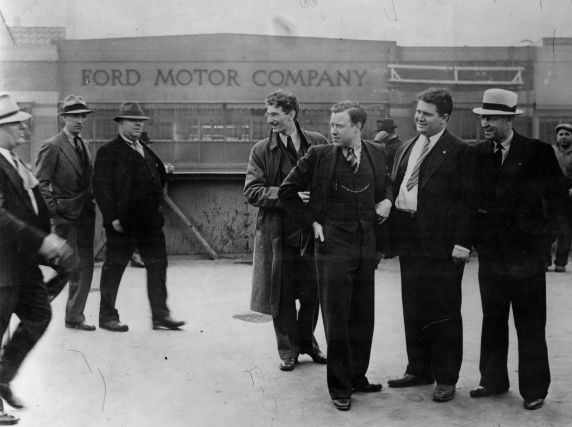
At around 2:00, several of the leading UAW organizers, including Walter Reuther, Richard Frankensteen and Richard Merriweather, were asked by Detroit News photographer Scotty Kilpatrick to pose for a picture on an overpass, with the Ford sign in the background. While they were posing, men from Ford's Service Department, an internal security force under the direction of Harry Bennett, came from behind, and began to beat them. The number of attackers is disputed, but may have been as many as 40.

Frankensteen had his jacket pulled over his head, and was kicked and punched. Merriweather suffered a broken back. Reuther described some of the treatment he received:

Seven times, they raised me off the concrete and slammed me down on it. They pinned my arms... and I was punched and kicked and dragged by my feet to the stairway, thrown down the first flight of steps, picked up, slammed down on the platform and kicked down the second flight. On the ground, they beat and kicked me some more.
 
Bennett told the media, "The affair was deliberately provoked by union officials... They simply wanted to trump up a charge of Ford brutality.. I know definitely no Ford service man or plant police were involved in any way in the fight." The photographs proved him a liar, and the incident greatly increased support for the UAW and hurt Ford's reputation. Still, it took 3 more years before Ford signed a contract with the UAW.

*

May 26, 1937 was a Wednesday. These baseball games were played that day:

* The New York Yankees beat the Detroit Tigers, 7-0 at Yankee Stadium. So, not a good day for Detroit. Lefty Gomez allowed 9 hits, but kept the shutout. George Selkirk and Tony Lazzeri it home runs, Lou Gehrig went 1-for-4 with an RBI, and Joe DiMaggio went 3-for-5 with an RBI. Hank Greenberg went 2-for-4 for the Tigers.

* The New York Giants beat the Cincinnati Reds, 6-3 at Crosley Field in Cincinnati.

* The Boston Red Sox beat the St. Louis Browns, 11-9 at Fenway Park in Boston. Jimmie Foxx went 3-for-4 with a home run and 3 RBIs.

* The Cleveland Indians beat the Philadelphia Athletics, 8-6 at Shibe Park in Philadelphia.

* The Chicago White Sox beat the Washington Senators, 6-5 at Griffith Stadium in Washington.

* The Philadelphia Phillies beat the Chicago Cubs, 6-1 at Wrigley Field in Chicago.

* The St. Louis Cardinals beat the Boston Bees, 6-4 at Sportsman's Park in St. Louis. This was during the experiment of the Boston National League team trying to get away from the name "Braves," but it didn't take.

* And the Brooklyn Dodgers and the Pittsburgh Pirates were rained out at Forbes Field in Pittsburgh. The game was made up as part of a doubleheader on June 20. The Pirates won the opener, 4-2. The Dodgers won the nightcap, also 4-2.

Monday, May 9, 2022

May 9, 1970: The Death of Walter Reuther

May 9, 1970: Walter Reuther, America's greatest leader of labor unions, is killed in a plane crash. He was 62 years old.

Walter Philip Reuther was born on September 1, 1907 in Wheeling, West Virginia. His father Valentine was a horse-drawn beer wagon driver and a Socialist union organizer who had emigrated from Germany at age 11. Reuther later recalled, "At my father's knee ,we learned the philosophy of trade unionism. We got the struggles, the hopes and the aspirations of working people every day." As a child, he and his brother Victor accompanied their father on a visit to a jail to meet the top American labor leader of the era, Eugene V. Debs, who was being incarcerated for his pacifism during World War I.

One day, the Reuther brothers saw local boys throwing rocks at black people being transported north through their hometown in open railways cars. Their father gave them a stern warning to never treat another human being like that. The Reuther boys never forgot that lesson, spending the rest of their lives fighting for racial and economic equality for all people.

In 1927, at the age of 19, Reuther left Wheeling for Detroit, and argued himself into an expert tool and die maker job at Ford Motor Company, a job that required 25 years experience. The foreman was baffled that at his young age he could read blueprints and dies, becoming one of the highest paid mechanics in the factory. In 1932, he was fired for organizing a rally for Norman Thomas, who was running for President of the United States as the nominee for the Socialist Party of America. His official Ford employment record states that he quit voluntarily, but Reuther himself maintained that he was fired for his increasingly visible socialist activities.

In 1934, he joined the United Auto Workers. By 1937, he had gotten General Motors and Chrysler to recognize the union. Ford, the other member of the "Big Three," refused, so he organized a strike. He and others were beaten by a private army hired by Henry Ford. It became known as the Battle of the Overpass, and led to the American public beginning to side with unions. Ford recognized the UAW in 1940.

That same year, Reuther organized a deal between the UAW, Ford and the federal government to produce 500 planes a day for the Department of War, in preparation for America's inevitable entry into World War II. Reuther was of German descent, but he knew that Nazi Germany was not only bloodthirsty and racist, but anti-union, and he wanted them defeated as much as President Franklin D. Roosevelt did. (Henry Ford did not: He admired Adolf Hitler, who had mentioned him in Mein Kampf as someone he thought held the same ideals. Henry never contradicted that.)

Walter and May Reuther were married on March 13, 1936, after meeting on a streetcar in Detroit only six weeks earlier. She was a teacher, and had organized a teachers' union. They had 2 daughters: Linda, born in 1942; and Elisabeth, in 1947. Reuther led a simple, austere lifestyle. He neither smoked nor drank alcohol, because he felt it sapped a person's vitality. For his daily lunch in his office, he had the same menu: A sandwich and a cup of tea.

In April 1938, 2 masked gunmen attempted to abduct Reuther at a party he was hosting. However, one guest managed to flee and alert the authorities, leading to their arrest. At the trial, the defense argued that the Reuther staged the entire event as a publicity stunt. Links between the gunmen and Harry Bennett, a union-busting enemy of the UAW, were not disclosed to the jury.

Reuther was elected President of the UAW in 1946, and was continually re-elected for the rest of his life. He won praise from liberals for standing up for good jobs at good wages, and for civil rights, demanding equal pay for black workers. He won praise from conservatives for purging Communists from the UAW's ranks.

In 1947, he was among the founders of Americans for Democratic Action, the leading liberal lobbying group of the post-World War II era. He was elected President of the Congress of Industrial Organizations in 1952, and held the post until it was reconsolidated with the American Federal of Labor, as the AFL-CIO, in 1955, negotiating it with AFL leader George Meany.

On April 20, 1948, Reuther barely survived a double-barrel shotgun blast that ripped through his kitchen window as he was preparing a late evening snack. As the gunshot went off at 9:48 PM, he turned toward his wife, and was hit in his right arm instead of the chest and heart. Four slugs shattered his right arm into 150 pieces of bone. Another slug pierced his back, and exited out his stomach. The assailant “fled in a bright red four-door Ford sedan," police said.

Reuther did not lose consciousness, and cursed his attacker as he was initially being treated by his next-door-neighbor, a doctor, as he lay on the kitchen floor. The doctor reported Reuther as saying, "Those dirty sons of bitches! They have to shoot a man in the back. They won't come out in the open and fight."

As doctors fought to save his life, he became infected with malaria and hepatitis from blood transfusions. Through months of therapy, he regained partial use of his right arm, but for the rest of his life had to train himself to write and shake with his left hand.

Attorney General Tom Clark requested J. Edgar Hoover to get the FBI to investigate the shooting. Hoover refused. I won't post what he said. It was that vile. The shooting was never solved.

Following the Bay of Pigs incident in 1961, President John F. Kennedy sent Reuther to Cuba to negotiate a prisoner exchange with Fidel Castro. He was instrumental in spearheading the creation of the Peace Corps. When Lyndon Johnson became President, he met with Reuther regularly, and Reuther got the UAW to support the Civil Rights Acts of the 1960s, Medicare and Medicaid.

When Dr. Martin Luther King Jr. and some of his supporters were arrested in Birmingham, Alabama in 1963 -- leading to King's "Letter from Birmingham Jail" -- Reuther raised $160,000 for their release. What became known as simply "The March On Washington" was, in full, The March On Washington for Jobs and Freedom, and Reuther not only helped organize it, but spoke at it, shortly before King's "I Have a Dream" speech. He served on the board of the NAACP, and was responsible for bringing the struggle of Cesar Chavez and the United Farm Workers to the attention of Senator Robert F. Kennedy.

The Republicans hated him as much as the Democrats liked him. During the 1960 election, then-Vice President Richard Nixon said about JFK, "I can think of nothing so detrimental to this nation than for any President to owe his election to, and therefore be a captive of, a political boss like Walter Reuther." The next Republican nominee for President, Senator Barry Goldwater of Arizona, said Reuther "was more dangerous to our country than Sputnik or anything Soviet Russia might do."

A lifetime environmentalist, Reuther played a critical role in funding and organizing the first Earth Day on April 22, 1970. Denis Hayes, the principal national organizer of the first Earth Day, said, "Without the UAW, the first Earth Day would have likely flopped!" So Reuther was important in many liberal causes.

But the struggles for women's and gay rights, and reproductive freedom, would not gain momentum in his lifetime. On May 9, 1970, 17 days after that 1st Earth Day, Walter and May Reuther, their bodyguard William Wolfman, architect Oscar Stonorov, pilot George O. Evans and co-pilot Joseph U. Karaffa boarded a chartered Learjet 23 in Detroit. In rain and fog, they were approaching Pellston Regional Airport in Pellston, Michigan, near the UAW's recreational and educational facility at Black Lake, Michigan. The plane crashed at 9:33 PM, and everyone on board was killed.

The National Transportation Safety Board discovered that the plane's altimeter was missing parts, some incorrect parts were installed, and one of its parts had been installed upside down. This has led to speculation of sabotage, that Reuther may have been murdered -- assassinated. Given the previous attempts on his life, it's not far-fetched. But the weather was almost certainly to blame.

The Spring of 1970 was the Winter of Discontent for "Sixties People." The dream seemed to be over: Nixon had been elected President, the Smothers Brothers had been canceled, there had been murder at Altamont, The Beatles had broken up, the Kent State Massacre and the Hard Hat Demonstration had just happened, and now, Walter Reuther had passed into legend along with the Kennedy brothers and Dr. King. And the Vietnam War, which Reuther had also opposed, was still going, with no end in sight.

However, shortly after his death, the State of Michigan named Interstate 696, a 28-mile highway in the northern suburbs of Detroit, the Walter P. Reuther Freeway. In 1999, Time magazine named him the most important labor union leader of the 20th Century.

*

May 9, 1970 was a Saturday. Dennis Coles, the Wu-Tang Clan member known as Ghostface Killah, was born on this day.

Football was out of season. The NBA season ended the night before, when the New York Knicks beat the Los Angeles Lakers in Game 7 of the Finals. The American Basketball Association, however, had far from decided its title. The Los Angeles Stars beat the Denver Rockets, 109-107 at the Denver Auditorium Arena, to win the Western Division Finals, 4 games to 1. Spencer Haywood scored 37 points in defeat for the Rockets, who became the Denver Nuggets in 1974. The Stars would lose the Finals to the Indiana Pacers.

The NHL season would end the next day, when Bobby Orr scored in overtime to give the Boston Bruins a 4-3 win over the St. Louis Blues, and a sweep of the Stanley Cup Finals, ending a 29-year Cup drought for the Bruins.

And these Major League Baseball games were played:

* The New York Yankees lost to the California Angels, 11-3 at Anaheim Stadium (now Angel Stadium of Anaheim). Andy Messersmith went the distance for the win, and hit a home run.

* The New York Mets beat the San Francisco Giants, 14-5 at Shea Stadium. Jerry Koosman was the winning pitcher. Art Shamsky hit a home run. Willie Mays went 0-for-3 with a walk.

* The San Diego Padres beat the Montreal Expos, 6-0 at Jarry Park in Montreal. Danny Coombs pitched a 2-hit shutout, allowing only singles by Don Hahn and Bob Bailey. This game was between the 2 National League expansion teams of 1969, and it was probably the best-pitched game in Padres history to that point, and possibly for many years to come.

* The Los Angeles Dodgers beat the Philadelphia Phillies, 9-4 at Connie Mack Stadium in Philadelphia. The Phils scored 2 runs in the bottom of the 9th, including a home run Byron Browne, to send the game to extra innings. But first Dick Selma, and then Joe Hoerner, melted down in the top of the 14th, allowing 5 runs. Manny Mota went 4-for-7 with 2 RBIs.

* The Baltimore Orioles beat the Chicago White Sox, 4-3 at Memorial Stadium in Baltimore. Brooks Robinson hit a home run. Frank Robinson did not play.

* The Atlanta Braves beat the St. Louis Cardinals, 5-3 at Atlanta Stadium (later renamed Atlanta-Fulton County Stadium). Hank Aaron hit his 567th career home run, and Orlando Cepeda hit his 323rd. Lou Brock went 2-for-4.

* The Minnesota Twins beat the Cleveland Indians, 5-3 at Cleveland Municipal Stadium. Harmon Killebrew went 0-for-4, and Rod Carew went 0-for-5, but Tony Oliva and Paul Ratliff hit home runs for the Twins.

* The Detroit Tigers beat the Kansas City Royals, 7-4 at Tiger Stadium in Detroit. Al Kaline went 1-for-4, Willie Horton hit 2 home runs, and Bill Freehan hit 1.

* The Chicago Cubs beat the Cincinnati Reds, 8-1 at Wrigley Field in Chicago. Ernie Banks hit his 499th home run. Three days later, he hit his 500th. Pete Rose went 1-for-3 with a walk. Johnny Bench went 0-for-3 with a walk.

* The Milwaukee Brewers beat the Washington Senators, 3-2 at Milwaukee County Stadium. Ted Kubiak singled Mike Hegan home with the winning run in the bottom of the 10th inning.

* The Pittsburgh Pirates beat the Houston Astros, 6-3 at the Astrodome in Houston. Roberto Clemente went 4-for-5 with an RBI. Willie Stargell went 2-for-5 with a walk.

* And the Boston Red Sox beat the Oakland Athletics, 5-3 at the Oakland Coliseum. Carl Yastrzemski hit 2 home runs, and Tony Conigliaro won it with a home run in the 9th inning. Reggie Jackson only appeared as a pinch-runner.
Saturday, April 16, 2022

April 16, 1963: Martin Luther King's Letter from Birmingham Jail

April 16, 1963: Dr. Martin Luther King Jr. proves that the pen is mightier than the sword -- or the billy club.

Birmingham, the largest city in the State of Alabama, was known for its intense racial segregation, and for its equally intense opposition to those who wished to end it. On April 3, 1963, Dr. King began his "Birmingham campaign," a nonviolent effort coordinated by his group, the Southern Christian Leadership Conference (SCLC) and the Alabama Christian Movement for Human Rights (ACMHR).

On April 10, a judge issued a blanket injunction against "parading, demonstrating, boycotting, trespassing and picketing." Leaders of the campaign announced they would disobey the ruling. On April 12, King was arrested with SCLC activist Ralph Abernathy, ACMHR and SCLC official Fred Shuttlesworth, and other marchers, while thousands of African Americans dressed for Good Friday looked on.

King was met with unusually harsh conditions in the Birmingham City Jail. An ally smuggled in a newspaper from April 12, which contained "A Call for Unity," a statement by 8 white Alabama clergymen against King and his methods. The letter provoked King, and he began to write a response to the newspaper itself. King writes in Why We Can't Wait: "Begun on the margins of the newspaper in which the statement appeared while I was in jail, the letter was continued on scraps of writing paper supplied by a friendly Black trusty, and concluded on a pad my attorneys were eventually permitted to leave me."

Walter Reuther, president of the United Auto Workers, who had worked his entire career to get black autoworkers the same working conditions as white ones, arranged $160,000 to bail out King and the other jailed protestors.

King's response was April 16, 1963, responded to several criticisms made by the "A Call for Unity" clergymen, who agreed that social injustices existed but argued that the battle against racial segregation should be fought solely in the courts, not the streets. He also criticizes the claim that African Americans should wait patiently while these battles are fought in the courts.

As a minister, King responded to the criticisms on religious grounds. As an activist challenging an entrenched social system, he argued on legal, political, and historical grounds. As an African American, he spoke of the country's oppression of Black people, including himself. As an orator, he used many persuasive techniques to reach the hearts and minds of his audience. Altogether, King's letter was a powerful defense of the motivations, tactics, and goals of the Birmingham campaign and the Civil Rights Movement more generally.

"I was invited," he said, by our Birmingham affiliate "because injustice is here" in what is probably the most racially-divided city in the country, with its brutal police, unjust courts, and many "unsolved bombings of Negro homes and churches." Referring to his belief that all communities and states were interrelated, King wrote, "Injustice anywhere is a threat to justice everywhere. We are caught in an inescapable network of mutuality, tied in a single garment of destiny. Whatever affects one directly, affects all indirectly."

King also warned that if white people successfully rejected his nonviolent activists as rabble-rousing outside agitators, that could encourage millions of African Americans to "seek solace and security in Black nationalist ideologies, a development that will lead inevitably to a frightening racial nightmare." King was well aware of the efforts along those lines of Malcolm X, a Nation of Islam spokesman in New York.

Citing previous failed negotiations, King wrote that the Black community was left with "no alternative." "We know through painful experience that freedom is never voluntarily given by the oppressor; it must be demanded by the oppressed."

The clergymen also disapproved of the timing of public actions. In response, King said that recent decisions by the SCLC to delay its efforts for tactical reasons showed that it was behaving responsibly. He also referred to the broader scope of history, when "'Wait' has almost always meant 'Never.'" Declaring that African Americans had waited for the God-given and constitutional rights long enough, King quoted "one of our distinguished jurists" that "Justice too long delayed in justice denied."

Against the clergymen's assertion that demonstrations could be illegal, King argued that civil disobedience was not only justified in the face of unjust laws but also was necessary and even patriotic: "The answer lies in the fact that there are two types of laws: just and unjust. I would be the first to advocate obeying just laws. One has not only a legal but a moral responsibility to obey just laws. Conversely, one has a moral responsibility to disobey unjust laws. I would agree with St. Augustine that 'an unjust law is no law at all.'"

Anticipating the claim that one cannot determine such things, he again cited Christian theologian Thomas Aquinas by saying any law not rooted in "eternal law and natural law" is not just, while any law that "uplifts human personality" is just. Segregation undermines human personality, ergo, is unjust. Furthermore, he wrote: "I submit that an individual who breaks a law that conscience tells him is unjust, and who willingly accepts the penalty of imprisonment in order to arouse the conscience of the community over its injustice, is in reality expressing the highest respect for law."

King stated that it is not morally wrong to disobey a law that pertains to one group of people differently from another. Alabama has used "all sorts of devious methods" to deny its Black citizens their right to vote and thus preserve its unjust laws and broader system of white supremacy. Segregation laws are immoral and unjust "because segregation distorts the soul and damages the personality. It gives the segregator a false sense of superiority and the segregated a false sense of inferiority."  Even some just laws, such as permit requirements for public marches, are unjust when they are used to uphold an unjust system.

King addressed the accusation that the Civil Rights Movement was "extreme" by first disputing the label but then accepting it. Compared to other movements at the time, King found himself as a moderate. However, in his devotion to his cause, King referred to himself as an extremist. Jesus and other great reformers were extremists: "So the question is not whether we will be extremists, but what kind of extremists we will be. Will we be extremists for hate or for love?"

King's discussion of extremism implicitly responded to numerous "moderate" objections to the ongoing movement, such as Dwight D. Eisenhower's claim while he was President that he could not meet with civil rights leaders because doing so would require him to meet with the Ku Klux Klan. There was no such requirement of "equal time."

In the closing, King criticized the clergy's praise of the Birmingham police for maintaining order nonviolently. The recent public displays of nonviolence by the police were in stark contrast to their typical treatment of Black people and, as public relations, helped "to preserve the evil system of segregation." It is wrong to use immoral means to achieve moral ends but also "to use moral means to preserve immoral ends." Instead of the police, King praised the nonviolent demonstrators in Birmingham "for their sublime courage, their willingness to suffer and their amazing discipline in the midst of great provocation. One day the South will recognize its real heroes."

Extensive excerpts from the letter were published, without King's consent, on May 19, 1963, in the New York Post Sunday Magazine. The complete letter was first published as "Letter from Birmingham City Jail" by the American Friends Service Committee (the Quakers) in May 1963. King included a version of the full text in his 1964 book Why We Can't Wait.

The Birmingham Campaign moved forward. But in May, under the command of Public Safety Commissioner Theophilus "Bull" Connor, the police unleashed angry dogs on the demonstrators, and used fire hoses with pressure so intense they could legitimately be called "water cannons." These images were captured on film and shown on television. Any chance that Birmingham had to claim the moral high ground vanished.


*

April 16, 1963 was a Tuesday. These baseball games were played that day:

* The New York Yankees lost to the Detroit Tigers, 7-2 at Yankee Stadium. Hank Aguirre outpitched Whitey Ford. Rocky Colavito went 3-for-4 with an RBI. Al Kaline went 1-for-4 with a walk and an RBI. For the Yankees, Tom Tresh went 3-for-4. Mickey Mantle did not play.

* The New York Mets lost to the Cincinnati Reds, 7-4 at Crosley Field in Cincinnati. Frank Robinson went 3-for-5 with 2 RBIs. Johnny Edwards went 3-for-3 with 3 RBIs. Pete Rose, in his 1st week as a major league player, went 1-for-4. Duke Snider hit a home run for the Mets.

* The Boston Red Sox beat the Baltimore Orioles, 6-1 at Fenway Park in Boston. Bill Monbouquette outpitched Robin Roberts. Carl Yastrzemski went 1-for-4. Dick Stuart went 2-for-4 with a home run and 4 RBIs. Brooks Robinson went 1-for-4 with an RBI.

* The Cleveland Indians beat the Washington Senators, 3-0 at Cleveland Municipal Stadium. Sam McDonwell pitched a 2-hit shutout, to outpitch Claude Osteen.

* The Kansas City Athletics beat the Chicago White Sox, 7-4 at Comiskey Park in Chicago.

* The Minnesota Twins beat the Los Angeles Angels, 11-10 at Metropolitan Stadium in the Minneapolis suburb of Bloomington, Minnesota. It was 1-0 Angels in the 1st, 2-1 Twins after the 1st, 4-2 Angels in the 3rd, 5-5 after 5, and 7-5 Angels going to the bottom of the 9th. But Bob Allison hit a home run to save the Twins, and send the game to extra innings. Both teams scored 2 runs in the 11th. Buck Rodgers hit a sacrifice fly to give the Angels a 10-9 lead into the bottom of the 13th, but the Twins tied it, loaded the bases, and George Banks drew a walk to end it in victory for Minnesota. Oddly enough, the Twins' best-known player, Harmon Killebrew, did not appear in this long and wild game.

* The Milwaukee Braves beat the Philadelphia Phillies, 8-0 at Milwaukee County Stadium. Warren Spahn, just short of his 42nd birthday, pitched a 4-hit shutout, and even got a hit. Hank Aaron went 3-for-4 with a walk and an RBI. Joe Torre went 2-for-4.

* The St. Louis Cardinals beat the Pittsburgh Pirates, 4-3 at the 1st Busch Stadium, which had been the last Sportsman's Park, in St. Louis. Stan Musial, in what turned out to be his last season, went 1-for-4 with an RBI. Roberto Clemente went 0-for-4.

* The Chicago Cubs beat the Los Angeles Dodgers, 2-1 at Dodger Stadium in Los Angeles. Ernie Banks won it with a sacrifice fly in the top of the 12th inning.

* And the San Francisco Giants beat the Houston Colt .45s, 7-0 at Candlestick Park in San Francisco. (The Colt .45s became the Astros in 1965.) Willie Mays went 1-for-2 with 2 walks and an RBI.

Football was out of season. Game 2 of the NBA Finals was played at the Boston Garden, and the Boston Celtics beat the Los Angeles Lakers, 113-106. The Celtics would win the title in 6 games.

Game 4 of the Stanley Cup Finals was played at the Olympia Stadium in Detroit. The Toronto Maple Leafs beat the Detroit Red Wings, 4-2. The Leafs would win the Cup at home 2 days later.

December 31, 1999 & January 1, 2000: The Millennium

December 31, 1999:  The Millennium arrives. The people of planet Earth survived. At a terrible cost. But we hadn't destroyed ourselves. ...