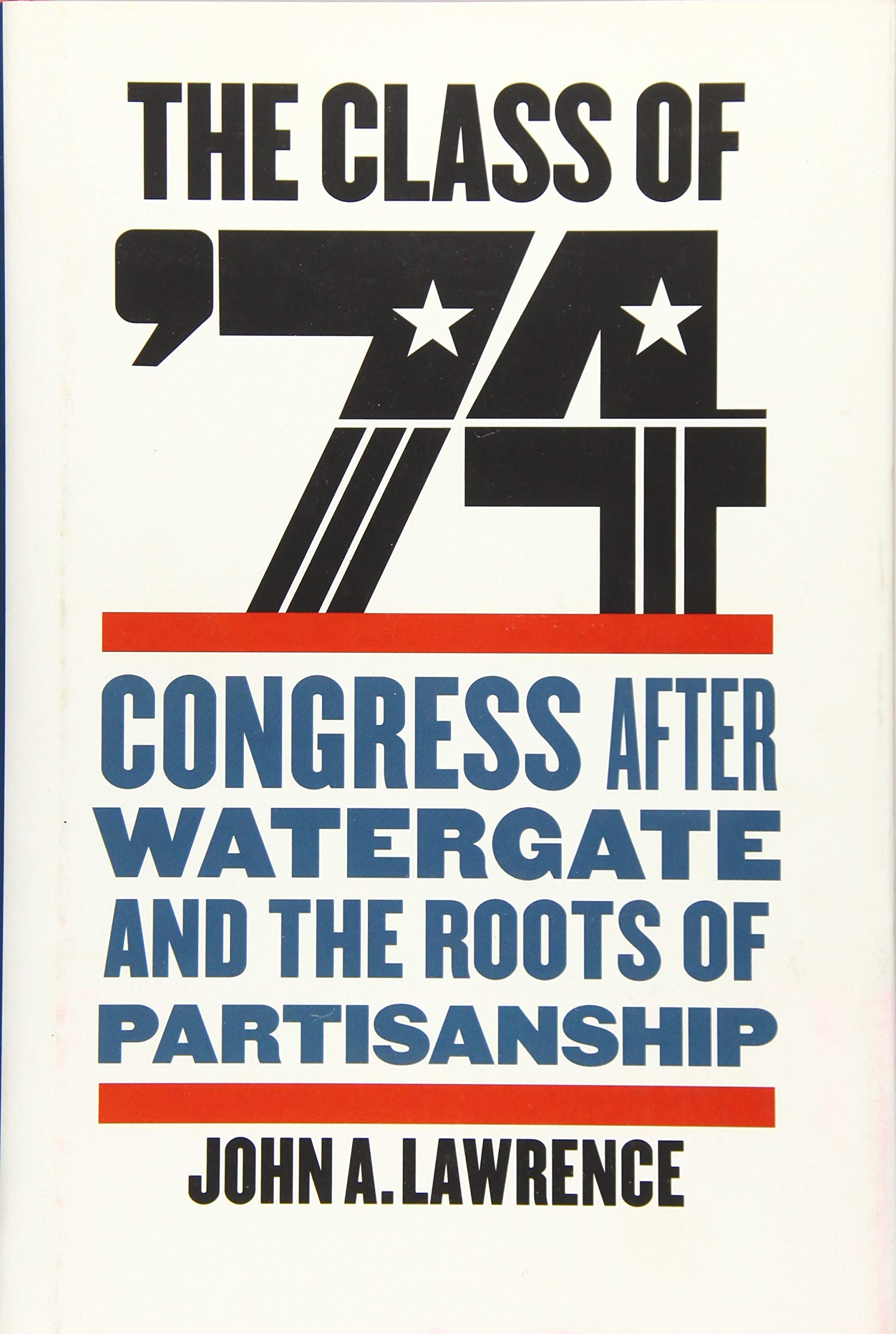
November 5, 1974: Elections for the Congress of the United States are held, the 1st major election after the resignation of President Richard Nixon as a result of the Watergate scandal, and his pardon by the new President, Gerald Ford.
Voters punished the Republican Party of Nixon and Ford: The Democratic Party picked up 5 Senate seats and 49 seats in the House of Representatives – a House pickup it has never again managed.
Among the new Representatives:
* George Miller of California, who served 40 years, eventually Chairman of the Natural Resources Committee and the Education and Labor Committee.
* Norman Mineta of California, who served 21 years, eventually Chairman of the Transportation Committee, and later Secretary of Transportation. The airport in San Jose, of which he had been Mayor, was named for him.
* Henry Waxman of California, who served 40 years, eventually the Chairman of the Energy Committee, but most famous for his 1990s hearings that helped break the tobacco lobby's hold on Congress.
* Tim Wirth of Colorado, who served 12 years, then won a term in the Senate.
* Chris Dodd of Connecticut, who served 6 years, then won 5 terms in the Senate. His father, Tom Dodd, also served the State in both houses of Congress.
* Larry McDonald of Georgia, who served 8 years, becoming perhaps the most conservative of these Democrats, before being one of the victims of the shooting down of Korean Air Lines Flight 007 by the Soviet Union in 1983.
* Paul Simon of Illinois, who served 10 years, then won 2 terms in the Senate. He ran for President in 1988, but only won his home State's Primary, getting him 74 of his 115 Delegates. He released those Delegates before the Democratic Convention.
* Tom Harkin of Iowa, who served 10 years, then won 5 terms in the Senate. He ran for President in 1992, winning 49 Delegates in the Iowa Caucuses, because nobody wanted to challenge him in his home State, but won only 6 more the rest of the way.
* Paul Tsongas of Massachusetts, who served 4 years, then won a term in the Senate. He ran for President in 1992, winning 209 Delegates, including the Primaries in New Hampshire, Maryland, Massachusetts and Rhode Island, and finishing 3rd at the Democratic Convention.
* James Blanchard of Michigan, who served 8 years, then won 2 terms as Governor, and served as U.S. Ambassador to Canada.
* Jim Oberstar of Minnesota, who served 36 years, becoming the longest-serving Congressman in his State's history, eventually chairing the Transportation and Infrastructure Committee.
* Max Baucus of Montana, who served 4 years, before winning 6 terms in the Senate, and serving as U.S. Ambassador to China.
* Jim Florio of New Jersey, who served 15 years, before being elected Governor.
* William J. Hughes of New Jersey, who served 20 years.
* Helen Stevenson Meyner of New Jersey, who served 6 years. She was the wife of former Governor Robert Meyner, and a cousin of Democratic Party icon Adlai Stevenson.
* Stephen Neal of North Carolina, who served 20 years. He won his 1st term by defeating a Republican incumbent, Wilmer "Vinegar Bend" Mizell, a former major league pitcher.
* John Jenrette of South Carolina, who served 6 years, before being defeated due to his involvement in the ABSCAM scandal, serving a year in prison.
* Harold Ford of Tennessee, who served 22 years, becoming the 1st black person elected to Congress from his home State.
* Bob Krueger of Texas, who served 4 years, later briefly serving as a U.S. Senator, the last Democrat to do so as of the 2022 election. He later served as U.S. Ambassador to the African nations of Burundi and Botswana.
There were 13 Republican freshmen who bucked the trend and were elected, either through defeating a Democratic incumbent or winning an open seat. One was Henry Hyde of Illinois, who became famous for the Hyde Amendment is a legislative provision barring the use of federal funds to pay for abortion, except to save the life of the woman, or if the pregnancy arises from incest or rape. He later chaired the Judiciary Committee, and, despite having been himself exposed as an adulterer and a homewrecker, led the House's effort to impeach President Bill Clinton in 1998-99.
The Republican freshmen also included Chuck Grassley of Iowa, who served 6 years, before being elected to the Senate, where, as of the 2022 election, he still serves; Millicent Fenwick of New Jersey, who served 8 years, and served as the basis for the character of Lacey Davenport in the comic strip Doonesbury; Larry Pressler of South Dakota, who served 4 years, before winning 3 terms in the Senate; and Bob Kasten of Wisconsin, who served 4 years, before winning 2 terms in the Senate.
And then there was Jim Jeffords of Vermont. He 14 years in the House and 18 years in the Senate. In 2001, angry at his Party, he left the Republicans and became an independent, caucusing with the Democrats, throwing control in the Senate to them.
Speaking of Bill Clinton: He also made his 1st run for public office in 1974, for the House, but losing, was Bill Clinton, challenging John Paul Hammerschmidt in the 3rd District of Arkansas. Two years later, Clinton was elected the State's Attorney General; 2 years after that, Governor.
There were 11 new Senators elected. The 8 Democrats were Dale Bumpers of Arkansas, Gary Hart of Colorado, Richard Stone of Florida, John Culver of Iowa, Wendell Ford of Kentucky, Robert Morgan of North Carolina, John Glenn of Ohio, and Patrick Leahy of Vermont. The 3 Republicans were Paul Laxalt of Nevada, Louis Wyman of New Hampshire, and Jake Garn of Utah.
Glenn was the 1st American to orbit the earth. Garn became the 1st sitting Senator to fly in space -- and Glenn became the 2nd. Glenn and Hart ran for President in 1984, and Hart tried again in 1988.
Many of the freshman Congressmen were young, and rode the issue of Watergate scandal to victory. So the media dubbed them the "Watergate Babies."
Some of the new House members made challenges to Chairmen of the various Committees, who held those posts due to seniority. Some of them had grown stale and/or conservative in office, and deserved something of a shake-up.
But those Chairmen had the loyalty of many of their colleagues, and that led to many of the insurgents blowing their chances at gaining favor with those established members.
But the writing was on the wall: Those Chairmen began to retire and/or die in office. Those Class of '74 Congressmen who survived the Republican-heavy elections of 1978 and 1980 went on to become leaders of Congress themselves. The last remainder of them was Senator Patrick Leahy of Vermont, the President Pro Tempore of the Senate, retiring for the election of 2022.

Patrick Leahy
Several States also elected Governors in 1974. With Ronald Reagan, elected in 1966 by defeating incumbent Edmund G. "Pat" Brown, not running for a 3rd term, California elected Pat's son, Edmund G. "Jerry" Brown.

Jerry Brown
He was re-elected in 1978, but hurt his reputation with some left-leaning stances, and a personality that led Tonight Show host Johnny Carson, operating out of the Los Angeles suburb of Burbank, to nickname him "Governor Moonbeam."
Brown didn't help himself at home with his ill-advised, ill-fated runs for President in 1976 and 1980. As a result, the Republicans won 4 straight gubernatorial elections, including a defeat of his sister, State Treasurer Kathleen Brown, by incumbent Pete Wilson in 1994.
But Jerry made a comeback. With California enacting term limits, limiting State officials to 2 terms, he was twice elected Mayor of Oakland, was twice elected State Attorney General, and was returned to the Governorship in 2010 and 2014. Having previously been the youngest Governor in California history, he had become the oldest.
Also elected in 1974 was Congresswoman Ella Grasso, as the new Governor of Connecticut. She was the 1st woman elected Governor of any State without having ascended to the job on the death of the previous Governor, or having been the wife of a Governor.

She was instrumental in building (and, after a roof collapse, the restoring) the Hartford Civic Center (now the XL Center) and in bringing the Boston-based New England Whalers to Hartford, and would be re-elected in 1978, but developed cancer, and died in 1981.
*
November 5, 1974 was, like all modern Election Days in America, a Tuesday. Baseball season was over. Football was in midweek. There were 2 games in the NBA. The New York Knicks beat the Houston Rockets, 106-93 at the Hofheinz Pavilion (now the Fertitta Center) in Houston. And the Kansas City-Omaha Kings, playing 1 of their 3 "home games" a year at the Omaha Civic Auditorium in Nebraska, beat the expansion New Orleans Jazz, 115-97.
There was 1 game in the American Basketball Association: The Denver Nuggets beat the Utah Stars, 145-101 at the Denver Auditorium Arena.
There were 5 games in the NHL:
* The New York Rangers lost to the Vancouver Canucks, 2-1 at the Pacific Coliseum in Vancouver.
* The New York Islanders and the Philadelphia Flyers played to a tie, 4-4 at the Nassau Coliseum.
* The Boston Bruins and the Buffalo Sabres played to a tie, 2-2 at the Boston Garden.
* The Los Angeles Kings beat the St. Louis Blues, 4-3 at the St. Louis Arena.
* And the Pittsburgh Penguins beat the Kansas City Scouts, 5-3 at the Kemper Arena (now the Hy-Vee Arena) in Kansas City.
And there were 5 games in the World Hockey Association:
* The Toronto Toros beat the Michigan Stags, 5-2 at Cobo Hall (now Huntington Place) in Detroit.
* The Phoenix Roadrunners beat the Indianapolis Racers, 3-0 at the Market Square Arena in Indianapolis.
* The Vancouver Blazers beat the Chicago Cougars, 5-4 at the International Amphitheatre in Chicago.
* The Winnipeg Jets beat the Minnesota Fighting Saints, 6-4 at the Winnipeg Arena.
* And the Houston Aeros beat the San Diego Mariners, 9-3 at the Sam Houston Coliseum in Houston.


No comments:
Post a Comment