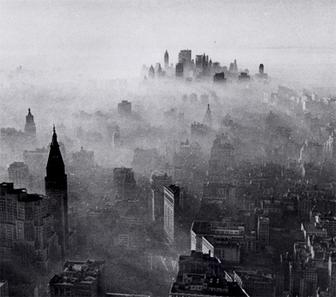
Photo on the front page of The New York Times,
November 25, 1966
November 24, 1966: New York City is struck with a major air-pollution episode and environmental disaster, coinciding with that year's Thanksgiving holiday weekend.
Smog -- the word is a combination, a portmanteau, of "smoke" and "fog" covered the New York Metropolitan Area (or "the New York Tri-State Area," including portions of the States of New York, New Jersey and Connecticut) from November 23 to 26, filling the City's air with damaging levels of several toxic pollutants. It was the City's 3rd major smog attack, following events of similar scale in 1953 and 1963.
On November 23, a large mass of stagnant air over the East Coast trapped pollutants in the city's air. For 3 days, New York City was engulfed in dangerously high levels of carbon monoxide, sulfur dioxide, smoke, and haze. Pockets of air pollution pervaded the Tri-State Area.
By November 25, the smog became severe enough that regional leaders announced a "first-stage alert." Leaders of local and State governments asked residents and industry to take voluntary steps to minimize emissions. Health officials advised people with respiratory or heart conditions to remain indoors. The City shut off garbage incinerators, requiring massive hauling of garbage to landfills.
Energy companies Consolidated Edison (called Con Ed for short) and the Long Island Lighting Company (LILCO) were asked to burn natural gas rather than fuel oil, to minimize the release of sulfur dioxide. Both companies voluntarily cut back emissions, with Con Ed reducing its emissions by 50 percent.
(Con Ed still runs New York City's electricity. LILCO lost favor over the years, and was replaced in 1998 by the Long Island Power Authority. In 2014, LIPA was bought out by Public Service Enterprise Group, or PSEG, which runs electricity for much of New Jersey.)
In spite of the danger, Macy's ran its Thanksgiving Day Parade as scheduled. Indeed, it ran the Parade every year from its 1st in 1924 until 2019, holding a virtual Parade due to COVID restrictions in 2020, and resuming in 2021. But fewer people than usual came out to attend.
A cold front dispersed the smog on November 26, and the alert ended. In the months that followed, medical researchers studied the smog's impact on health. City officials initially maintained that the smog had not caused any deaths, but it soon became clear that the smog had significantly harmed public health.
A study published in December 1966 estimated that 10 percent of the City's population -- around 800,000 people -- had suffered adverse health effects, such as stinging eyes, coughing and respiratory distress. A statistical analysis published in October 1967 found that 168 deaths had likely been caused by the smog. For comparison's sake: The smog event of 1953 is believed to have killed 260; the one in 1963, perhaps as many as 400.
The smog catalyzed greater national awareness of air pollution as a serious health problem and a political issue. The government of New York City updated local laws on air-pollution control. Prompted by the smog, President Lyndon B. Johnson and members of Congress worked to pass federal legislation regulating air pollution in the United States, culminating in the 1967 Air Quality Act and the 1970 Clean Air Act. The extent of harms from subsequent pollution events, including the health effects of pollution from the September 11, 2001 terrorist attack, have been judged by reference to the 1966 smog in New York.
*
November 24, 1966 was a Thursday, Thanksgiving Day. English singer Russell Watson, known for singing "Where My Heart Will Take Me," the theme from Star Trek: Enterprise, was born.
For the 1st time, the Dallas Cowboys hosted a Thanksgiving Day game, beating the Cleveland Browns, 26-14 at the Cotton Bowl in Dallas. The NFL's established T-Day team, the Detroit Lions, lost to the San Francisco 49ers, 41-14 at Tiger Stadium in Detroit. And in the American Football League, the Buffalo Bills beat the Oakland Raiders, 31-10 at the brand-new Oakland-Alameda County Coliseum.
There were 5 games played in college football:
* Number 4 Nebraska were upset by arch-rival Oklahoma, 10-9 at Memorial Stadium (later Owen Field, now Gaylord Family Memorial Stadium) in Norman, Oklahoma.
* Villanova beat George Washington University, 16-7 at District of Columbia Stadium in Washington. This turned out to be the last football game that GWU ever played: The school's trustees dropped its football program on January 17, 1967. In 1969, D.C. Stadium was renamed Robert F. Kennedy Memorial Stadium.
* Virginia Tech beat Virginia Military Institute, 70-12 at Victory Stadium in Roanoke, Virginia. VMI now compete in the NCAA Football Championship Subdivision (FCS), formerly Division I-AA.
* The University of Tulsa beat Wichita State, 47-14 at Skelly Stadium in Tulsa, Oklahoma. Wichita State dropped its program after the 1986 season.
* And Texas beat arch-rival Texas A&M, 22-14 at Memorial Stadium in Austin, Texas.
Baseball was out of season. There were 2 games played in the NBA. The Philadelphia 76ers beat the San Francisco Warriors, 140-123 at the Philadelphia Civic Center. Wilt Chamberlain scored 27 points and grabbed 36 rebounds against his former team. Rick Barry scored 36 in defeat.
And the Boston Celtics beat the St. Louis Hawks, 101-78 at the Kiel Auditorium in St. Louis. Larry Siegfried of the Celtics led all scorers with 24 points, while Bill Russell, now also the head coach of the Celtics, scored 8 points and grabbed 33 rebounds.
There were 2 games in the NHL. The Boston Bruins beat the Detroit Red wings, 8-3 at the Boston Garden. And the Chicago Black Hawks beat the Montreal Canadiens, 5-0 at the Chicago Stadium. The New York Rangers and the Toronto Maple Leafs were not scheduled.


No comments:
Post a Comment