
September 1, 1964: Masanori Murakami makes his major league debut. This makes him the 1st Asian-trained player in Major League Baseball.
Harry Kingman was born in Tianjin, China, the son of missionaries, but grew up outside Los Angeles, and played 4 games with the 1914 New York Yankees. He remains the only MLB player born on the Chinese mainland, although there have been 16 born in Taiwan and 1 in Hong Kong (Austin Brice, who grew up in North Carolina, currently pitching for the Pittsburgh Pirates).
Bobby Balcena, with 2 games with the 1956 Cincinnati Redlegs, was also from the Los Angeles area, and of Philippine descent. This made him MLB's 1st player of Asian descent. But Murakami was the 1st born, raised, and trained to play the game in Asia -- and, for a long time, the only one.
He was born on May 6, 1944, in Ōtsuki, in Yamanashi Prefecture, on Honshu, the main island of Japan, about 50 miles west of the capital city of Tokyo. In 1962, he was signed out of high school by the Nankai Hawks (now the Fukuoka SoftBank Hawks) of Japan's Pacific League.
In 1964, the Hawks sent him, and 2 other young players, as "exchange students" to the Fresno Giants, a farm team of the San Francisco Giants. Murakami was only supposed to stay until June, but the Hawks forgot to send the paperwork to call him back, and he ended up going 11-7 with a 1.78 ERA for Fresno.
On September 1, 1964, he was called up to San Francisco, and made his groundbreaking major league debut against the New York Mets, at Shea Stadium in New York. Wearing Number 10, he began the bottom of the 8th inning, and struck Charley Smith out, allowed a single to Chris Cannizzaro, struck Ed Kranepool out, and got Roy McMillan to ground to short. In the top of the 9th, Hal Lanier singled, Willie Mays walked, and Orlando Cepeda singled Lanier home. But that would be the only run the Giants scored, as the Mets beat them, 4-1. Ron Hunt had hit a home run off Giants starter Bob Hendley.
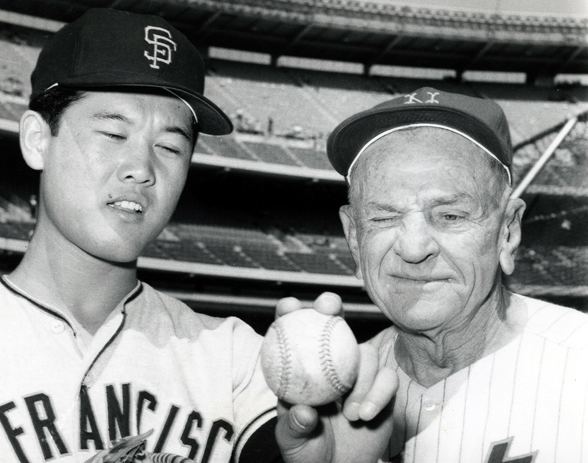
Showing his screwball to Mets manager Casey Stengel,
before the game that marked his debut
He pitched in 9 games for the Giants down the stretch, all in relief, including the last 3 innings against the Houston Colt .45s (they became the Astros the next season) on September 29, for his 1st major league win. He didn't allow a run until his last appearance, allowing 3 of them, for a 1.80 ERA. In 15 innings, he struck out 15 batters, and only walked 1.
It had been only 20 years since the end of World War II, in which Japan was an enemy of America. But that seemed to be enough time for Giant fans to accept "Mashi," as he was never booed at Candlestick Park. San Francisco ranks 4th among large American cities with 1.5 percent of its population being of Japanese descent, slightly behind Sacramento and Seattle, slightly ahead of San Jose, a little ahead of Los Angeles, all of which are far behind, understandably, Honolulu. American-born Japanese in San Francisco embraced him, while American fans treated him like any other player.
Finally, the Hawks came calling, and demanded that Murakami be returned to Japan. The Giants were so high on him that they refused. An international incident was avoided when an agreement was reached: He would pitch 1 more season for the Giants, and then return to the Hawks for 1966, similar to a loan deal in professional soccer.
Like many later Asian pitchers, he had an unusual delivery. How unusual was it? As far as I know, he is the only lefthanded pitcher in MLB history who threw sidearm. His best pitch was a screwball, and he was also said to have a good curveball and a good changeup, but his fastball topped out in the mid-80s.
He carried a Japanese/English dictionary with him, but still struggled with the language. In 1973, Brendan C. Boyd and Fred C. Harris, in their book The Great American Baseball Card Flipping, Trading and Bubble Gum Book, jokingly called him, "with the possible exception of Yogi Berra, the only major league ballplayer who did not speak English." (They forgot about several Mexican- and Caribbean-born players who spoke only Spanish.)
In 1965, now wearing Number 37, Mashi appeared in 45 games, only 1 of them a start, going 74 1/3rd innings, with a record of 4-1 and a 3.75 ERA. His control was still excellent: 85 strikeouts and only 22 walks. His WHIP was 1.063. The Giants finished 2 games behind their arch-rivals, the Los Angeles Dodgers, for the Pennant. He was 21 years old, and seemed to have a great future ahead of him.
But a deal was a deal, and that future would not be in America. He returned to the Hawks, and struggled at first. In 1968, pitching half his games as a starter and half as a reliever, he went 18-4. He was nearly a full-time starter in 1970 and '71, but was put back in the bullpen for 1972. In 1973, he had a bad season, but the Hawks won the Pacific League Pennant, his 1st title.
The Hawks released him after the 1974 season, and he was signed by the Hanshin Tigers of Nishinomiya. After a difficult season with them, he was signed by the Nippon Ham Fighters, of Sapporo on the northernmost "home island," Hokkaido. He was much improved for them, but, again, only won a Pennant in what was a bad year, statistically, for him, in 1981. He retired after the 1982 season, with a record of 103-82, plus 30 saves, in the Japanese leagues.
In 1983, he returned to the Giants, as a batting practice pitcher. In 1984, he went back to Japan, as a broadcaster. In 1987, he became a pitching coach, first for the Hawks (by this point, named the Fukuoka Daiei Hawks), then the Seibu Lions in Saitama. Again, he worked for the Giants as a scout, and is now a broadcaster for Japan's largest TV network, NHK, and writes a column for the Daily Sports newspaper.
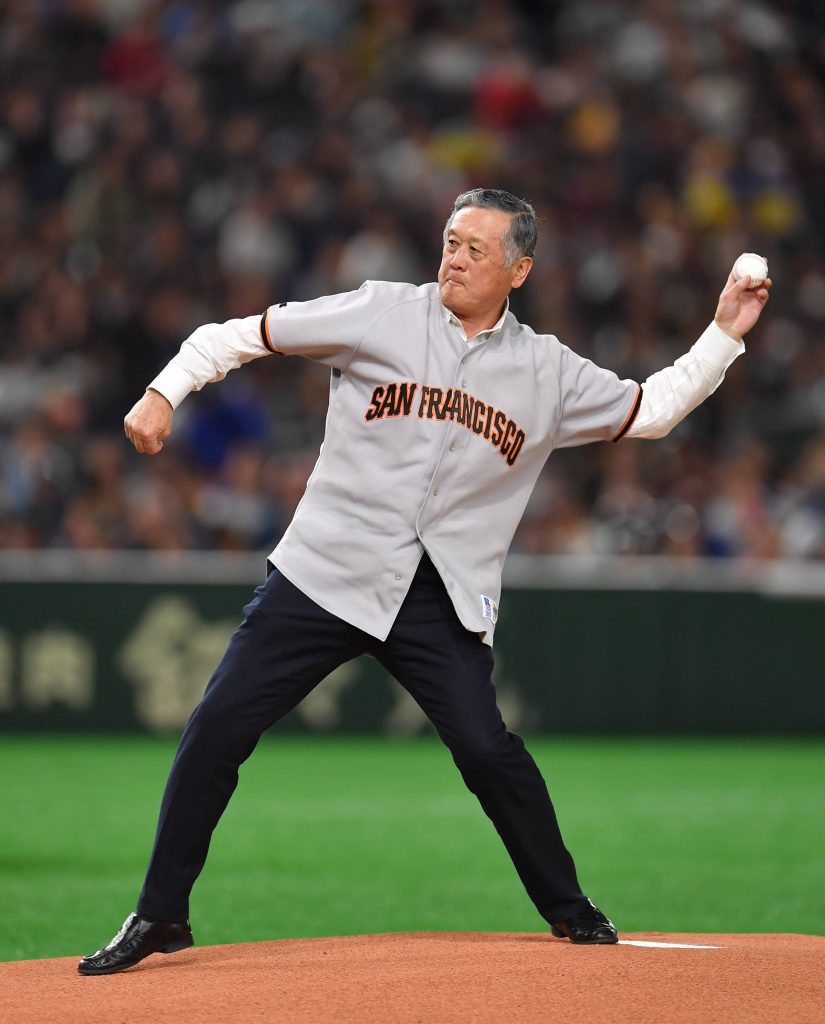
The Giants have invited him back for the 2002, 2010, 2012 and 2014 World Series. On May 15, 2014, the 50th Anniversary of his arrival in San Francisco, the team honored him on Japanese Heritage Night, and gave him the chance to throw out the ceremonial first ball.
But after he returned to Japan in 1965, it would take until 1994 for another player born and trained in baseball in Asia to play in the American major leagues. It was Korean pitcher Chan Ho Park, with the Los Angeles Dodgers. In 1995, with Park's success established, the Dodgers signed Japanese pitcher Hideo Nomo, and he took baseball by storm -- not quite literally, but the spins on both his windup and his fastball earned him the nickname "The Tornado."
It would take until 2001 before MLB got its 1st 2 non-pitchers from Japan: Ichiro Suzuki of the Seattle Mariners, and Tsuyoshi Shinjo of the New York Mets. Ichiro becomes eligible for the Baseball Hall of Fame in 2025. He, Nomo, Hideki Matsui of the New York Yankees, Yu Darvish of the San Diego Padres (having previously pitched for 3 other teams), and Shohei Ohtani of the Los Angeles Angels have been the most successful Japanese players in America.
As of September 1, 2022, there have been 73 MLB players born in Japan, 27 from Korea (all from the South, none from the North), 16 from Taiwan, 2 from the Philippines, 2 from Guam, 2 born in Saudi Arabia, 1 born in mainland China, 1 born in Hong Kong, 1 born in Afghanistan, 1 from American Samoa, 1 born in Indonesia, 1 born in Singapore, and 1 born in Vietnam.
In some of these cases, including 8 of the players born in Japan, they were born there to 2 American parents, but raised and trained to play baseball in America; in others, to 1 American and 1 native, but raised and trained to play baseball in America. Still, 65 of the Japanese-born major leaguers were ethnically fully Japanese, and learned to play baseball in their home country.
It all started with a sidearming lefty screwballer named Masanori Murakami.
*
September 1, 1964 was a Tuesday. In addition to the Giants' loss to the Mets, these major league games were played in baseball that day:
* The New York Yankees beat the Los Angeles Angels, 4-1 at Dodger Stadium in Los Angeles, where the Halos groundshared with the O'Malley ballclub from 1962 to 1965. Mickey Mantle went 1-for-4, and Clete Boyer went 2-for-4 with 2 RBIs, in support of Al Downing, who went the distance for the win. At the close of business that night, the Yanks were in 3rd place in the American League, with the Baltimore Orioles leading the Chicago White Sox by half a game, and the Yankees by 2.
* The Philadelphia Phillies beat the Houston Astros, 4-3 at Connie Mack Stadium in Philadelphia. At the close of business that night, the Phils led the National League by 5 1/2 games with 30 to play. They were in better shape than the Yankees. But the Yankees would end up winning their Pennant; the Phillies, not.
* The Cleveland Indians beat the Washington Senators, 3-0 at District of Columbia Stadium in Washington. (It would be renamed Robert F. Kennedy Memorial Stadium in 1969.) Sam McDowell, making an emergency start on just 1 day's rest, went 6 1/3rd innings, pitching shutout ball and allowing 6 hits. Don McMahon pitched hitless ball the rest of the way.
* The Pittsburgh Pirates beat the Los Angeles Dodgers, 5-2 at Forbes Field in Pittsburgh. Roberto Clemente went 0-for-4, but Willie Stargell hit a home run.
This was the only season from 1962 to 1966 in which the Dodgers weren't at least tied for the Pennant at the scheduled end of the regular season. The reason would seem to be clear: Sandy Koufax got hurt, and pitched his last game of the season on August 16, finishing 19-5.
Except the Dodgers were already 12 1/2 games back at that point, and finished 13 back. The real problems were their inability to hit much, and, aside from Koufax and Don Drysdale (and he was 18-16 that season due to the lack of hitting), they didn't have a reliable 3rd starter, let alone a 4th. They traded for Claude Osteen, and that made a big difference the next 2 seasons.
* The Cincinnati Reds beat the Chicago Cubs, 2-1 at Crosley Field in Cincinnati. Jim Maloney went the distance, striking out 13 and allowing just 3 hits and 1 walk. The losing pitcher for the Cubs? Ernie Broglio, the man they traded Lou Brock to St. Louis to get.
Frank Robinson went 1-for-2 with a walk. Pete Rose, the previous season's NL Rookie of the Year and eventually the most famous Reds player of all time, did not play in this game, due to a minor injury that caused him to miss 6 games in a 7-game stretch. Ernie Banks went 0-for-3.
* The Detroit Tigers beat the Chicago White Sox, 8-0 at Comiskey Park in Chicago. Mickey Lolich pitched a 3-hit shutout. Al Kaline went 1-for-4 with a walk and 2 RBIs, while Don Wert and Jerry Lumpe hit home runs for the Tigers.
* The Minnesota Twins beat the Baltimore Orioles, 2-1 at Metropolitan Stadium in the Minneapolis suburb of Bloomington, Minnesota. Harmon Killebrew hit 2 home runs. Brooks Robinson went 1-for-4 with an RBI.
* The St. Louis Cardinals beat the Milwaukee Braves, 5-4 at Busch Stadium (formerly Sportsman's Park) in St. Louis. Bob Uecker, of all people, singled home the winning run in the bottom of the 9th, off Denny Lemaster. Hank Aaron went 1-for-4, and Joe Torre went 2-for-4 with an RBI.
The aforementioned Lou Brock went 0-for-4, with 3 strikeouts. In fact, for a man who ended up with 3,023 career hits, and only 149 of them home runs, he struck out a lot: 1,730 times. At the time, this was 2nd-most all-time, behind Stargell, who broke Mantle's record of 1,710, and finished with 1,936. (Mantle joked that he'd expected to be invited to present Stargell with a diamond-studded trophy in the shape of the letter K.) The current record-holder is Reggie Jackson, with 2,597. Jim Thome almost broke that record, with 2,548. No player active in 2022 is a serious threat to this record. Of course, side from Brock, these men all hit at least 475 homers.
* And the Boston Red Sox beat the Kansas City Athletics, 3-2 at Kansas City Municipal Stadium. Carl Yastrzemski went 2-for-3 with 2 walks and an RBI.


No comments:
Post a Comment