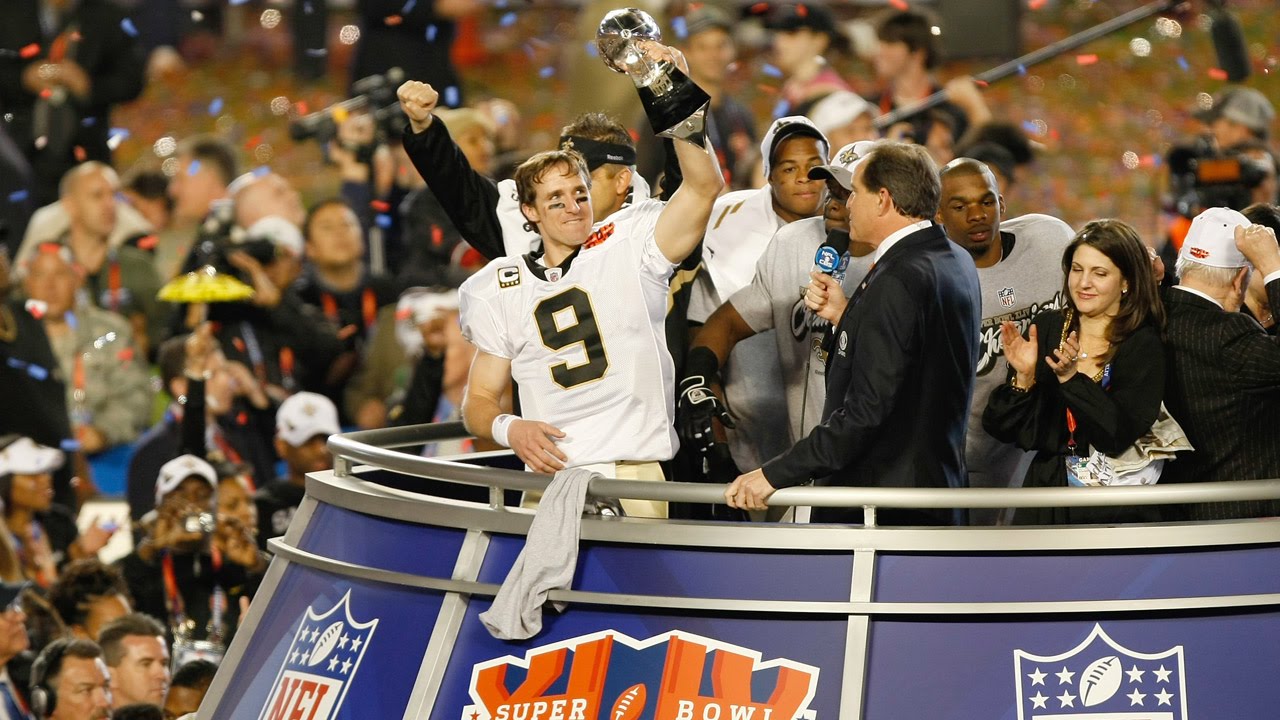
Drew Brees
February 7, 2010: Super Bowl XLIV is played at Sun Life Stadium (now Hard Rock Stadium) in Miami Gardens, Florida.

The City of New Orleans, Louisiana had hosted 9 Super Bowls to that point. But its team, the New Orleans Saints, had never played in one. Now, they would.
On August 29, 2005, Hurricane Katrina hit New Orleans, resulting in a broken levee that flooded the city, which was already below sea level. By nightfall, 80 percent of the Crescent City, and parts of neighboring areas, were flooded. Over 1,800 people were killed, and thousands were left homeless.
The Louisiana Superdome, home of the Saints, was used as a shelter, topping out at 26,000 people. But because of the nature of the emergency, getting relief supplies into the city was incredibly difficult.
As late as 1950, New Orleans' population was 660,000, putting it in America's top 20 cities. White flight led to a drop to about 484,000 people within the city limits in the 2000 Census. After Hurricane Katrina, it dropped to 230,000, losing over half its people in one fell swoop. According to a recent estimate, it's back up to about 391,000, making it larger than such NFL cities as Tampa, St. Louis, Pittsburgh, Cincinnati and Buffalo (and, of course, Green Bay).
But the metropolitan area has just 1.27 million people, making it the smallest metro area in the NFL, if Green Bay is included with Milwaukee and Niagara Falls is included with Buffalo. And the poverty issue, so pervasive before the hurricane, is worse. And crime is definitely an issue.
In 1940, the city was 70 percent white. As late as 1970, it was 51 percent white. By 1990, it was 62 percent black, and the proportions are roughly the same today: 61 percent black, 31 percent white, 5 percent Hispanic and 3 percent Asian. The further east you go, the greater the black percentage; the further west, the more white.
The Saints played their entire 2005 season on the road while the dome was refurbished. The Superdome reopened for the 2006 season, and the Saints provided a lift to the devastated city.
Under coach Sean Payton, the Saints were more popular than ever. They started the 2009 season 13-0, before dropping their last 3: 24-17 at home to the Dallas Cowboys, 20-17 in overtime at home to the Tampa Bay Buccaneers, and 23-10 away to the Carolina Panthers.
Maybe having clinched the NFC South Division early, earning them a bye week for the Wild Card Round, helped. Certainly, having home-field advantage all the way through the Playoffs did. In the Divisional Playoff, they beat the Arizona Cardinals 34-3. And in the NFC Championship Game, which they had reached only once before in their 42 previous seasons, they beat the Minnesota Vikings, 31-28. They were headed for the Super Bowl.
Their opponents would be the Indianapolis Colts, a perennial Playoff team, and Super Bowl winners just 3 seasons before. Ironically, their quarterback was from New Orleans: Peyton Manning, son of former Saints quarterback Archie Manning, who stayed in the city after his retirement as a player.
The Colts had gone 14-2 -- and they, too, had started on a long undefeated run before losing at the end, 29-15 at home to the New York Jets, and 30-7 away to the Buffalo Bills. But they also had home-field advantage all the way through, and beat the Baltimore Ravens 20-3, before avenging their loss to the Jets, 30-17.
Both teams played on artificial turf, under domes. The Colts would be playing in the same stadium, on the same natural grass field, on which they'd won Super Bowl XLI. That might not have been much of an advantage. The Colts went into the game favored by 5 points.
But there was a sense around the country that the Saints had more people rooting for them. Maybe it was because of the sympathy people felt for New Orleans after the hurricane. Or maybe it was because the Colts had won recently, while the Saints had never been to the big game before. Or, maybe people were just sick of Peyton Manning always being on TV, in games and in all those commercials. He advertised so many products, even Joe Namath, Reggie Jackson and Shaquille O'Neal must have thought he was overexposed.
At the age of 42, Matt Stover became the oldest man ever to play in a Super Bowl (a record since broken). He kicked a 38-yard field goal that put the Colts up, 3-0, midway through the 1st quarter.
Toward the end of the quarter, Manning launched a 96-yard drive, tying the record for the longest in Super Bowl history. Joseph Addai accounted for 53 of those yards with his rushing. The last play was a 19-yard touchdown pass from Manning to Pierre Garçon. With a French name like that, people could have been excused for thinking he was from New Orleans. In fact, he was a local, having grown up in the suburbs of Miami, a black man of Haitian descent. The Saints led, 10-0.
The Saints got on the board with a 46-yard field goal from Garrett Hartley. He kicked a 44-yarder on the last play of the 1st half, and the teams went into the locker rooms with the score 10-6 in Indy's favor. The Colts had been the better team, but hadn't pulled away.
The Saints had won the opening coin toss, and chose to receive the ball. Which meant they had to kick off to start the 2nd half. But Sean Payton made the gutsiest coaching move in the history of NFL Championship Games. It would have been bold enough had he been winning, but, down by 4 points, it was huge. He called for an onside kick. Never before, in 43 Super Bowls, had an onside kick been attempted before the 4th quarter.
Thomas Morstead kicked the ball to his left. It went 15 yards -- it had to go at least 10 for the Saints to have a chance to recover it and keep it -- and it bounced off the facemask of Hank Baskett of the Colts, making it a free ball. It took the officials more than a minute to separate the pile of men on the ball. When they did, it was Jonathan Casillas who had it: Saints ball, on their own 42-yard line.
Saints quarterback Drew Brees threw 5 passes, all complete, for 58 yards, the last a 16-yarder to Pierre Thomas, for a go-ahead touchdown. (Nope, this Pierre wasn't from Louisiana, either: He was from the Chicago suburbs.) It was 13-10 New Orleans.
Manning shook it off, and led a 76-yard drive that ended with a 4-yard touchdown run by Addai. 17-13 Indianapolis. Hartley kicked a 47-yard field goal to make it 17-16, making him the 1st kicker to make 3 field goals of 40 or more yards in a single Super Bowl. As the 4th quarter began, Stover tried a 51-yard field goal, but missed.
Drew "breezed" through the Colts' defense on the next drive, ending with a 2-yard touchdown pass to Jeremy Shockey, the tight end whose bad behavior had gotten him exiled from the New York Giants. (Not that they cared much: They'd already won a Super Bowl without him, and with Manning's brother Eli, and would win another that way.)
Sean Payton made another gutsy call, and went for a 2-point conversion. Brees threw to Lance Moore, and the ball was knocked away from him by Jacob Lacey. The play was ruled an incomplete pass, but Payton challenged the call. The instant replay showed that he had possession in the end zone long enough, and it was 24-17 Saints, with 5:42 to go.
This was plenty of time for Peyton Manning, of course. And he got into Saint territory. But he was intercepted at the Saint 26 by Tracy Porter, and he took it to the house. Hartley's extra point made it 31-17 New Orleans.
The Colts still had 3:12 to go, plus all 3 of their 2nd half time-outs, plus the 2-minute warning. But now, they needed 2 touchdowns. They got to the Saints' 3-yard line, but, with a field goal offering them little help, they had to go for it on a 4th down, and couldn't do it. The Saints took over, and Brees knelt with the ball to run out the clock. He was named the game's Most Valuable Player.
The Saints were NFL Champions. New Orleans had a World Championship. Louisiana had a professional World Championship. In each case, it was the 1st. (The football team at Louisiana State University had won 3 National Championships, and has since won another. But this was the pros.)
It had been a little over 4 years since the hurricane, and it resulted in the biggest party in the history of America's greatest party city. For this game, and for all his charitable efforts, in New Orleans and elsewhere, Brees was named Sportsman of the Year for 2010 by Sports Illustrated.
In preparation for Super Bowl 50, 6 years later, Slate writer Justin Peters watched every Super Bowl over a 2-month period. He ranked Super Bowl XLIV the 5th-best -- behind XXII, XXXIV, XIII and XXIII -- saying, "Coming as it did five years after New Orleans was flooded in Hurricane Katrina, the Saints' victory actually mattered." (For the record, he named Super Bowl XII -- the 1st one I can remember watching -- as the worst game of the 1st 49.)
UPDATE: The Saints have a Ring of Honor. It does not include their only 2 retired numbers, both for Hall-of-Famers from very early in Saints history: 31, for running back Jim Taylor; and 81, for defensive end Doug Atkins. It does include 1970s quarterback Archie Manning, 1980s kicker Morten Andersen, 1980s linebackers Rickey Jackson and Sam Mills, 1990s offensive tackle Willie Roaf, 2000s defensive end Will Smith, 2000s and '10s guard Jahri Evans, and 1985-2018 team owner Tom Benson.
The Saints also have a team Hall of Fame. It includes:
* From the founding period, 1967 to 1979: Atkins, Manning, quarterback Billy Kilmer, receiver Danny Abramowicz, running back Tony Galbreath, tight end Henry Childs, guard Jake Kupp, defensive end Bob Pollard, defensive tackle Derland Moore, linebacker Jim Federspiel, cornerback Dave Whitsell, safety Tommy Myers, and kicker Tom Dempsey.
* From the 1980s: Benson, Andersen, Jackson, Johnson, Mills, general manager Jim Finks, head coach Jim Mora Sr., assistant coach Steve Sidwell; quarterback Bobby Hebert; running backs George Rogers, Dalton Hilliard and Rueben Mayes; receiver Eric Martin, tight end Hoby Brenner, centers John Hill and Joel Hilgenberg, offensive tackle Stan Brock, defensive ends Jim Wilks and Frank Warren, linebacker Pat Swilling, and safeties Dave Waymer and Brett Maxie.
* From the 1990s: Benson, Roaf, guard Jim Dombrowski, defensive ends Wayne Martin and Joe Johnson, defensive tackle LaRoi Glover, cornerback Tyrone Hughes, safety Sammy Knight.
* From the 2000s, but not the Super Bowl season: Quarterback Aaron Brooks, running back Deuce McAllister, receivers Joe Horn and Michael Lewis, and special teams player Fred McAfee.
* From their Super Bowl XLIV winners: Benson, Smith, Evans, quarterback Drew Brees; running backs Reggie Bush and Pierre Thomas; receivers Devery Henderson, Lance Moore and Marques Colston; guard Carl Nicks, linebacker Jonathan Vilma, cornerbacks Tracy Porter and Jabari Green, safety Roman Harper, and kicker John Carney -- but not yet head coach Jim Haslett.
Abramowicz, Manning, Andersen, Finks, Mora, Jackson, Johnson, Mills, Swilling, Hebert, Hilliard, Martin, Brees, Colston and Evans have also been inducted into the Louisiana Sports Hall of Fame.
*
February 7, 2010 was a Sunday. The Super Bowl was the only football game played that day. Baseball was out of season. There were 2 games played in the NBA. The Orlando Magic beat the Boston Celtics, 96-89 at the TD Garden in Boston. And the Toronto Raptors beat the Sacramento Kings, 115-104 at the Air Canada Centre (now the Scotiabank Arena) in Toronto. Chris Bosh scored 36 points for the Raps.
And there were 2 games played in the NHL. In an "Original Six" matchup, the Boston Bruins beat the Montreal Canadiens, 3-0 at the Bell Centre in Montreal. And the Washington Capitals beat the Pittsburgh Penguins, 5-4 at the Verizon Center (now the Capital One Arena) in Washington. Mike Knuble scored the winning goal, with 2:11 left in overtime.
Also, Arsenal lost to Chelsea, 2-0 at Stamford Bridge in West London.


No comments:
Post a Comment