
April 14, 1936: Orson Welles' Federal Theatre Project premieres its all-black "Voodoo Macbeth" at the Lafayette Theatre at 2225 7th Avenue, at 132nd Street in Harlem.
For the record, there really was a Macbeth who was King of Scotland, from 1040 to 1057, and he is generally regarded as one of the better Scottish monarchs. The play seems to suggest he was a good man gone bad, and getting worse as he gains more power, and that he only reigned for a few weeks, as opposed to 17 years. He is egged on by his wife, and "Lady Macbeth" has become an insult for any woman who plots to become "the power behind the throne."
William Shakespeare first produced Macbeth in 1606. It tells of a nobleman whose ambition gets the better of him. The highlight comes near the end, when the title character realizes he's lost his kingdom, his wife, everything but his own life, all through his own fault. He says:
Tomorrow, and tomorrow, and tomorrow,
Creeps in this petty pace from day to day,
To the last syllable of recorded time;
And all our yesterdays have lighted fools
The way to dusty death. Out, out, brief candle!
Life's but a walking shadow, a poor player,
That struts and frets his hour upon the stage,
And then is heard no more. It is a tale
Told by an idiot, full of sound and fury,
Signifying nothing.
William Faulkner took this soliloquy, and titled his greatest noel The Sound and the Fury. And the Star Trek franchise titled an episode of its original series "All Our Yesterdays," and one of the later (though taking place earlier) series Strange New Worlds "Tomorrow and Tomorrow and Tomorrow." Another episode, "Dagger of the Mind," also takes its title from Macbeth.
The duel scene between Macbeth and Macduff was filmed in 1905. The 1st full-length film version was a 1908 American one. The 1st sound version was a British one in 1945, with Wilfrid Lawson. Welles filmed it, starring himself, in 1948. The series Hallmark Hall of Fame, then on NBC, produced it for TV in 1954 and 1960, both with Maurice Evans.
Laurence Olivier, having spectacularly succeeded with film versions of Shakespeare's plays Henry V in 1944, Hamlet in 1948, and Richard III in 1955, tried to get funding for a film version of Macbeth in the late 1950s, but failed.
Sean Connery, not yet having playing James Bond, starred in a version for Canada's CBC in 1961. Roman Polanski directed a film version in 1971, with Jon Finch. Ian McKellen starred in a version for Britain's ITV in 1979. Jeremy Brett starred in a feature film in 1981, Nicol Williamson in a BBC TV version in 1983, and Brian Cox voiced an animated version for BBC2 in 1992.
Jason Connery followed his father into the role for a 1997 feature film, Sean Pertwee (also the son of a major British actor, former Doctor Who star Jon Pertwee) in a Channel 4 TV production in 1998, Patrick Stewart in a 1960s-styled TV version for BBC Four in 2010, Michael Fassbender in a 2015 feature film, and Denzel Washington starred in the 2021 American film The Tragedy of Macbeth.
There are stories of accidents, misfortunes and even deaths taking place during runs of Macbeth. And so, actors and others in the theatre industry often consider it bad luck to mention Macbeth by name while inside a theatre, and sometimes refer to it indirectly, for example as, "The Scottish Play" -- although it is not considered bad luck to utter the name "Macbeth" when referring to the character himself. Welles himself was a student of the occult, and with Shakespeare's use of witches, Macbeth is his most occult play. But Welles didn't take the superstition seriously.
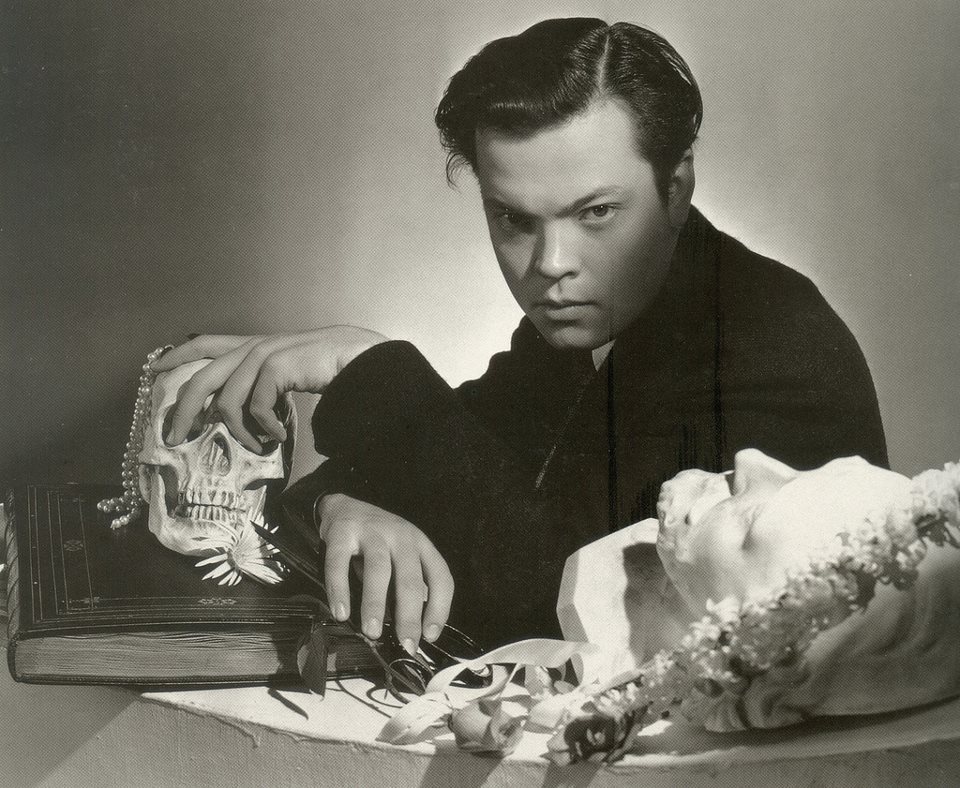
Orson Welles, age 20
He was also a believer in civil rights, and it was his idea to produce and direct a version of the play with all black actors. Jack Carter played the usurper king. The action was moved from Scotland to a Caribbean island, and the three witches were replaced by witch doctors. Welles pulled this imaginative idea off despite being just 20 years old.
The good news is, a portion of this play survives on film. The bad news is, the Lafayette Theatre does not: It was demolished in 2013.
Jack Carter had played Crown in the original 1927 Broadway production of Porgy and Bess, and would work with Welles again in 1937, playing the Devil role, Mephistopheles, in Doctor Faustus, with Welles directing and playing Faust. He appeared in films with mostly-black casts in the 1940s, and lived until 1967.
*
April 14, 1936 was a Tuesday. Actress Arlene Martel was born. So was Frank Serpico, the undercover detective who blew the whistle on police corruption in New York in the early 1970s, was nearly killed by his fellow cops over it, and was immortalized in film by Al Pacino.
Football was out of season. The NBA hadn't been founded yet. And the hockey season had ended 3 days earlier, when the Detroit Red Wings beat the Toronto Maple Leafs to win the Stanley Cup. But it was not just Opening Night for Welles' Macbeth, it was Opening Day for the season in what would later be called Major League Baseball, and there was a full slate of games:
* The New York Yankees lost to the Washington Senators, 1-0 at Griffith Stadium in Washington. President Franklin D. Roosevelt threw out the ceremonial first ball. Louis "Bobo" Newsom pitched a 4-hit shutout, outpitching Vernon "Lefty" Gomez. The game was scoreless until the bottom of the 9th inning, when Gomez gives up a single to Cecil Travis and a double to Carl Reynolds.
Lou Gehrig went 1-for-4. The Yankees' much-hyped rookie, Joe DiMaggio, had a foot injury, and did not make his major league debut until May 3.
* New York City's National League arch-rivals opened against each other. The New York Giants beat the Brooklyn Dodgers, 8-5 at the Polo Grounds. The Giants scored 3 runs in the bottom of the 8th to win it. Dick Coffman was the winning pitcher in relief of Hal Schumacher, while George Earnshaw went the distance for the Dodgers. Mel Ott and Dick Bartell hit home runs. Giant manager Bill Terry put himself in as a pinch-hitter, but did not reach base.
* The Boston Red Sox beat the Philadelphia Athletics, 9-4 at Fenway Park in Boston. Wes Ferrell went the distance for the win. Jimmie Foxx, making his Sox debut after they essentially paid the A's $150,000 for him (with additional, marginal players going each way), went 3-for-5 with an RBI.
* The Philadelphia Phillies beat the Boston Bees, 4-1 at Baker Bowl in Philadelphia. After a terrible season in 1935, the Boston franchise of the National League "rebranded" as we would say today, dropping the name "Braves" for "Bees," and renaming Braves Field "National League Park." The change never caught on, and the old names were restored in 1941.
* The Detroit Tigers beat the Cleveland Indians, 3-0 at League Park in Cleveland. Lynwood "Schoolboy" Rowe outpitched Mel Harder. Hank Greenberg went 1-for-4 with 2 RBIs. Charlie Gehringer went 3-for-4. Catcher-manager Mickey Cochrane went 0-for-5.
* The Pittsburgh Pirates beat the Cincinnati Reds, 8-6 at Crosley Field in Cincinnati. Paul Waner went 2-for-5. Lloyd Waner did not play, but, in his place in center field, Daniel "Bud" Hafey, a cousin of Hall-of-Famer Charles "Chick" Hafey, went 2-for-5 with a home run and 3 RBIs. Former Yankee Waite Hoyt, a Hall-of-Famer, pitched the last 6 innings in relief, and was the winning pitcher.
* The Chicago White Sox beat the St. Louis Browns, 7-6 at Comiskey Park in Chicago. The ChiSox scored 3 runs in the bottom of the 8th to win it. Luke Appling went 2-for-4.
* And the Chicago Cubs beat the St. Louis Cardinals, 12-7 at Sportsman's Park in St. Louis. Lon Warneke went the distance for the Cubs, outpitching Dizzy Dean. The Cards decided that if you can't beat him, get him, and acquired Warneke the next season. Frank Demaree hit 2 home runs for the Cubs, and they got 1 each from 3 future Hall-of-Famers: Gabby Hartnett, Billy Herman and former Phillies star Chuck Klein added 1.


No comments:
Post a Comment