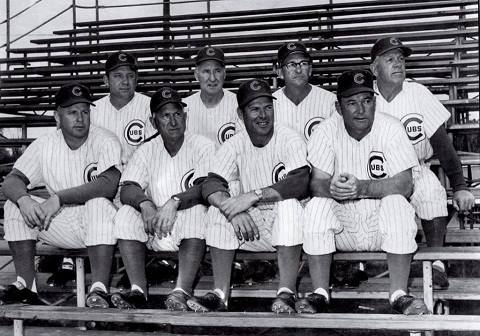
The reason the Chicago Cubs did not win a National League Pennant between 1945 and 2016 wasn't because of any curse cast by a man over a goat. It was because, for the better part of 70 years, their management was so dumb.
How dumb were they? Take the example of "the College of Coaches."
April 11, 1961: The Cubs adopt one of the daffiest ideas in baseball history, and it doesn't come close to working.
After the 1960 season, team owner Philip K. Wrigley went to backup catcher and coach El Tappe for his input on a successor to Lou Boudreau, who had managed the Cubs from May 5 through the end of the season, before going back to the broadcast booth. (Boudreau had been a Hall of Fame shortstop for the Cleveland Indians, and had managed them to win the 1948 World Series, but hadn't done much as a manager since.)
Tappe said years later that he suggested that Wrigley not allow the incoming manager to bring in his own coaches, as was standard practice. Rather, he suggested Wrigley bring in 8 veterans from the Cubs organization as coaches, 4 for the minor-league teams, and 4 for the "parent club." Tappe believed that if the coaches remained the same during inevitable managerial changes, the franchise would still have some consistency. Wrigley liked this idea, but added a twist: One of the coaches should also fill the manager's role.
The Cubs officially rolled out the College of Coaches during 1961 Spring Training. The original "faculty" were these men, in descending order of qualifications:
* Charlie Grimm, 62, had been a 1st baseman for the Cubs, and had managed them to Pennants in 1932, 1935 and 1945. But he had also been fired in 1938, with catcher Charles "Gabby" Hartnett then leading the Cubs to the Pennant. Grimm had managed the minor-league Milwaukee Brewers to 3 Pennants, but had also been fired as Milwaukee Braves manager in 1956, with his replacement, Fred Haney, winning the next 2 Pennants. Then he had managed the Cubs in early 1960, and was demoted back down to coach. He was already a relic of another era.
* Harry Craft, 45, had been the center fielder for the Pennant-winning Cincinnati Reds in 1939 and 1940. He had managed the Kansas City Athletics from 1957 to 1959, before coming to the Cubs.
* Bobby Adams, 39, had been a decent 3rd baseman, mostly with the Reds, before closing his career with the Cubs from 1957 to 1959, and joining the coaching staff. Young infielders seemed to respond well to him.
* Elvin "El" Tappe, 33, had been a catcher for the Cubs since 1954, and a player-coach since 1959. Lifetime batting average: .207.
* Verlon Walker, 42, had been a catcher who never reached the majors. A catcher who did was his brother, Alvin "Rube" Walker. Verlon had managed in the Cubs' farm system since 1957.
* James "Ripper" Collins, 57, had been the 1st baseman on the St. Louis Cardinals' "Gashouse Gang" team that won the 1934 World Series. Easily the best player among these men, he made 3 All-Star Games, and also helped the Cubs win the Pennant in 1938. He had been pressed into managing in the minor leagues due to the manpower drain of World War II, had done well under the circumstances, and had been a scout for the Cubs.
* Avitus "Vedie" Himsl, 54, had been a pitcher who never reached the major leagues. First in the Cardinal organization, then with the Cubs, he had been both a minor-league manager and a scout.
* Golden "Goldie" Holt, 59, had been an outfielder who never reached the major leagues as a player. He had coached for the Pittsburgh Pirates, and had scouted for the Brooklyn Dodgers. He was new to the Cubs' organization, which seems to have gone against Tappe's idea.
The results were bad from the beginning. The Cubs opened the season on April 11, losing to the Reds, 7-1 at Crosley Field in Cincinnati. The only Cub run came on a home run by Andre Rodgers. Frank Robinson went 1-for-4 with an RBI.
There was no discernible pattern in the coaching rotation. The head coach position rotated among four different men in 1961, and three more in 1962. Occasionally, the various coaches were at odds with each other. Each coach brought a different playing style and a different lineup. Additionally, according to relief pitcher Don Elston, the other coaches didn't bother to help the "head coach," leaving whoever was in charge to fend for himself. In other words, the consistency and continuity that Tappe had wanted went out the window every time a new "professor" took over the "class."
Most of the Cubs farm teams also employed multiple managers because of the College of Coaches concept. For instance, Lou Klein, who joined the college midway through the 1961 season, found himself leading teams ranging from Class D (the equivalent of a Rookie-level team today) to the parent club during the 1961 season.
Without firm and consistent leadership, chaos reigned in the Cubs' dugout, and it showed on the field. In 1961, the Cubs finished with a 64-90 record, 7th in the 8-team National League -- although that was a slight improvement over the previous year. They started with Himsl, who went 10-21; then Craft, 7-9; then Tappe, 42-54; ending with Klein, 5-6.
The 1962 season brought the worst record in Cubs history, as they finished 59-103, in 9th place in the now-10-team NL. Tappe went 4-16, Klein 12-18, and Charlie Metro 43-69. Only the disastrous 1st-year New York Mets finished lower, at 40-120. The Cubs finished 6 games behind the other expansion team, the Houston Colt .45s -- managed by one of the departed Cubs' "Collegians," Craft. One anonymous player told the Chicago Tribune that he'd never been on a club with lower morale in his career.
The only good that came from the experiment was that, in 1962, the Cubs promoted one of their scouts to the coaching staff: John "Buck" O'Neil, former manager of the Kansas City Monarchs of the Negro Leagues, which made him a former manager of the Cubs' biggest star, Ernie Banks. This made O'Neil the 1st black coach in Major League Baseball. However, he never became part of the rotation of managers, and MLB had to wait until the 1975 season for its 1st black manager, when the Cleveland Indians hired the aforementioned Frank Robinson.
Other coaches who took turns as "head coach" were Dick Cole and Fred Martin. For the 1963 season, Wrigley gave up on the goofball idea, and named Bob Kennedy as regular manager. He led them to a winning season, lasted until mid-1965, and was replaced by Klein. After that season, Wrigley hired Leo Durocher, who nearly got them into the Playoffs in 1969, but made as many mistakes as genius moves, and blew it.
Craft became the 1st manager of the expansion Houston Colt .45s in 1962, staying through 1964, before they changed their name to the Astros. Metro lasted 52 games as manager of the Kansas City Royals in 1970. They were the only members of the College of Coaches to manage a major league team after leaving the Cub organization.
Walker stayed with the Cubs as Durocher's bullpen coach, but developed leukemia. Holt eventually went back to the Dodgers, in Los Angeles. He is credited with teaching the knuckleball to pitcher Charlie Hough.
Collins died in 1970, Walker in 1971, Klein in 1976, Wrigley in 1977, Martin in 1979, Grimm in 1983, Holt and Durocher in 1991, Craft in 1995, Adams in 1997, Tappe in 1998, Himsl in 2004, Kennedy in 2005, O'Neil in 2006, Metro in 2011, and Cole in 2018.
*
April 11, 1961 was a Tuesday. These other games were played on that Opening Day:
* The New York Yankees lost to the Minnesota Twins, 6-0 at Yankee Stadium. It was the Twins' 1st regular-season game, after having been the Washington Senators from 1901 to 1960. Bob Allison and Reno Bertoia hit home runs, and Pedro Ramos pitched a 3-hit shutout to beat Whitey Ford. Mickey Mantle went 0-for-4. Roger Maris went 0-for-3. No one had any idea that Mantle, Maris and Ford would all have epic seasons, leading the Yankees to win the World Series.
* The Kansas City Athletics beat the Boston Red Sox, 5-2 at Fenway Park in Boston. Making his major league debut as the new Red Sox left fielder, replacing the retiring Ted Williams, was Carl Yastrzemski. He singled to left off Ray Herbert in his 1st at-bat, going 1-for-5.
* The Los Angeles Angels, named for a team in the Pacific Coast League, made their major-league debut, beating the Baltimore Orioles, 7-2 at Memorial Stadium in Baltimore. Former Cincinnati slugger Ted Kluszewski hit 2 home runs. Brooks Robinson went 1-for-4.
* The Cleveland Indians beat the Detroit Tigers, 9-5 at Tiger Stadium in Detroit. This was the 1st game under that name for the ballpark built in 1912 as Navin Field, and renamed Briggs Stadium in 1938. Al Kaline went 1-for-4 with 2 RBIs.
* The St. Louis Cardinals beat the Milwaukee Braves, 2-1 at Milwaukee County Stadium. Daryl Spencer hit a home run off Warren Spahn in the top of the 10th inning, making a winning pitcher out of Lindy McDaniel, in relief of Ernie Broglio. Stan Musial went 1-for-4. The Braves' only run came on a solo home run by Eddie Mathews. Hank Aaron went 0-for-4.
* The Los Angeles Dodgers beat the Philadelphia Phillies, 6-2 at the Los Angeles Memorial Coliseum. Don Drysdale outpitched Robin Roberts.
* And the Pittsburgh Pirates beat the San Francisco Giants, 8-7 at Candlestick Park in San Francisco. Bill Virdon hit a 3-run home run in the top of the 9th, to win it for the Bucs. Roberto Clemente went 1-for-4 with 2 RBIs. Willie McCovey and Orlando Cepeda hit home runs for the Giants, and Willie Mays went 1-for-4 with a walk and an RBI.
* The day before, the other American League expansion team, the "new" Washington Senators, opened the season against the Chicago White Sox, at Griffith Stadium in Washington, with President John F. Kennedy throwing out the ceremonial first ball. The White Sox won, 4-3.
Football was out of season. The Stanley Cup Finals were underway. The Chicago Black Hawks led the Detroit Red Wings, 2 games to 1, and would win, 4 games to 2. And the NBA Championship was won on this day: The Boston Celtics beat the St. Louis Hawks, 121-112 at the Boston Garden. Bill Russell had 30 points and 38 rebounds. The Celtics won the series, 4 games to 1. After playing the Celtics in the Finals 4 times in 5 seasons, winning only in 1958, the Hawks -- first in St. Louis, and then, in Atlanta since 1968 -- have, through the 2021-22 season, never reached the NBA Finals again.


No comments:
Post a Comment