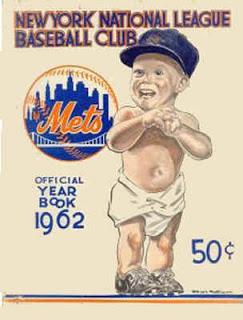
Here's the initial starting lineup:
1 CF Richie Ashburn
18 SS Félix Mantilla
4 2B Charlie Neal
25 LF Frank Thomas
3 RF Gus Bell
14 1B Gil Hodges
17 3B Don Zimmer
5 C Hobie Landrith
38 P Roger Craig
If you know your New York baseball history, you know that Hodges, Zimmer and Craig were all members of the 1955 World Champion Brooklyn Dodgers. All were also members of the Dodgers' 1st title team in Los Angeles, in 1959, as was Neal.
To boost attendance, the Mets played on memories of the Dodgers, the New York Giants who were now in San Francisco, and the New York Yankees by acquiring as many players from those teams as they could, including former Yankee manager Casey Stengel. This strategy did not work.
(It also didn't work when the original 1982-83 New Jersey Devils tried to acquire as many New York Islander Stanley Cup winners as they could. As George Santayana put it, "Those who cannot remember the past are condemned to repeat it.")
Ashburn, the Philadelphia Phillies' former All-Star, began the Mets' history by batting against the Cardinals' Larry Jackson, and flying out to Curt Flood in center field. The Cards scored 2 runs in the bottom of the 1st, including an RBI single by Stan Musial.
The Mets scored their 1st runs in the top of the 3rd. With 1 out, Ashburn singled, Mantilla drew a walk, and Neal singled Ashburn home, and Neal over to 3rd base. Thomas then hit a sacrifice fly, scoring Mantilla. That tied the game at 2-2.
The Cards struck back in the bottom of the inning, taking a 4-2 lead. Hodges hit the Mets' 1st home run in the 4th, and Neal hit one in the 5th, to close to within 5-4. But the Cards made it 6-4 in the bottom of the 5th, and 10-4 in the bottom of the 6th. They tacked on another in the 8th, to make the final score 11-4.
The Mets would get a ticker-tape parade in New York the next day, just for existing. The Yankees were the defending World Champions, and hadn't gotten one the preceding October. So they objected, and Mayor Robert F. Wagner Jr. gave them one on April 9.
The day after the parade -- a Friday the 13th -- the Mets had their home opener, and lost 4-3 to the Pittsburgh Pirates. All that fuss over New York losing National League baseball, and being happy to get it back, and attendance at the 55,987-seat Polo Grounds was 12,447 fans. Just as the last Giant game there, in 1957, only got 11,606; and the last Dodger game in Brooklyn, 5 days earlier, got just 6,702.
The Mets ended up losing their 1st 9 games, at which point they were 9 1/2 games out of 1st place. That was possible because the Dodgers were 10-0. Th Mets finally won for the 1st time on April 21, beating the Pirates 8-4 at Forbes Field.
They finished 40-120, the most losses of any MLB team since 1899. It led Stengel to say, "Come and see my amazing Mets! I been in this game 100 years, but they've shown me ways to lose I never knew existed before."
So the Mets became known as "The Amazin's." Bill Veeck, who had owned the Cleveland Indians, the St. Louis Browns and the Chicago White Sox, and would later own the White Sox again, said that they had accomplished as much ineptitude in one year as the Browns had in 50 years.
Finally, in 1969, "the Amazin' Mets" name stopped being a joke, and became reality.

But, true to his iconoclastic nature, the New York Post's Leonard Shecter, possibly the most hated baseball writer in the City because he told the truth, published a book right after that series, titled Once Upon the Polo Grounds, detailing the Mets' pathetic 1st 2 seasons before moving into Shea Stadium in 1964, just to remind Met fans not to get too cocky. That is a warning they rarely observe, to this day.
UPDATE: The Mets have a team Hall of Fame. For all their fans' mockery over the Yankees' packing of their Monument Park, the New York Mets Hall of Fame considerably more dubious selections, along with the proper ones:
* From their founding era, 1962 to 1968: Team owner Joan Whitney Payson; executives William A. Shea, George Weiss and Johnny Murphy; manager Charles "Casey" Stengel, 1st basemen Gil Hodges and Ed Kranepool; and broadcasters Lindsey Nelson, Bob Murphy and Ralph Kiner. Johnny Murphy and Bob Murphy were not related, but Bob's brother, Jack Murphy, was a sportswriter who advocated for major league sports status for the City of San Diego, and their stadium was named for him from 1981 to 1997.
Hodges and Kiner, however belatedly, were elected to the Hall of Fame as players; while Nelson and Murphy won the Hall's Ford Frick Award for broadcasters. Center fielder Richie Ashburn (1 season, 1962), center fielder Edwin "Duke" Snider (1 season, 1963), catcher Lawrence "Yogi" Berra (4 games in 1965), and pitcher Warren Spahn (20 games in 1965) all played for the Mets in this period, and made the Baseball Hall of Fame, but not on what they did with the Mets.
Stengel's 37 was the 1st uniform number retired by the Mets, at his retirement in 1965.
* From their 1969 World Series "Miracle": Mrs. Payson, Shea, Murphy; Hodges, now the manager; Kranepool, shortstop Derrel "Bud" Harrelson, left fielder Cleon Jones, center fielder Tommie Agee, catcher Jerry Grote; pitchers Tom Seaver, Jerry Koosman and Frank "Tug" McGraw; and broadcasters Nelson, Murphy and Kiner.
Berra is not in the Mets Hall of Fame, but was one of Hodges' coaches. Hodges died just before the start of the 1972 season, and his Number 14 was then retired. Seaver was elected to the Hall of Fame, the 1st player so honored as a Met. His Number 41 has been retired. Nolan Ryan played on the 1969 team, and it turned out to be the only Pennant, let alone World Series win, in his 27-season major league career. But he was elected to the Hall of Fame based on events later in his career.
* From their 1973 National League Pennant: Mrs. Payson, Shea; Kranepool, Harrelson, Jones, Grote, Seaver, Koosman, McGraw; right fielder Daniel "Rusty" Staub, pitcher Jon Matlack; and broadcasters Nelson, Murphy and Kiner.
Berra was now the manager. Hall-of-Famer Willie Mays played on this team, and the Mets have retired his Number 24, but he is not a member of the Mets Hall of Fame. Joe Torre played for the Mets, and then managed them, between their 1973 and 1986 Pennants, and is in the Baseball Hall of Fame, but not the Mets Hall of Fame.
* From their 1986 World Series winners: Shea, Harrelson as a coach, manager Davey Johnson, general manager Frank Cashen; 1st baseman Keith Hernandez, 3rd baseman Howard Johnson, center fielders Lee Mazzilli and William "Mookie" Wilson, right fielder Darryl Strawberry, catcher Gary Carter; pitchers Dwight Gooden and Ron Darling; and broadcasters Bob Murphy and Ralph Kiner.
Carter was elected to the Hall of Fame, but the Mets have not retired his Number 8. They have retired Gooden's 16, Hernandez's 17 and Strawberry's 18.
* Eddie Murray and Jeff Kent played on the Mets between their 1986 and 2000 Pennants, and made the main Baseball Hall of Fame, for what they did elsewhere.
* From their 2000 National League Pennant: Manager Bobby Valentine, coach Mookie Wilson; catcher Mike Piazza, 2nd baseman Edgardo Alfonzo, pitchers Al Leiter and John Franco; and broadcasters Bob Murphy, Ralph Kiner, Tom Seaver, Gary Cohen and Howie Rose. 2nd baseman Roberto Alomar, from the 2002 and '03 Met teams, is in the Baseball Hall of Fame, but not the Mets Hall of Fame.
* From their 2006 NL Eastern Division title: 3rd baseman David Wright, center fielder Carlos Beltrán; and broadcasters Ralph Kiner, Gary Cohen, Howard Rose, Keith Hernandez and Ron Darling. Beltrán has been elected to the Baseball Hall of Fame. So have pitchers Tom Glavine, Pedro Martínez, and Billy Wagner. None of those last 3 have yet been inducted into the Mets Hall of Fame.
* Wright is the only player from the Mets' 2015 National League Pennant who has yet been inducted into the Mets Hall of Fame. Elected along with him have been broadcasters Gary Cohen, Howie Rose, Keith Hernandez and Ron Darling.
*
April 11, 1962 was a Wednesday. Not every team started play that day, but most of these teams did:
* The other National League expansion team, the Houston Colt .45s, the Astros-to-be, beat the Chicago Cubs, 2-0 at Colt Stadium in Houston. The Colts had actually debuted the day before, beating the Cubs 11-2.
* The Boston Red Sox beat the Cleveland Indians, 4-0 at Fenway Park. Carroll Hardy hit a walkoff home run in the 12th inning.
* The Minnesota Twins beat the Kansas City Athletics, 8-0 at Kansas City Municipal Stadium. Camilo Pascual pitched a 4-hit shutout.
* The San Francisco Giants beat the Milwaukee Braves, 3-1 at Candlestick Park.
* And the Los Angeles Dodgers beat the Cincinnati Reds, 6-2 at Dodger Stadium in Los Angeles. Sandy Koufax was the winning pitcher. It was the 2nd game at Chavez Ravine. The Dodgers had played the day before, losing to the Reds 6-3. Wally Post hit the 1st home run, off Johnny Podres.
Also on April 10, the Yankees opened at home, beating the Baltimore Orioles 7-6, with Mickey Mantle, Roger Maris and Moose Skowron homering in support of Ralph Terry.
And District of Columbia Stadium in Washington hosted its 1st baseball game on April 9, after opening in time for the previous year's football season. The Washington Senators beat the Detroit Tigers 4-1. President John F. Kennedy threw out the ceremonial first ball. He was assassinated in 1963. His brother and Attorney General, Robert F. Kennedy, ran for President in 1968, and he was assassinated, too. In 1969, D.C. Stadium was renamed for him.


No comments:
Post a Comment