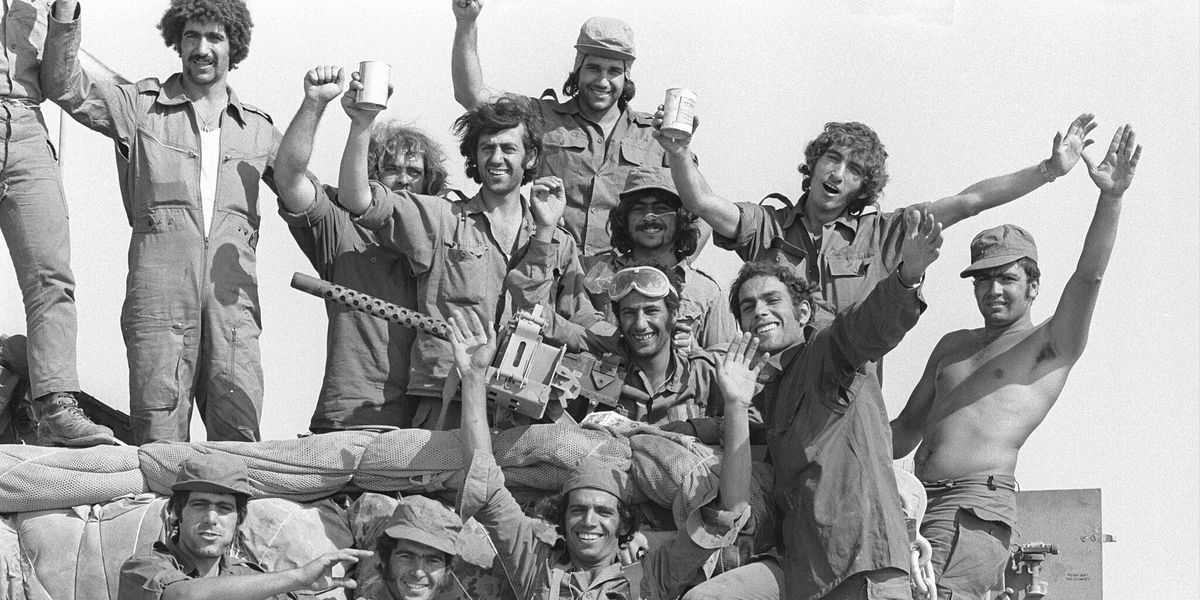
October 6, 1973: The Yom Kippur War begins. Egypt and Syria, 2 of the Arab neighbors that Israel had defeated in the Six-Day War of June 1967, sought revenge. The 3rd of the 1967 opponents, Jordan, sat this one out, not wanting to get clobbered again.
The coalition launched a surprise attack on Israel during Yom Kippur, the holiest day on the Jewish calendar, figuring they could take the Jewish state by surprise. Egyptian and Syrian forces crossed their respective ceasefire lines with Israel, advancing into the Sinai Peninsula and the Golan Heights, respectively.
After 3 days, Israel halted the Egyptian advance and pushed most of the Syrians back to the Purple Line. Israel then launched a counteroffensive into Syria, shelling the outskirts of their capital of Damascus.
Both sides' leading supports kicked in support: The United States for Israel, and the Soviet Union for the Arabs. This heightened tensions between the two superpowers, who had gotten closer following the signing of the SALT I Treaty the year before.
Complicating things further was the political crisis in America: Not only was President Richard Nixon fighting to stay in office as a result of the Watergate scandal, but his Vice President, Spiro Agnew, resigned as part of a plea-bargain on October 10. This meant that, if something happened to Nixon, a Republican, the next man in line was the Speaker of the House of Representatives, Carl Albert, a Democrat. And the event that became known as "The Saturday Night Massacre," further inflaming the public against Nixon, came on October 20, with the war still ongoing.
Egyptian forces attempted to push further into Sinai, but were repulsed, and Israeli forces crossed the Suez Canal, advancing toward Ismailia City on October 18. Israeli forces were then defeated in the Battle of Ismailia, and accepted a United Nations-brokered ceasefire. On October 22, the ceasefire broke down. Israeli forces then advanced on Suez City, but were successfully repulsed in the ensuing battle amid stiff Egyptian resistance.
Nixon sent Henry Kissinger, now both his Secretary of State and his National Security Adviser, back and forth between Prime Minister Golda Meir in Tel Aviv, President Anwar Sadat in Cairo, and President Hafez al-Assad in Damascus, in what became known as "shuttle diplomacy." A second ceasefire was imposed on October 25, officially ending the war.
The Arab world, humiliated by the 1967 defeat, felt psychologically vindicated by its early and late successes in 1973. Meanwhile, Israel, despite battlefield achievements, recognized that future military dominance was uncertain.
Nevertheless, any victory Egypt had was a morale victory (if not a "moral victory") at best, and Sadat, Vice President under Gamal Abdel Nasser in 1967, did not want a 3rd defeat. He began moving Egypt out of the Soviet sphere of influence. When Menachem Begin became Prime Minister of Israel in 1977, Sadat reached out to him. With President Jimmy Carter acting as moderator, Sadat and Begin signed the Camp David Accords in 1978.
In 1994, despite not having fired a shot at Israel since 1967, Jordan signed a peace treaty with Israel. As of October 6, 2022, Israel's peace treaties with Egypt and Jordan remain in effect. Syria, however, would remain an enemy of Israel under Assad, and later his son, Bashar al-Assad. They aided terrorist groups in their attacks on Israel, assisting both Iran and the Palestine Liberation Organization.
*
October 6, 1973 was a Saturday. Rebecca Lobo, one of the greatest players in the history of women's basketball, was born that day. So was Welsh actor Ioan Gruffudd.
Both baseball leagues' League Championship Series began that day. In the American League, the Baltimore Orioles beat the Oakland Athletics, 6-0 at Memorial Stadium in Baltimore. Jim Palmer pitched a 5-hit shutout, beating Vida Blue. However, the A's won the series in 5 games.
In the National League, the Cincinnati Reds beat the New York Mets, 2-1 at Riverfront Stadium in Cincinnati. Pete Rose and Johnny Bench hit home runs, enabling Pedro Borbón to outpitch Tom Seaver. However, the Mets won the series in 5 games.
Among the college football games played that day were these:
* In a regular-season Big Ten/Pac-8 matchup, Number 1 Ohio State beat Washington State, 27-3 at Ohio Stadium in Columbus. Ohio State won the Big Ten Conference title.
* Number 2 Nebraska beat Minnesota, 48-7 at Memorial Stadium in Minneapolis. Nebraska blew the Big 8 title with a loss to Missouri the next week, and another loss to Oklahoma later on. They were still invited to the Cotton Bowl.
* Number 3 Alabama beat Georgia, 28-14 at Denny Stadium (later renamed Bryant-Denny Stadium) in Tuscaloosa, Alabama. 'Bama won the Southeastern Conference Championship, and went undefeated in the regular-season, setting up a de facto National Championship game in the Sugar Bowl.
* Number 4 University of Southern California beat Oregon State, 21-7 at Parker Stadium (now Reser Stadium) in Corvallis, Oregon. USC won the Pacific-8 Conference title, then lost the Rose Bowl to Ohio State.
* In another regular-season Big Ten/Pac-8 matchup, Number 5 Michigan beat Oregon, 24-0 at Michigan Stadium in Ann Arbor. Michigan and Ohio State went into their annual showdown tied for the Big Ten title, and finished in a tie. So it was up to the Conference's university presidents to decide which team went to the Rose Bowl, and by a 6-4 vote, they picked Ohio State. And they had a rule that said the only bowl they could send teams to was the Rose Bowl. That infuriated Michigan fans, and the rule was changed for the 1975 season.
* Number 6 Oklahoma beat Number 17 Miami, 24-20 at Owen Field in Norman, Oklahoma. Oklahoma had tied USC the week before, won the Big 8 Conference title, and finished undefeated at 10-0-1. But they were on probation, and thus ineligible for a bowl game, and only minor polls proclaimed them National Champions. So, like Michigan, Oklahoma were 10-0-1, but not chosen as National Champions. The difference being that Michigan got screwed, while Oklahoma screwed themselves.
* Number 7 Penn State beat Air Force, 19-9 at Falcon Stadium in Colorado Springs, Colorado. With Heisman Trophy-winning running back John Cappelletti, Penn State went undefeated in the regular season.
* Number 8 Notre Dame beat Michigan State, 14-10 at Notre Dame Stadium in South Bend, Indiana. Losses by USC and Nebraska, and the Ohio State-Michigan and USC-Oklahoma ties, opened the door for Notre Dame to rise to Number 2 and face Number 1 Alabama in the Sugar Bowl. Notre Dame won, 24-23.
When the final polls were announced, the Associated Press (AP), the sportswriters, had undefeated-and-untied Notre Dame at Number 1, undefeated-but-tied Ohio State at Number 2, undefeated-but-tied-and-on-probation Oklahoma at Number 3, 1-loss Alabama at Number 4, undefeated-and-untied Penn State at Number 5, and undefeated-but-tied-and-bowlless Michigan at Number 6.
United Press International (UPI), the coaches, selected Alabama at Number 1 in spite of their bowl defeat, Oklahoma at Number 2, Ohio State at Number 3, Notre Dame at Number 4 in spite of their perfect season and their defeat of the outgoing Number 1; Penn State at Number 5 in spite of their perfect season; and Michigan at Number 6 in spite of their undefeated season.
For the 3rd time in 6 seasons, Penn State had finished a season with no losses and no National Championship. Their fans felt it was unfair. They had a case. So did Michigan fans, who were cheated once and it felt like twice. Notre Dame fans felt it was unfair that a team they beat at a not-so-neutral site -- Alabama was used to playing in the Sugar Bowl -- was selected ahead of them by the coaches. And Ohio State fans knew they were undefeated (though not untied), and were the only team to win a major bowl game in a blowout. They may not have deserved the National Championship as much as Notre Dame or Penn State, but they deserved it more than the other 3.
So 4 of the final top 6 had a case to feel at least partially robbed. If any college football season prior to the institution of the Bowl Championship Series
* Number 9 Tennessee beat Kansas, 28-27 at Neyland Stadium in Knoxville, Tennessee.
* Number 10 Louisiana State University beat Florida, 24-3 at Tiger Stadium in Baton Rouge, Louisiana. LSU started out 9-0, rising to Number 7 but lost their last 3: To then-Number 2 Alabama, costing them the SEC title; to arch-rival Tulane; and then the Orange Bowl to Penn State.
* Number 11 Oklahoma State were upset by Texas Tech, 20-7 at Lewis Field (now Boone Pickens Stadium) in Stillwater, Oklahoma.
* Number 13 Texas beat Wake Forest, 41-0 at Memorial Stadium in Austin, Texas. Texas won the Southwest Conference title, but lost the Cotton Bowl to Nebraska.
* Number 15 Missouri beat Number 19 Southern Methodist University (SMU), 17-7 at Texas Stadium in the Dallas suburb of Irving, Texas.
* Number 20 West Virginia were upset by Indiana, 28-14 at the old Mountaineer Field in Morgantown, West Virginia.
* In another regular-season Big Ten/Pac-8 matchup, Stanford beat Illinois, 24-0 at Memorial Stadium in Champaign, Illinois.
* Army lost to Georgia Tech, 14-10 at Grant Field in Atlanta.
* Navy lost to Boston College, 44-7 at Alumni Stadium in the Boston suburb of Chestnut Hill, Massachusetts.
* Among New Jersey's schools, Rutgers lost to the University of Massachusetts, 25-22 at Rutgers Stadium in Piscataway; and Princeton lost to Columbia, 14-13 at Baker Field in Upper Manhattan.
The NBA season opened 3 days later; the ABA and the NHL, 4 days later. The World Hockey Association opened their season on this day, and the New York Golden Blades, formerly the New York Raiders, and soon to move to the Philadelphia suburb of Cherry Hill and become the Jersey Knights, played the Cleveland Crusaders to a tie, 2-2 at the Cleveland Arena.
Due to the large Jewish community in my hometown of East Brunswick, New Jersey, observing Yom Kippur, the football game between East Brunswick High School and Cedar Ridge High School of Madison Township (which was renamed Old Bridge in 1975), scheduled for Saturday afternoon, October 6, was moved to Friday night, October 5.
This was possible because, along with Memorial Stadium in New Brunswick, Vince Lombardi Field at what was then Madison Township High School had lights, and Cedar Ridge groundshared with them, because they didn't have their own stadium.
For the 1st time in 5 games with E.B., Cedar Ridge won, 21-0, and went on to an undefeated season, winning the Middlesex County Athletic Conference and Central Jersey Group IV Championships, their only football titles. Opened in 1968, in 1994 they were consolidated with the school later renamed Madison Central, to form Old Bridge High School.
And in English soccer, the team I would one day support, Arsenal F.C., beat West Midlands team Birmingham City, 1-0 at the Arsenal Stadium, a.k.a. Highbury, in North London.


No comments:
Post a Comment