
Left to right: Joe Tinker, Johnny Evers, Frank Chance
July 12, 1910: A poem by "FPA" appears in the New York Evening Mail, under the title "That Double Play Again." (Its more familiar title would come later.) It accompanies the paper's story about the previous day's baseball game at the West End Grounds in Chicago.
The Chicago Cubs beat the New York Giants, 4-2, snuffing out a late Giant rally with a double play, started by their shortstop, Joe Tinker; who threw to their 2nd baseman, Johnny Evers, for the 1st out; and then Evers threw to their 1st baseman, Frank Chance, also their manager, for the 2nd out.
The poem read as follows:
These are the saddest of possible words:
"Tinker to Evers to Chance."
Trio of bear cubs, and fleeter than birds,
Tinker and Evers and Chance.
Ruthlessly pricking our gonfalon bubble,
Making a Giant hit into a double,
Words that are heavy with nothing but trouble:
"Tinker to Evers to Chance."
"Tinker to Evers to Chance."
Trio of bear cubs, and fleeter than birds,
Tinker and Evers and Chance.
Ruthlessly pricking our gonfalon bubble,
Making a Giant hit into a double,
Words that are heavy with nothing but trouble:
"Tinker to Evers to Chance."
Tinker, Evers, and Chance began playing together with the Cubs at those positions on September 13, 1902, a 12-0 Cubs win over the St. Louis Cardinals. They won the National League Pennant in 1906, 1907, 1908 and 1910, with the 1908 Pennant coming in controversial fashion. (See the Fred Merkle Game and the Merkle Playoff, September 23 and October 8, respectively.) They also won the World Series in 1907 and 1908.
On April 11, 1912, the Cubs opened the season with a 10-6 loss to the Cincinnati Reds, in the 1st game at the Cincinnati ballpark later to be renamed Crosley Field. The next day, they lost to the Reds again, 3-2. That April 12, 1912 game was Chance's last as a player for the Cubs. After the season, he was hired to manage the New York Yankees, with considerably less success.
Tinker also left the Cubs, as he was traded to the Cincinnati Reds. He would return to Chicago with the Federal League's Whales in 1914 and '15, and played 1 more season with the Cubs in 1916. Evers remained with the Cubs through 1913, helped the Boston Braves win the 1914 World Series, was last a regular with the 1917 Philadelphia Phillies, and then had single-game returns with the 1922 Chicago White Sox and the 1929 Braves, making him, at age 48, one of the oldest players ever.
In 1946, Tinker, Evers and Chance were elected to the Baseball Hall of Fame -- together. Chance did not live to see it, dying on September 15, 1924, only 48 years old, from heart disease brought on by a long struggle with bronchial asthma. The other 2 did live to see their election: Evers died on March 28, 1947 at 65; while Tinker died on July 27, 1948, his 68th birthday.
Teammates being elected to the Hall at the same time is unusual, but hardly impossible. Mickey Mantle and Whitey Ford retired 2 years apart, and were elected together. So were Greg Maddux and Tom Glavine, who retired at the same time. But 3 long-term teammates at once?
There have been cases where some teammates are irretrievably linked. Maddux, Glavine and John Smoltz anchored the Atlanta Braves' rotation for several years in the 1990s and 2000s, and Smoltz would also eventually be elected.
But it usually doesn't work that way. The Yankees won 5 straight World Series from 1949 to 1953, based on a pitching triad of Allie Reynolds, Eddie Lopat and Vic Raschi. Individually, none of them is on a Hall of Fame level; collectively, they provided Hall of Fame results. (With Ford added in 1950 and 1953, missing the 2 seasons in between due to military service.) With another double-play combination, the longest-lasting one ever, from 1977 to 1995, Alan Trammell, shortstop for the Detroit Tigers, has been elected, but, as of the election of 2022, his 2nd base partner, Lou Whitaker, has not.
So, were Tinker, Evers and Chance really worthy of election to the Hall? Baseball-Reference.com has what it calls a "Hall of Fame Monitor," based on statistics, and a "Likely HOFer" is at 100. Evers is at 34, Tinker 25, and Chance 22.
B-R also has "Hall of Fame Standards," which is geared more toward career stats, and the "Average HOFer" is at 50. Chance and Evers are at 24 -- making Chance one of the few players whose HOF Standards is higher than his HOF Monitor -- and Tinker is at 20.
And B-R has "Similarity Scores," in which they judge a players stats against all others, weighted toward players who played the same position, and list their 10 most similar, as a way of saying, "He's about the same as these guys, who are (or are not) in the Hall of Fame."
Of Tinker's Top 10, Number 6, Phil Rizzuto, is in. None of the others are, or are likely ever to be. Rizzuto is also Evers' Number 8. His Number 6 is former Reds and St. Louis Cardinals 2nd baseman Miller Huggins, and while he was well-regarded as a player in his time, he is in the Hall because he managed the Yankees to 6 Pennants and 3 World Series wins in the 1920s. He's not in as a player. None of Evers' other Top 10 are.
Likewise, in Chance's Top 10, there's only 1 fellow HOFer, his Number 2, Billy Southworth, and he, like Huggins, is in for his managing.
And then there's "JAWS." In 2004, Jay Jaffe, a member of the Society for American Baseball Research, or "SABR," and thus a "sabermetrician," came up with what he called the "Jaffe WAR Score System," based in part on "WAR": Wins Above Replacement, which purports to show a player's value against one of "replacement level" -- that is, against a guy just good enough to make it at the major league level.
It's subjective, and it's based on guesses, and while it sometimes corresponds to a player's level of greatness, it also frequently misses the mark. Therefore, WAR and its derivatives, such as bWAR, dWAR and JAWS, should be taken with a grain of salt. Or a pinch of salt. Or an entire damn salt mine.
At any rate, JAWS ranks Tinker as the 25th best shortstop, Evers as the 30th best 2nd baseman, and Chance as the 37th best 1st baseman. That's not that surprising: While Chance was the best offensive player of the 3, there have been more good hitters at his position than at the others'.
So, what gives? Were Tinker, Evers and Chance simply not that good? Would any of these 3 guys, if they were only on different teams, and Chance not also a successful manager, be in the Hall?
Born on September 9, 1876 in Fresno, California, Chance was 1 of 14 players from Fresno High School to make the major leagues. And not the only Hall-of-Famer: Tom Seaver was also a graduate. The school tends to produce good pitchers: Dutch Leonard, Monte Pearson, Jim Malone, Dick Selma, and the better of the 2 Bobby Joneses that the New York Mets had on their 2000 Pennant winners. Also, infielder-turned-manager Pat Corrales.
Known for his managing as "The Peerless Leader," Chance did bat .310 or higher 4 times, led the NL in stolen bases in 1903 and '06, led it in on-base percentage in 1905, led it in runs scored in 1906, and had a career OPS+ of 135.
He stole 403 bases for his career, with a peak of 67, although that was hardly unusual in the Dead Ball Era. Speaking of which, all 3 played in that Era, so we shouldn't judge them by home runs, but Chance's RBIs topped out at 81. He was no slouch, but, as a hitter, he was a good one at a position where there have been so many.
In contrast, Evers, born on July 21, 1881, known as "The Trojan" because he was from Troy, New York, across the Hudson River from the State capital of Albany, and "The Crab" for his nasty disposition -- it's said that he and Tinker wouldn't even speak to each other except during games, to discuss strategy -- only batted .300 twice, although he did reach .341 in 1912. His highest RBI year was 61, but he stole 324 bases, topping out at 49.
Tinker, born July 27, 1880, and growing up in Herington, Kansas, was so nondescript on his own that he never ever got a noticeable nickname. He once batted .317, but that was his only time topping .291, his RBIs topped off at 70, and he stole more bases thank Evers, 336, though at 41 his peak was lower than Evers'. Career OPS+: Evers 106, a little more than average (100); Tinker, 96, less than average.
All right, then, what about their fabled defense, capable of "ruthlessly pricking our gonfalon bubble"? Fielding stats, especially in their era, when the gloves were smaller and much less reliable than they are now, and the fields were not nearly as well-cared-for, are pretty much useless.
So let's go with the thing they're most famous for: Double plays. From 1906 to 1910, the years when they won 4 Pennants in 5 years, the Cubs turned 491 double plays, the 3rd-most in the NL during that time. According to Bill James, the established king of baseball statistical analysis, and his formula, "expected double plays," the Cubs led the NL with 50 more double plays than expected during those seasons.
But, from 1906 through 1910, the specific sequence of a Tinker to Evers to Chance" double play happened 54 times in 770 games, and the trio did not collaborate on a double play during any of their 21 World Series games.
Given the triad's fame, one of baseball's most-asked trivia questions is: "Who was the 3rd baseman for the Cubs when they had Tinker-to-Evers-to-Chance?" Harry Steinfeldt, a St. Louis native and a decent player, who had to leave the game in 1911, due to an illness that would kill him in 1914, only 38 years old.
It is safe to say that Chance deserved to be elected to the Baseball Hall of Fame as a manager; but also that Tinker and Evers would not have been, if not for that poem. And that says more about its author than it does about its subjects.
"FPA" was Franklin Pierce Adams. He wrote a weekly column for the New York Evening Mail titled called "Always in Good Humor." The Mail was absorbed by the New York Evening Telegram in 1924, and that paper would eventually become the World-Telegram and Sun, going out of business in 1966.
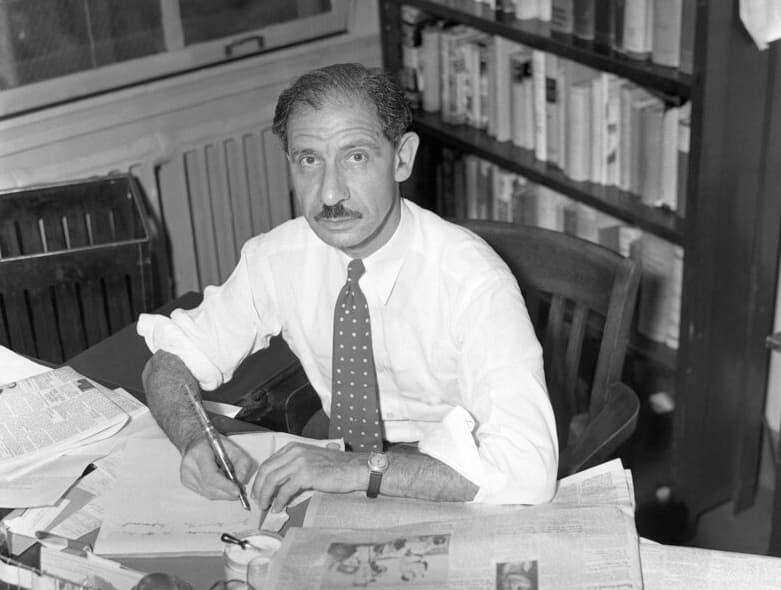
The story goes that Adams hoped to leave work to attend a Giants game, but his editor found that Adams had not produced enough content for his column. While reflecting on Tinker, Evers, and Chance as the Giants played the Cubs, Adams wrote the poem. But this story doesn't hold up: The previous day's game was in Chicago, both teams had the next day off, and the Giants' next series was in Pittsburgh.
At any rate, the Mail published the poem under the title "That Double Play Again" on July 12, 1910. Adams considered the lines to be forgettable as he wrote them, and an editor at the paper told him that he did not consider the work to be "much good." But it got picked up by the Chicago Daily Tribune, which reprinted it under the title "Gotham's Woe" on July 15. On July 18, the Mail published it again, under the title by which it is best known today: "Baseball's Sad Lexicon."
In 1911, the Giants replaced the Cubs as the NL's dominant team, just as the Cubs had replaced them as such: John McGraw's men won the next 3 NL Pennants, and the Cubs would have a very different roster the next time they won the Pennant, in 1918.
Franklin Leopold Adams was born on November 15, 1881 -- not in New York, but in Chicago. It turned out, he wasn't a Giant fan bemoaning his team's fate at all: He was a Cub fan, mocking the Giants. At age 13, following his bar mitzvah, he legally changed his name to Franklin Pierce Adams, meaning he could say he had the names of 3 Presidents (counting the 2 Adamses).
He began working for the Chicago Daily Journal in 1903, with a sports column, and then a humor column, "A Little about Everything." The next year, the New York Evening Mail hired him. In 1914, he was hired by the New-York Tribune, where he renamed his column "The Conning Tower."
For this column, he accepted submissions from other writers, giving them a leg up in their careers, including Robert Benchley, Edna Ferber, Moss Hart, George S. Kaufman, Edna St. Vincent Millay, John O'Hara, and, most notably, Dorothy Parker and James Thurber. Parker admitted of Adams, "He raised me from a couplet." Parker dedicated her 1936 publication of collected poems, Not So Deep as a Well, to F.P.A. Many of the poems in that collection were originally published in "The Conning Tower."
Adams, Parker, Benchley and Kaufman were among the "charter members" of what became known as the Algonquin Round Table. So was sportswriter Heywood Broun. Kaufman's wife Beatrice and Ferber were also said to be members at times, as were comedian Harpo Marx (but not any of his brothers), playwright Noël Coward, and actress Tallulah Bankhead.
From 1938 to 1948, Adams was a panelist on the radio show Information Please. He was their "designated expert" on the subjects of poetry, old barroom songs, and the operas of William S. Gilbert and Arthur Sullivan, although he always reversed their usual order, calling them "Sullivan and Gilbert." Johnny Evers, despite his reputation as a "crab," made an appearance in 1938, and thanked Adams for his poem, as it insured he was remembered.
That appearance led to Evers and Tinker being brought together for the radio broadcast of that year's World Series, which the Cubs lost to the Yankees. This has been credited with ending their feud. But, like so many things about the Tinker-Evers-Chance triad, it's not true: They had patched things up by 1929, when they got together to perform a theatrical skit on baseball in different cities across the country.
Adams died on March 23, 1960, at 78.
Speaking of poetry: In
1949, Ogden Nash, my grandmother's favorite poet, wrote "Line-Up for
Yesterday" for Sport magazine, an alphabetical list of
star players. For the letter E, he wrote:
E is
for Evers,
His jaw in advance;
Never afraid
To Tinker with Chance.
But for C, he honored Ty Cobb, not Chance; and, for T, being a Giants fan, he honored Bill Terry, not Tinker.
One more note: On October 22, 1910, the football team at Vanderbilt University went to New Haven, Connecticut to play Yale. This was the Elis' 1st game against a Southern team. The game ended 0-0. It was the closest any Southern team had yet come to beating a Northern team in the North. And Vanderbilt graduate Grantland Rice, 3 months after first reading FPA's poem, wrote:
These are the gladdest of possible words,
"Yale Was Unable to Score,"
Sweeter than song from the clear singing birds,
"Yale Was Unable to Score,"
Words that are sweeter than nectar and honey,
Sweeter by far than the jungle of money,
Words that are roseate, golden and sunny,
"Yale Was Unable to Score,"
Find in the classics another such phrase,
"Commodores Draw with the Blue,"
Phrase that is all to the ripple and razzle,
Canonized cluster of words on the dazzle,
Words that have Emerson smashed to a frazzle,
"Commodores Draw with the Blue,"
"Yale Was Unable to Score,"
Sweeter than song from the clear singing birds,
"Yale Was Unable to Score,"
Words that are sweeter than nectar and honey,
Sweeter by far than the jungle of money,
Words that are roseate, golden and sunny,
"Yale Was Unable to Score,"
Find in the classics another such phrase,
"Commodores Draw with the Blue,"
Phrase that is all to the ripple and razzle,
Canonized cluster of words on the dazzle,
Words that have Emerson smashed to a frazzle,
"Commodores Draw with the Blue,"
Rice was a little off: Ralph Waldo Emerson graduated from Harvard, not Yale.
*
July 12, 1910 was a Tuesday. As I said, neither the Cubs nor the Giants played that day. These baseball teams did:
* The New York Highlanders beat the Chicago White Sox, 4-3 at Hilltop Park in Upper Manhattan. Harry Wolter went 4-for-4 with 2 RBIs for the not-yet-Pinstriped not-yet-Yankees. Jack Warhop was the winning pitcher, but would become best known for giving up Babe Ruth's 1st career home run in 1915. Ed Walsh, the ChiSox' Hall of Fame pitcher, appeared as a pinch-hitter, but did not reach base.
* The Brooklyn Superbas, who became the Dodgers the next season, lost to the Cincinnati Reds, 1-0 in 13 innings at The Palace of the Fans in Cincinnati. Harry Gaspar allowed only 5 hits over 11 innings, and Fred Beebe pitched the last 2, allowing 1 hit, getting the win. He had been only 1-10 on the season to that point, but rebounded to finish 12-14.
Ward Miller pinch-hit for Beebe in the bottom of the 13th, and singled home George "Dode" Paskert with the winning run. A good hitter and a very good center fielder, Paskert was also nicknamed "Honey Boy," which was a popular nickname for boxers.)
After the 1911 season, the elaborate Palace of the Fans was demolished, and the much simpler Redland Field was built on the site. An even dumber name, and it didn't last: It was renamed Crosley Field in 1934.
* The Boston Red Sox beat the Cleveland Naps, 17-5 at the Huntington Avenue Grounds in Boston. The visiting team was named for their 2nd baseman and manager, Napoleon "Nap" Lajoie. After he left in 1914, they were renamed the Cleveland Indians, and they became the Cleveland Guardians in 2022. Lajoie went 1-for-5 in this game. Shoeless Joe Jackson was on the Naps' roster, but did not play.
The Red Sox did not score in the 1st inning, but scored 5 runs in the 2nd, 2 in the 3rd, 3 in the 4th, and 4 in the 5th. 05234. That ZIP Code is not in use, but if it were, it would be in the Red Sox' home region of New England, in central Vermont.
* The Philadelphia Athletics beat the Detroit Tigers, 6-4 at Shibe Park in Philadelphia. Oddly, Ty Cobb did not start the game, but came in to play center field after George Washington "Hack" Simmons was injured, and went 1-for-3.
* The St. Louis Browns and the Washington Senators were tied, 4-4 after 8 innings at American League Park in Washington, when the game was called due to rain. Browns pitcher Bill Crouch managed to match the Senators' already-great Walter Johnson.
* And the Boston Doves beat the St. Louis Cardinals, 7-5 in 14 innings at Robison Field in St. Louis. Named for their owners, the brothers George and John Dovey, the Doves were bought by William H. Russell in 1911, and he renamed them for himself: The Boston Rustlers. He died after 1 season, and they were bought by James Gaffney, an official in the New York political organization of Tammany Hall, a "Brave." He renamed them the Boston Braves.


No comments:
Post a Comment