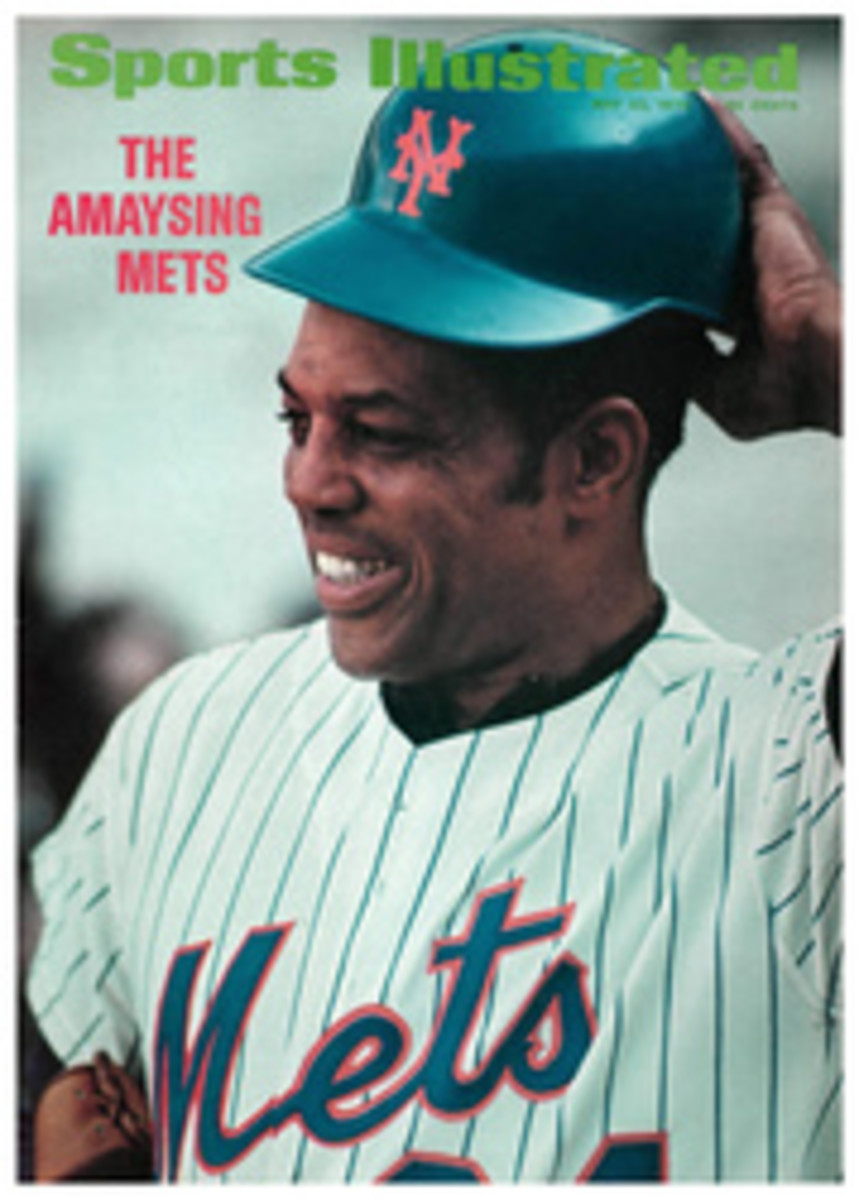
May 14, 1972: Willie Mays returns
to New York, after the San Francisco Giants had traded him to the Mets for
Charlie Williams. He hits a home run, the 647th of his career, and it
provides the winning run, as the Mets beat the Giants, 5-4 at Shea Stadium. Rusty
Staub also hits a home run, in support of Ray Sadecki.
Mays had played the 1951, '54, '55, '56 and '57 seasons in New York, with the Giants, plus a fraction of '52 before he was drafted into the U.S. Army for the Korean War. It was a time when New York City had 3 great center fielders, and locals argued over which was best: Mays, Edwin "Duke" Snider of the Brooklyn Dodgers, or Mickey Mantle of the New York Yankees.
Statistically speaking, Mays had the edge in 1951 (with Mantle having a rough rookie season) and 1954; Snider in 1952 (with Mays unavailable) and 1955; and Mantle the edge in 1953 (with Mays unavailable), 1956 and 1957.
Mays won Pennants in '51 and '54 (and in '62 in San Francisco); Snider, in '47, '49, '52, '53, '55 and '56 (and in '59 in Los Angeles); Mantle, in '51, '52, '53, '55, '56 and '57 (and, after the other 2 left, in '58, '60, '61, '62, '63 and '64). Mantle opposed Mays in the World Series in '51 (briefly, before Mantle wrecked his knee chasing a fly ball Mays hit, and again in '62); and opposed Snider in '52, '53, '55 and '56. At least 1 New York team was in every World Series from 1949 to 1958; at least 1 New York team came close to a Pennant ever year from 1946 to 1964, except 1959.
After the 1957 season, the Giants moved to San Francisco, and the Dodgers moved to Los Angeles. San Francisco fans loved the players who came up to the Giants in San Francisco, like Willie McCovey, Orlando Cepeda, and Juan Marichal. But, being from a rather provincial city, they didn't really trust outsiders like Mays. A few years later, after the Soviet dictator Nikita Khrushchev visited America, New York Journal-American writer Frank Conniff wrote of San Francisco, "What a town. They boo Willie Mays and cheer Khrushchev."
Eventually, over the course of his 14 full seasons in the City By the Bay, Mays won them over. But by 1972, he was 41, and winding down. The Giants traded him to the Mets, even-up, for Charlie Williams, a pitcher who lasted in the major leagues from 1971 to 1978, and had a career record of 23-22. It's not fair to say that he was a bad pitcher, but it is fair to say that being traded for Mays was the only interesting thing about his career.
The year 1972 was the dawn of the 1950s and early 1960s nostalgia wave, as Baby Boomers were now growing up, and realizing, as the man now managing the Mets, former Yankee catcher Yogi Berra, once said, "The future ain't what it used to be." Not liking the new, heavier rock music, they wanted the doo-wop and rockabilly of the late '50s and early '60s. It was the year of the musical Grease. The next year would see the film American Graffiti; the next, the TV show Happy Days.
They went to Madison Square Garden to see Elvis Presley, and, in separate concerts, former Beatle John Lennon and former Beatles George Harrison and Ringo Starr. Not wanting Richard Nixon, Vietnam and Watergate, they wanted the solemn certainty of Dwight D. Eisenhower or the peppy hopefulness of John F. Kennedy. And not wanting the fallen Yankees and post-"Miracle" Mets of 1972, they wanted to think back to Mantle and Mays. But Mantle was retired; yet here was Mays, "The Say Hey Kid," still playing.
Before this game, against the Giants, Mays was presented on the field with a mockup of a San Francisco cable car. He hadn't played a home game in New York in nearly 15 years, but he was still beloved there, as the young man who had led the Giants to stun the world by winning the 1954 World Series, thanks to his National League batting title, his daring on the bases, and his defense, including a sensational catch that saved Game 1 of the Series.
In this game, Mays led off, played 1st base, and, of course, wore Number 24. Except for a few games at the start of his career, when he wore 14, he had always worn 24. There didn't seem to be any significance to it: It was just the number he was assigned at the time.
But on October 11, 1966, Peanuts cartoonist Charles Schulz, a native of St. Paul, Minnesota who had seen Mays play for the Giants' former farm team, the Minneapolis Millers, and then had moved to Northern California and become a Giants fan, showed Charlie Brown remembering his locker combination of 3-24-7 by telling his best friend, Linus Van Pelt, "Babe Ruth was Number 3, Willie Mays is Number 24, and Mickey Mantle is Number 7!"

A year earlier, on August 2, 1965, Mays had hit his 478th career home run. Mantle then had 477. Up to that point, they had seemed like co-favorites to be the player to go on to break Babe Ruth's career home run record of 714. By May 14, 1972, that was no longer the case: Mantle retired in Spring Training 1969, with 536; and Mays had slown down.
As with Mantle's 500th career
home run, 5 years to the day before, Mays should have retired right there. As
with Mantle, the next year and a half in uniform did him no good. One man who certainly thought so was Berra, who was not consulted about bringing Mays in.
Despite his close friendship with his former Yankee teammate Joe DiMaggio, who seemed to insist upon exemption from the rules set forth for players who were mere mortals, Berra was unhappy about Mays doing whatever he wanted, including leaving games early, or not showing up at all. Yogi would put up with a lot, but not the kind of disrespect that Mays was showing. It didn't matter to Yogi that Willie was showing Yogi Berra up; it mattered a lot to him that Willie was showing his manager up.
On June 10, 1972, Hank Aaron hit his 649th home run, passing Mays 2nd place on the all-time home run list. Mays wrapped it up after the 1973 season with 660, seeing Aaron break the record at the start of the next season.
On September 25, 1973, Willie Mays Night was held at Shea Stadium, and he told the crowd, "I look at the kids over here, the way they're playing, the way they're fighting for themselves, and it tells me one thing: 'Willie, say good by to America.'" The Mets won the Pennant, but the entire country saw his last games in the World Series, and he looked terrible.
He was elected to the Hall of Fame in his 1st year of eligibility, 1979, and the Giants retired his Number 24. They gave him a statue outside their new ballpark, now named Oracle Park, whose mailing address is 24 Willie Mays Plaza.
Original Mets owner Joan Payson, who had previously been the only stockholder of the Giants to vote against moving to San Francisco, said that no Met would ever wear Number 24 again. She died during the 1975 postseason, and, since then, 3 Mets have worn 24: Kelvin Torve for 7 games in 1990 before fans protested, Rickey Henderson (at least, another Hall-of-Famer) for 152 games in 1999 and 2000, and Robinson Canó for 168 games from 2019 to 2022. (Before Mays, the best Met to wear 24 was Art Shamsky on the 1969 "Miracle" team.)
Mays has not been back to Met games very often. His appearances include their 1977 Old-Timers' Day, where he appeared in a Met uniform, along with Mantle, Snider and Joe DiMaggio in their respective uniforms; the 2008 closing of Shea Stadium; and the 2013 All-Star Game at Citi Field. He is still alive at age 91, and the Mets may wait until he dies to officially retire his Number 24.
UPDATE: The Mets retired Mays' Number 24 on August 27, 2022, as part of their 60th Anniversary celebrations. He was too frail to attend, but some of his former Met teammates were on hand.
*
May 14, 1972 was a Sunday. These other games were played in Major League Baseball that day:
* The New York Yankees lost to the California Angels, 6-2 at Anaheim Stadium (now Angel Stadium of Anaheim). Leroy Stanton -- the other guy the Mets traded to the Angels along with Nolan Ryan to get Jim Fregosi the preceding December -- hit 2 home runs, and former Yankee Andy Kosco hit 1. Fritz Peterson had nothing, and did not get out of the 5th inning.
* The Montreal Expos beat the San Diego Padres, 9-3 at Jarry Park in Montreal.
* The Atlanta Braves beat the Chicago Cubs, 2-1 at Atlanta Stadium (later Atlanta-Fulton County Stadium). Hank Aaron went 1-for-3, and Darrell Evans hit a home run, and Phil Niekro outpitched Milt Pappas.
* The Houston Astros beat the Pittsburgh Pirates, 7-6 at the Astrodome in Houston. Willie Stargell went 3-for-5 with a home run and 3 RBIs, and Roberto Clemente had a pinch-hit single, but it wasn't enough, as César Cedeño and Bob Watson homered for the Astros.
* The Cleveland Indians beat the Texas Rangers, 4-3 at Cleveland Municipal Stadium. The previous season's American League Rookie of the Year hit a home run in the bottom of the 10th to win it for the Tribe. It was the 1st time he had hit what would now be called a "walkoff" home run in the major leagues. It would not be the last. His name was Chris Chambliss.
* The Cincinnati Reds swept a doubleheader from the St. Louis Cardinals at Riverfront Stadium in Cincinnati, 4-3 and 2-0. Over the 2 games, Pete Rose went 3-for-8, Johnny Bench went 1-for-7, Joe Morgan went 2-for-6, Lou Brock went 1-for-8 with a home run and 2 RBIs, and Joe Torre went 4-for-8. Tony Pérez, on his 30th birthday, hit a home run in each game.
* The Chicago White Sox beat the Baltimore Orioles, 4-1 at Comiskey Park in Chicago. Brooks Robinson went 1-for-4.
* The Minnesota Twins beat the Milwaukee Brewers, 4-2 at Metropolitan Stadium in the Minneapolis suburb of Bloomington, Minnesota. Jim Kaat not only went the distance for the win, but hit a home run. Rod Carew went 1-for-4 with 2 RBIs. Harmon Killebrew went 0-for-3, with a walk.
* A doubleheader was split at Kansas City Municipal Stadium. The Detroit Tigers won the 1st game, 3-2. The Kansas City Royals won the 2nd game, 8-4. Al Kaline didn't play in the opener. In the nightcap, he went 0-for-3, but had an RBI on a sacrifice fly.
* And the Oakland Athletics beat the Boston Red Sox, 6-5 at the Oakland Coliseum. The A's got home runs from Mike Epstein and Reggie Jackson. Carl Yastrzemski did not play for the Red Sox.
Football was out of season. The hockey season had ended 3 days before, when the Boston Bruins won the Stanley Cup in Game 6, over the New York Rangers at Madison Square Garden. The basketball season had ended 4 days before that, when the Los Angeles Lakers won the NBA Championship in Game 5, over the New York Knicks at The Forum outside Los Angeles in Inglewood, California. The ABA Finals were between Games 3 and 4, and the Indiana Pacers beat the New York Nets in 5 games.
The old Madison Square Garden had never hosted the NBA Finals and the Stanley Cup Finals in the same season. This was the 1st time the "New Garden" had done it, and it would do so again in 1994.


No comments:
Post a Comment