
Babe Ruth batting at Yankee Stadium,
sometime between 1929 and 1934.
The right field stands were extended
around the foul pole in 1937.
April 18, 1929: The New York Yankees beat the Boston Red Sox, 7-3 at the original Yankee Stadium. It had been 6 years to the day since they opened the Stadium, also by beating the Sox. Current Yankee pitcher George Pipgras outpitched future Yankee ace Red Ruffing. Thrilling most, but surprising few, both Babe Ruth and Lou Gehrig hit home runs.
Today is another innovation: The Yankees take the field wearing numbers on the backs of their uniforms.
In 1894, a man whose name has been lost to time suggested to James Hart, president of the Chicago Colts, that his players should wear uniform numbers. At the time, players were listed on scorecards at a particular position. But it was very common then for a play more than one position, and if he did, or even if he didn't play at all, and a substitute played his position, it confused the fans, especially those who didn't come often enough to know the players by face. But the Colts didn't go for the suggestion.
In 1903, the team had taken on its permanent name, the Chicago Cubs. In 1906, they assigned each player a number that would appear on the scoreboard, which could then be put on the scoreboard, and inform fans of who is playing, including in-game substitutions. But they didn't put those numbers on the players' uniforms. The idea was to encourage the sale of scorecards, and it worked well enough that every other team adopted it over the next few years.
The 1st time that a major league team wore numbers was on June 26, 1916. Inspired by the recent adoption of numbers in football and hockey, the Cleveland Indians added large numbers to their left sleeves for a game at League Park. This experiment was tried for a few weeks, then again the next season, before being abandoned. In 1923, the St. Louis Cardinals adopted uniform numbers on their sleeves, but this didn't last long, either.
In 1929, both the Indians and the Yankees were planning to start the season with uniform numbers on the back of the jersey. Both teams were scheduled to begin their seasons on April 16. However, a rainout forced the Yankees to postpone their season opener. The Indians played their game as scheduled, in the process becoming the first major league team to wear uniform numbers on the back of the jersey.
The Yankees had a system, though this didn't last: The players wore numbers that reflected their usual position in the batting order:
* 1 Earle Combs, center field
* 2 Mark Koenig, shortstop
* 3 Babe Ruth, right field
* 4 Lou Gehrig, 1st base
* 5 Bob Meusel, left field
* 6 Tony Lazzeri, 2nd base
* 7 Leo Durocher, 3rd base
At the time, in spite of all their talent, the Yankees did not have a regular catcher. So the catcher usually batted 8th, and the 3 catchers they used that season had the next 3 numbers: 8, Johnny Grabowski; 9, Benny Bengough; 10, Bill Dickey.
After that, the pitchers got the next few numbers; after them, reserve hitters; in each case, according to seniority. Therefore, these pitchers wore these numbers: 11, Herb Pennock; 12, Waite Hoyt; 13, not used, given its traditional status as an "unlucky number"; 14, George Pipgras; 15, Hank Johnson; 16, Tom Zachary; 17, Fred Heimach; 18, Wilcy Moore; 19, Ed Wells; 20, Myles Thomas; 21, Gordon Rhodes.
And these other players wore these numbers: 21, George Burns, not to be confused with the legendary comedian; 22, Gene Robertson; 23, not assigned; 24, Lyn Lary; 25, Ben Paschal; 26, Cedric Durst; 27, Sammy Byrd, who would fill in for Ruth for defensive purposes as Ruth's weight problems returned, to the point where Byrd was nicknamed "Babe Ruth's Legs"; 28, Elias "Liz" Funk.
Manager Miller Huggins never wore a number. Nor did coach Harry Mathews. Former pitcher turned pitching coach Bob Shawkey was given 29. Three players acquired later in the season got higher numbers: 30, Francis "Bots" Nekola, a pitcher who later became a scout for the Red Sox, and signed Carl Yastrzemski; 31, Roy Shend; and 32, Art Jorgens. Coaches Charley O'Leary wore 33 and Art Fletcher wore 34.
By 1931, all teams had numbers on the back, with the Philadelphia Athletics being the last to adopt them. That year, Joe McCarthy became the Yankees' manager. He managed in the major leagues as late as the 1950 season, but never wore a number. Hence, the Yankees have not retired one for him, although they did give him a Plaque in their Monument Park, in addition to the Monument for Huggins, who died in office near the end of the 1929 season.
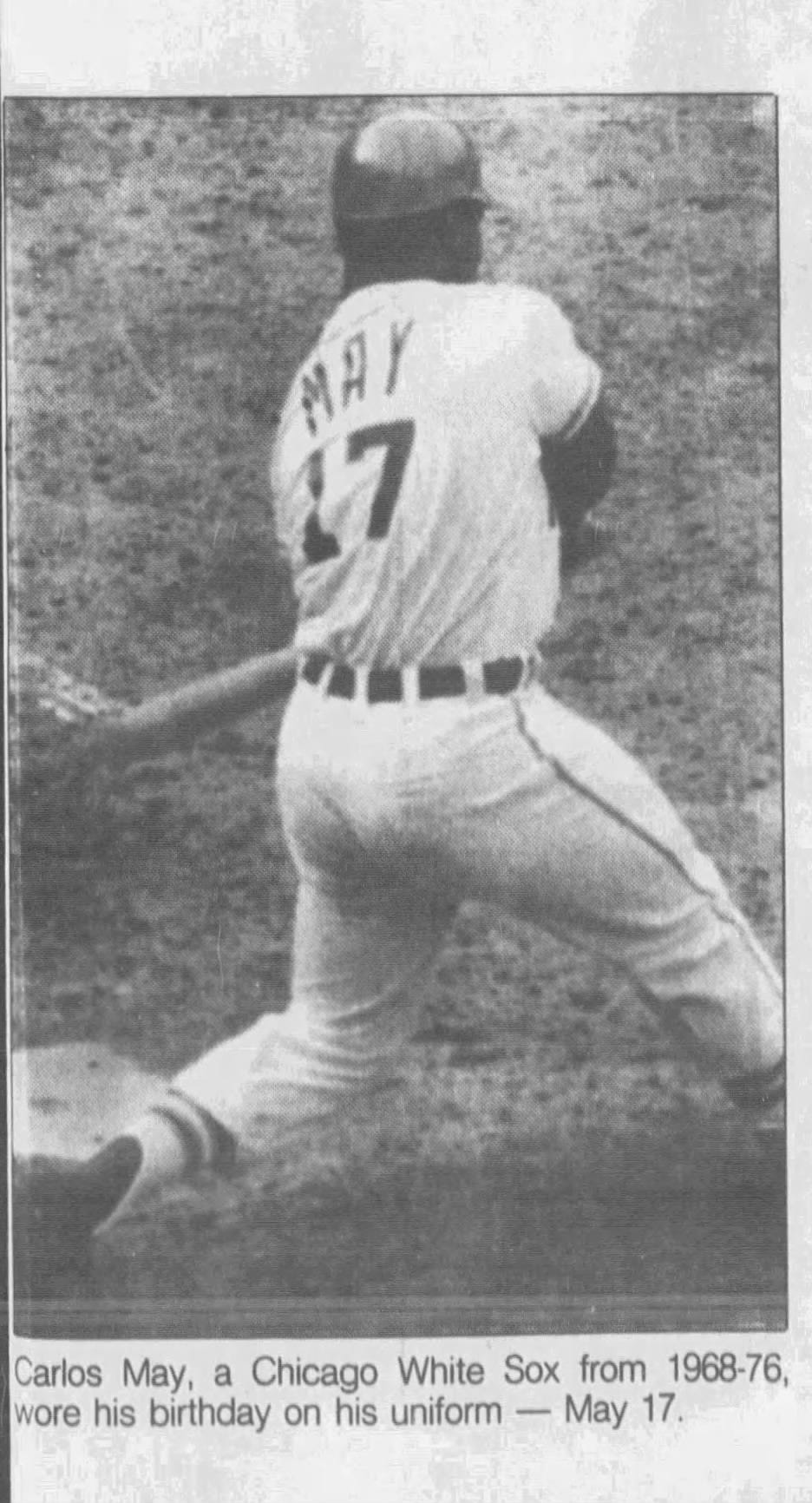
In 1952, the Brooklyn Dodgers made a concession to television, and added bright red numbers to the front of their jerseys, under the blue script "Dodgers." In 1960, the Chicago White Sox not only became the 1st team to wear numbers on their sleeves, to help for easier identification on TV, but also the 1st team to have names on the back. This resulted in Carlos May, an outfielder who played for them from 1968 to 1976, becoming, through the 2021 season, the only player ever to wear his birthday on his back: "MAY 17."
Football long preceded baseball in using uniform numbers. The Detroit Heralds are the first professional team known to have done so, in 1905. The NFL "suggested" numbers at its founding in 1920, and by 1930, all teams were using them. In 1952, the policy of assigning numbers by position, to make it easier for referees to call penalties, went into place.
The teams that had been in the AFL adopted this in 1970, though the players who had previously worn numbers in defiance of this were allowed to keep them. With names on the back, it was the other way around: The AFL did it at its founding in 1960, to aid TV, while the NFL adopted it with the merger.
The NBA had numbers from its founding in 1946, but, unlike the college game, did not prohibit digits higher than 5 to make it easier for referees to use hand signals for fouls. They began using names on the back in 1968.
The National Hockey Association, the predecessor of the NHL, put numbers on the back in 1911. The NHL added names in 1977.
Most teams adopted a policy of having good hitters be given low numbers, pitchers be given high numbers, and the manager and his coaches having numbers close to one another. This made it weird on some teams, where the manager's number would be a single digit, and so would that of his pitching coach, nearly always a former pitcher (but sometimes a former catcher).
With the retirement of Derek Jeter in 2014, it was believed that the Yankees would never have another player wear a single digit. But in 2019 and 2020, pitcher Adam Ottavino was acquired, and he insisted on continuing to do what a few other players whose first or last name began with O had done: Wearing the number zero. (UPDATE: In 2023, Domingo Germán, who had previously worn 55, wore 0, including in the perfect game he pitched that season. Marcus Stroman wore 0 in 2024 and 2025.)
The fact that the Yankees have retired so many numbers, starting with Gehrig's 4 in 1939, has meant that team numbers have gotten higher and higher, to where several players have had numbers in the 80s and the 90s, and their current biggest star, Aaron Judge, wears Number 99.
*
April 18, 1929 was a Thursday. These other baseball games were played that day:
* The New York Giants beat the Philadelphia Athletics, 11-9 at Baker Bowl in Philadelphia. This one was wild. It was tied 4-4 after 7. The Giants scored a run in the 8th, and 6 in the top of the 9th. But the Phils scored 5 in the bottom of the 9th, and almost came back. Almost. Carl Hubbell went 7 innings for the win. Bill Terry went 2-for-4 with a walk. Mel Ott went 1-for-5 with an RBI. Lefty O'Doul hit 2 home runs for the Phils.
* The Brooklyn Dodgers lost to the Boston Braves, 13-12 at Braves Field in Boston. The Robins, as the Dodgers were officially known while Wilbert Robinson was their manager from 1914 to 1931, may have been in an even wilder game than their crosstown arch-rivals. Boston led 11-4 after 5 innings. Brooklyn closed to within 11-10 in the top of the 8th, the Braves scored 2 in the bottom of the 8th, and the Robins scored 2 in the top of the 9th, but it wasn't quite enough.
Babe Herman went 4-for-6 with a home run and 3 RBIs. George Sisler, playing out the string with the Braves, went 3-for-5 with 2 RBIs.
* The Philadelphia Athletics beat the Washington Senators, 8-2 at Griffith Stadium in Washington. Although they had future Hall-of-Famers Jimmie Foxx, Mickey Cochrane and Al Simmons (although Simmons didn't play in this game), it was Edmund "Bing" Miller who was the offensive star, going 3-for-5 with an RBI.
* The Cleveland Indians beat the Detroit Tigers, 8-4 at League Park in Cleveland.
* The St. Louis Cardinals beat the Cincinnati Reds, 3-1 at Redland Field (later renamed Crosley Field) in Cincinnati.
* The Chicago Cubs beat the Pittsburgh Pirates, 11-1 at Wrigley Field in Chicago. Hack Wilson and Charlie Grimm each had 4 RBIs for the Cubs.
* And the St. Louis Browns beat the Chicago White Sox, 4-1 at Sportsman's Park in St. Louis.


No comments:
Post a Comment