
April 17, 1960: Rock and roll star Eddie Cochran dies, a day after a car crash in the West Country of England. He was only 21 years old.
The crash also injured his girlfriend, Sharon Sheeley, and another early rock star, Gene Vincent. The history of rock and roll was changed, in ways that we can never really know.
Ray Edward Cochran was born on October 3, 1938 in Albert Lea, Minnesota. His parents were from Oklahoma, and he had something of a Southern twang when he sang. He spent his teenage years in the Los Angeles suburb of Bell Gardens, California.
His 1st single was released in 1956, when he was just 17: "Skinny Jim" was a regional hit in Southern California. This, and his proximity to the Hollywood film studios, got him a chance to be in one of the earliest rock-and-roll-themed movies, The Girl Can't Help It. In it, he sang "Twenty Flight Rock," about a man with a girlfriend who lives on the 20th floor of an apartment building, and the elevator's broken down: "Get to the top, I'm too tired to rock."
"Twenty Flight Rock" was written by a woman named Nelda Fairchild, who, in order to make it as a woman in a man's profession, published it under the name Ned Fairchild. It wasn't much of a hit in America, but it was in Britain. Later in 1957, in Liverpool, a 15-year-old kid played it for the 16-year-old leader of the Quarry Men. "I think what impressed him most was that I knew all the words," that 15-year-old said, decades later. His name was Paul McCartney. The Quarry Men's leader was John Lennon.
Cochran's biggest hit came in 1958, "Summertime Blues." It turned the usual "School's out, let's have some fun" idea for a Summer song on its head, talking about how he had to work to earn money to have fun, and now he didn't have time to spend the money he was making. "Summertime Blues" would later be a hit for hard rock bands Blue Cheer and The Who. And every "garage rock," "party rock," or "frat rock" song of the 1960s can be traced back to it. In the 1987 film La Bamba, Brian Setzer, lead singer of The Stray Cats, played Cochran and sang a version that was far beyond anything Cochran had done.
Cochran also had a hit with "Somethin' Else," and recorded a song titled "My Way," which has no connection besides title to the Paul Anka song that was recorded by Frank Sinatra and Elvis Presley. But in 1959, he was shaken by the deaths of his friends Buddy Holly, Ritchie Valens and J.P. "the Big Bopper" Richardson in a plane crash. He didn't want to tour anymore. But he needed the money, and accepted an offer to tour Britain in the Winter and Spring of 1960.
He brought his fiancée with him. Sharon Kathleen Sheeley was born on April 4, 1940 in the Los Angeles suburb of Newport Beach, California. In 1958, only 18 years old, she had a Number 1 hit when Ricky Nelson recorded her song "Poor Little Fool." Another song she wrote was "Somethin' Else," which, as I've said, was recorded by Cochran. She joined him on the British tour.

So did Gene Vincent. Vincent Eugene Craddock was born on February 11, 1935 in Norfolk, Virginia. He served in the U.S. Navy at the end of the Korean War, but saw no combat. He had just begun his music career with his band, Gene Vincent and His Blue Caps (named for sailors, as they had all been), when he crashed his motorcycle. There is dispute as to whether Vincent or the guy driving the car that hit him was drunk.
What's not in dispute is that his left leg was shattered, and required several surgeries to save it. He wore a steel sheath around it for the rest of his life. In 1956, he had a big hit with "Be-Bop-a-Lula" (for a girl named Lula), and it made him a legend of early rock. He recorded it for Capitol Records, who wanted him to be their answer to RCA Victor's Elvis Presley.

But it didn't work out, as the pain in his leg led to self-medication, mostly with booze, but he also turned to pills well before Elvis did. Like Cochran, he only had a few other hits.
But, also like Cochran, he turned out to be more popular in Britain than in America. That was true of several early rockers, especially those who had toured Britain, like Bill Haley and Little Richard. But Cochran and Vincent hadn't yet done so. So he joined Cochran on his tour of Britain.
On April 16, 1960, Cochran and Vincent played the Bristol Hippodrome, in Bristol, the largest city in England's West Country. Cochran and Sheeley decided to take a break from the tour to go back to America to get married. They hired a taxi to take them to London's Heathrow Airport. It was a 1960 Ford Consul Mark II, driven by George Martin. Not the man who would go on to produce The Beatles: This George Martin was only 19 years old. Also in the car were Vincent, and the tour's manager, Patrick Tompkins, 29.
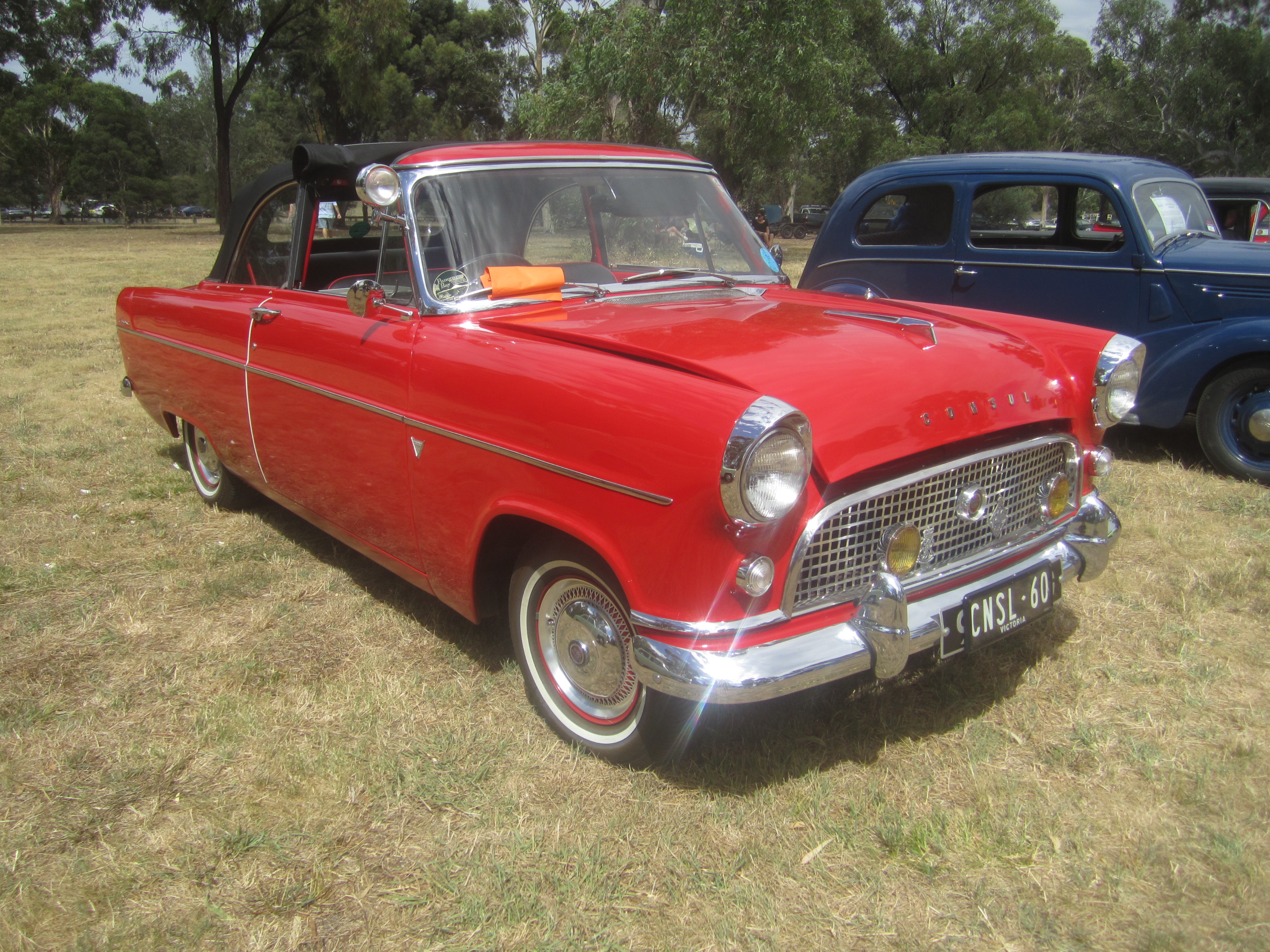
Does this look like a safe car to you?
Because it sure doesn't look like a safe car to me.
At 11:50 that night, despite good weather and a dry road, Martin lost control of the car, and crashed into a concrete lamppost at Rowden Hill in Chippenham, Wiltshire. They were 86 miles west of Heathrow, and just short of Chippenham Community Hospital, but that did Cochran no good. Sheeley said that Eddie saw what was happening, and threw himself over her to try to shield her from injury, but the impact threw him from the car, and he sustained a traumatic brain injury. He died the next day.
Vincent broke his collarbone and several ribs, and his bad leg was damaged further. Sheeley broke her pelvis. Tompkins fractured his skull. Martin, the incompetent driver, was not seriously hurt.
Just before leaving for the tour, Cochran had recorded a song titled "Three Steps to Heaven." It had nothing to do with death, but it became one in a string of poignantly titled "last songs" by performers that already included "I'll Never Get Out of This World Alive" by Hank Williams and "It Doesn't Matter Anymore" by Holly. "Three Steps to Heaven" was not a hit in America, but it hit Number 1 in Britain.
The day it did, June 24, 1960, George Martin, the driver of the taxi, was convicted of what American justice would call vehicular manslaughter. He was fined 50 pounds, sentenced to 6 months in prison, and lost his driving privileges for 15 years.
Having tax problems in America, Gene Vincent spent most of the rest of his life in Britain, where he still played to adoring crowds. On a tour of Europe in 1968, he was at his hotel in Germany, with a rising star that was his supporting act. In a drunken rage, he pulled a gun and fired several shots at the rising star, but missed them all. The rising star left the tour and went back to Britain. His name was Paul Francis Gadd, but he performed under the name Gary Glitter. In hindsight, had Vincent killed Glitter then, Vincent might have been the only person who wasn't better off.
Vincent died on October 12, 1971, while visiting his father in the Los Angeles suburb of Santa Clarita, California. The cause was a ruptured ulcer, due to his alcoholism. He was 36.
Cochran was elected to the Rock and Roll Hall of Fame in 1987, Vincent in 1998.
Sharon Sheeley recovered, and, with Jackie DeShannon, wrote several hits, including "Dum Dum" for Brenda Lee and "Breakaway" for Irma Thomas. (Not the same song recorded decades later by Kelly Clarkson.) In 1961, she married Los Angeles disc jockey Jimmy O'Neill. In 1964, she and Jimmy created the ABC music show Shindig!

She died in 2002, of a cerebral hemorrhage, probably unconnected to her 1960 injuries, at age 65. Though much too young, she had lived long enough to return to Britain and attend the dedication of a memorial plaque to Eddie at the site of the crash.
Patrick Tompkins died in 1993. George Martin died in 2009, the last survivor of the crash he caused. He should not be confused with the Englishman of the same name who produced The Beatles' recordings.
*
April 17, 1960 was a Sunday. This was the same day as the trade of Rocky Colavito by the Cleveland Indians to the Detroit Tigers for Harvey Kuenn. I have a separate entry for that event.
There were 5 games played in Major League Baseball that day. The Yankees, at the time the only team in New York City (not just figuratively), were not in any of them:
* The Milwaukee Braves beat the Philadelphia Phillies, 8-4 at Connie Mack Stadium in Philadelphia. Hank Aaron went 0-for-4, but Eddie Mathews hit a home run off Robin Roberts.
* The Pittsburgh Pirates swept a doubleheader from the Cincinnati Reds at Forbes Field in Pittsburgh. The Buccos won the 1st game, 5-0, as Bob Friend pitched a 4-hit shutout. They won the 2nd game, 6-5. Roberto Clemente went 2-for-4 with a home run and 4 RBIs in the opener, but 0-for-4 in the nightcap. Frank Robinson went the other way: 0-for-4 in the 1st game, and 2-for-4 with 2 RBIs in the 2nd game, but no home run, which may have made the difference in the game.
* The Los Angeles Dodgers beat the St. Louis Cardinals, 7-5 at the Los Angeles Memorial Coliseum. Stan Musial went 2-for-4 with a solo home run, but it wasn't enough, as Gil Hodges and Wally Moon hit homers for L.A. Larry Sherry went 6 innings for the win, and Sandy Koufax went 3 innings for the save.
* And the San Francisco Giants beat the Chicago Cubs, 4-3 at Candlestick Park in San Francisco. Ernie Banks went 1-for-5 with 2 RBIs. Willie Mays went 1-for-5, and Orlando Cepeda hit a home run. The game was won on a single by Jim Davenport in the bottom of the 14th inning.
Football was out of season. The NHL season had ended 3 days before, with the Montreal Canadiens completing a total 8-game sweep of the Playoffs for their 5th straight Stanley Cup. They beat the Toronto Maple Leafs 4-0 at Maple Leaf Gardens in Game 4 of the Finals. This would be the last game for their greatest legend, Maurice "The Rocket" Richard, who retired.
The NBA season had ended 8 days before, with the Boston Celtics winning the Finals over the St. Louis Hawks. The Celtics won Game 7 at the Boston Garden, 122-103.


No comments:
Post a Comment