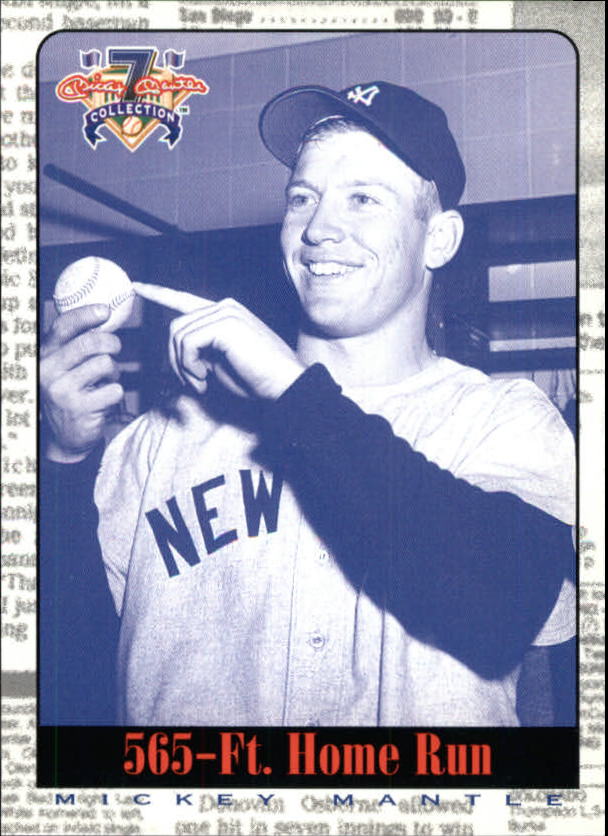
April 17, 1953: The New York Yankees beat the Washington Senators, 7-3 at Griffith Stadium. It was 2 days after Opening Day, when the new President, Dwight D. Eisenhower, threw out the ceremonial first ball. So instead of a sellout of around 30,000 people, only 4,206 fans attended.
Eddie Lopat went 8 innings to get the win for the Yankees. Billy Martin and Gene Woodling each had 2 hits. So did Mickey Mantle, the Yankees' 21-year-old center field phenom. One of Martin's hits was a home run. So was one of Mantle's.
It was 2 years to the day after Mantle's major league debut, and he found a way to celebrate the anniversary. In the top of the 5th, with 2 out and Yogi Berra on 1st base, the switch-hitting Mantle batted righthanded against Chuck Stobbs, a lefthander.
Mantle admitted that he was a better hitter for average from the left side, but he also knew that he clearly had more power from the right side. Stobbs threw him a fastball, and Mantle hit one of the most powerful drives anyone had ever seen. It glanced off a scoreboard at the back of the bleachers, a 460-foot drive. The ball caromed off the board, and kept going.
Arthur "Red" Patterson, then the Yankees' public-relations director, noted that nobody had ever hit a ball out of the left side of Griffith Stadium. This probably was not true: Josh Gibson, whose Homestead Grays divided their Negro League home games between Washington and Pittsburgh, probably did it a few times.
Patterson left the ballpark, and looked for the ball. He finally found a 10-year-old boy, in the backyard of a house at 434 Oakdale Place NW, across 5th Street from the left-field bleachers. Patterson asked for the ball. The boy wanted 75 cents -- about the standard price at the time for a fresh baseball from a store. Patterson gave him a dollar (about $11 in 2022 money), and got the ball.
Then he paced off the distance to the wall of the bleachers. Then he got the width of the bleachers. Then he saw the 391-foot marker on the wall where the ball had crossed the fence. He put it all together, and decided that Mantle had hit the ball 565 feet.

Griffith Stadium. The scoreboard in question
can be seen at the back of the left field bleachers.
5th Street is behind them. Oakdale Place extends
from the scoreboard, and 434 is 4 houses down.
He did not use a tape measure. But, later in the season, Mantle would also hit long home runs over the left field pavilion at Busch Stadium in St. Louis and the double-decked left field bleachers at Connie Mack Stadium in Philadelphia. Patterson did use a tape measure for those, and so, whenever Mantle hit a particularly long home run, it became known as a "tape measure home run."
(Both of those ballparks had their names changed that season: From their joint openings in 1909 until this point, Connie Mack Stadium had been Shibe Park; and the first ballpark to be known as Busch Stadium had been the last ballpark to be known as Sportsman's Park.)
The ball Mantle hit in Washington on this date went into The Guinness Book of World Records, recognized as the longest home run ever hit in a Major League Baseball game. In fact, he did not hit that ball 565 feet. A batted ball is supposed to be measured from home plate to where it first hit something. The ball made contact with the scoreboard, 460 feet away. That's the distance that should count for it. Still, that is a very long drive, and it would remain the longest authenticated home run in that ballpark's history. (As I said, Gibson may have hit one longer, but no one measured his drives.)
Did Mantle hit a baseball 565 feet, ever? Possibly: In addition to the preceding, he hit 2 drives over the left-field roof at Comiskey Park in Chicago, which probably exceeded 550 feet. He hit one over the right field roof at Tiger Stadium in Detroit that may have gone that far, although the 643-foot distance suggested by Mark Gallagher in Explosion!, a book about Mantle's home runs that was published in 1987, is almost certainly a gross miscalculation. (Gallagher admitted he'd used trigonometry to determine the distance.)
And there were at least 3 occasions when Mantle hit the facade atop the right field roof at the old Yankee Stadium, which came close to clearing the roof. It's been suggested that, had those balls been just a little higher, they would have gone over 600 feet.
Did Mantle hit the longest home run in baseball history? The evidence for that is flimsy. Home runs were not measured in the 1920s and 1930s, when Babe Ruth was hitting them lefthanded, and Jimmie Foxx was hitting them righthanded -- in each case, further than anybody had that way until Mantle. Ruth has been suggested as having hit them further than 565, sometimes even 600.
Ted Williams is said to have the longest home run at Fenway Park, in 1946; while Mantle is said to have the longest home run at the original Yankee Stadium, in 1964; and each is said to have gone 502 feet. But Ruth has been alleged to have exceeded those distances in previous configurations of those parks.
One thing is for sure: At a time when pitching was paramount, but a few sluggers hit the ball over 500 feet -- including Luke Easter, Frank Robinson, Harmon Killebrew, Frank Howard, Dick Allen, and the player most often compared to Mantle, Willie Mays -- Mickey Mantle hit the ball further than anybody, and hit long home runs more frequently than anybody. Despite a seemingly unending run of injuries, he played 18 seasons, and finished his career with 536 home runs. At the time, he was 3rd on the all-time list, behind Ruth and Mays.
Griffith Stadium was replaced by District of Columbia Stadium in 1961, and torn down in 1965. The Howard University Hospital was built on the site. D.C. Stadium became Robert F. Kennedy Stadium in 1969.
*
April 17, 1953 was a Friday. These other Major League Baseball games were played that day:
* A doubleheader was split between arch-rivals at the Polo Grounds. The New York Giants won the 1st game, beating the Brooklyn Dodgers, 6-3. Sal Maglie outpitched Johnny Podres, getting a home run from Wes Westrum. The Dodgers won the 2nd game, 12-4. Billy Loes pitched a complete game, Jim Hearn got knocked out of the box, and Carl Furillo hit a home run.
Jackie Robinson went 5-for-7, with 2 walks, but no RBIs, in the doubleheader. Willie Mays was serving in the Korean War, and did not play in these games.
* The Philadelphia Athletics beat the Boston Red Sox, 5-0 at Connie Mack Stadium in Philadelphia. Charlie Bishop pitched a 5-hit shutout for the A's. Like Mays, Ted Williams was in the war, and unavailable for the Red Sox.
* The Cincinnati Reds beat the Milwaukee Braves, 10-9 at Crosley Field in Cincinnati.
* The Detroit Tigers beat the Cleveland Indians, 6-5 at Briggs Stadium in Detroit. (It was renamed Tiger Stadium in 1961.)
* And the St. Louis Browns beat the Chicago White Sox, 6-4 at Comiskey Park in Chicago.
Football was out of season. The NHL season had ended the day before, with the Montreal Canadiens beating the Boston Bruins, 1-0 at the Montreal Forum, to win the Stanley Cup in 5 games. Elmer Lach scored the winning goal, 1 minute and 22 seconds into overtime. And the NBA season had ended the preceding Friday, with the Minneapolis Lakers winning the NBA Championship, beating the New York Knicks in 5 games.


No comments:
Post a Comment