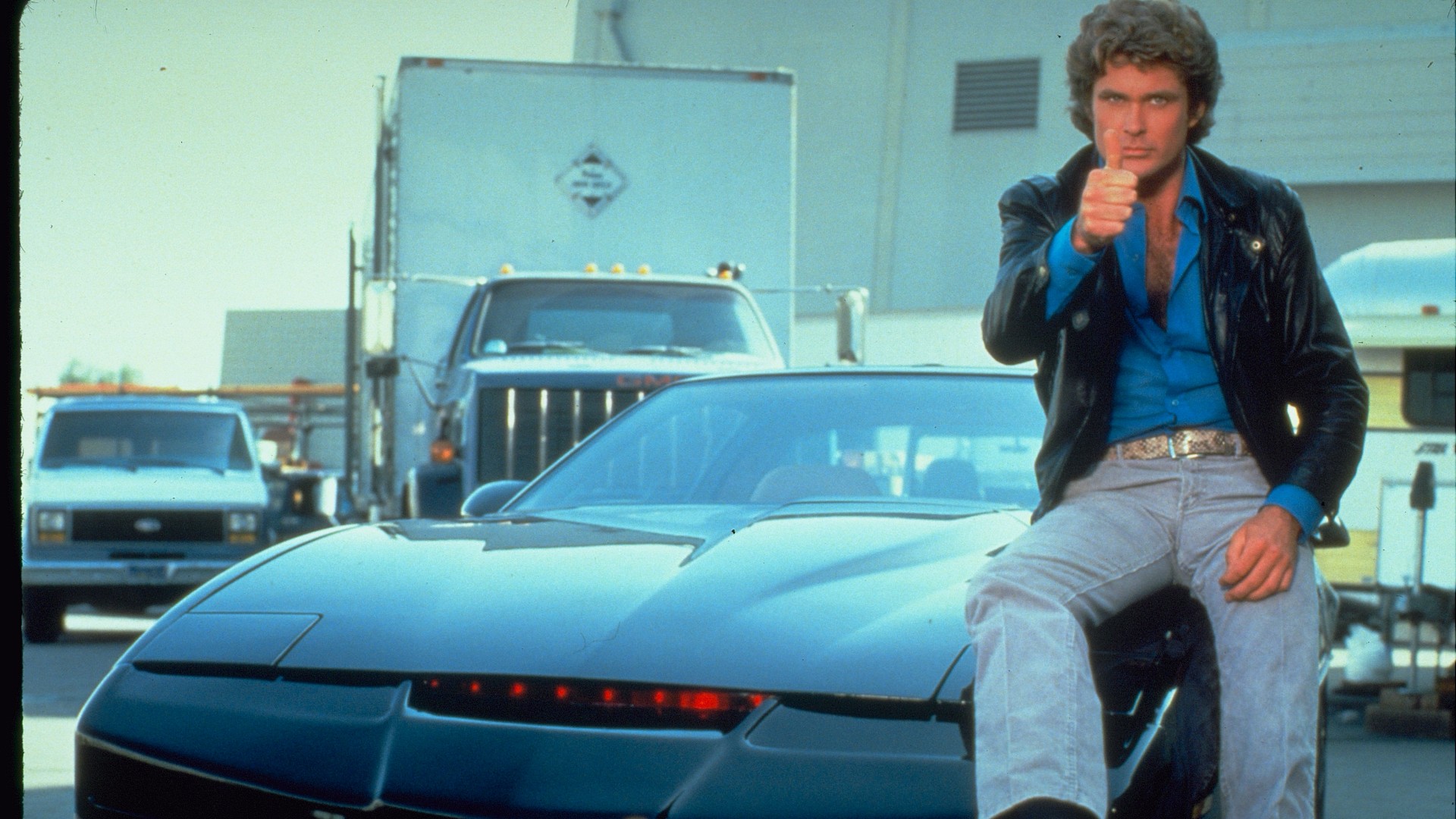
September 26, 1982: Knight Rider premieres on NBC. Although a crimefighting drama at its core, it introduced what became the coolest car in the history of television, cooler than the Batmobile, cooler than The Green Hornet's Black Beauty, and blowing away the still-active General Lee from The Dukes of Hazzard.
Series creator Glen A. Larson was also responsible for such shows as Alias Smith and Jones, Quincy, M.E., the original version of Battlestar Galactica, Buck Rogers in the 25th Century, B.J. and the Bear, the original version of Magnum, P.I., and The Fall Guy.
Larson had been a member of the 1950s vocal group The Four Preps. But, for the Knight Rider theme song, he and composer Stu Phillips took inspiration from "March Et Cortège De Bacchus," Act III -- No. 14, from the 1876 ballet Sylvia, written by French composer Léo Delibes. The network pushed them to feature synthesizers, which made total sense, based on what was happening in music in the early 1980s. Larson claimed that they used 5 or 6 synthesizers, drums and a Fender bass guitar to create the theme song.
Over it, a speech is delivered, setting up the premise of the show: "Knight Rider: A shadowy flight into the dangerous world of a man who does not exist: Michael Knight, a young loner on a crusade to champion the cause of the innocent, the helpless, the powerless, in a world of criminals who operate above the law."
This narration is provided by actor Richard Basehart, from 1964 to 1968 the star of the science-fiction series Voyage to the Bottom of the Sea. In the pilot of Knight Rider, he played Wilton Knight, an eccentric billionaire, the founder of the Foundation for Law & Government (FLAG).
Michael Long is a Los Angeles detective on special assignment in Las Vegas. While there, he gets shot in the head. A metal plate that had been put in his head during his service in the Vietnam War saved his life, but his face was destroyed. He was saved by agents of FLAG, and given plastic surgery, so that, according to Wilton's aide, Devon Miles (played by Irish actor Edward Mulhare, until then known for playing the first half of The Ghost & Mrs. Muir), he looks just like Wilton as a young man.
(Hasselhoff had just turned 30 when the show premiered. But if Michael Long had served in Vietnam, and was now an LAPD Detective, then he would likely have been at least 30 at the time the show began. He wasn't that "young," and "loner" was also something of a misnomer.)
He's given the name Michael Knight, a new identity, and enhancements to his car, a 1982 Pontiac Trans Am: It becomes The Knight Industries Two Thousand, or KITT for short. Shortly after the premiere, the show was featured in an article in the science fiction magazine Starlog. It included schematics of KITT, and suggested that it cost Knight Industries $11.4 million to build the car. In 2022 money, that would be about $35 million.
To put that in perspective: The Six Million Dollar Man premiered on ABC in 1973. The $6 million price tag for the bionic eye, arm and legs of Steve Austin (Lee Majors) would be about $40 million today. I seriously doubt that a few body parts would cost $5 million more than the most advanced car ever shown on TV to that point.
As Wilton dies, he tells Michael, "One man can make a difference." And so, Devon becomes CEO of FLAG, and turns KITT over to Michael. As it turns out, KITT isn't the car: It's the car's central processing unit (CPU), and it talks, voiced by William Daniels, at that point best known for playing Mr. Braddock in The Graduate and John Adams in the film version of the musical 1776. Daniels, at his own request, was never listed in the show's credits.
KITT follows science fiction author Isaac Asimov's "Three Laws of Robotics":
* 1. A robot may not harm a human being or, through inaction, cause one to come to harm.
* 2. A robot must follow the orders given to it by human beings, unless such an order conflicts with the First Law.
* 3. A robot must protect its own existence, unless doing so conflicts with the First or the Second Law.
While their relationship is difficult at first, KITT is completely devoted to Michael's protection, although there are times when Michael, feeling the risk is worth it, overrides KITT's protections. As Season 1 goes along, they develop a friendship between man and machine. And while the machine had opinions from the show's pilot onward, he seemed to develop emotions as the show progressed.
KITT has a "molecular-bonded shell" on his surface, including his tires, that protects him, and his passengers, from bullets and other weaponry. He has all the traditional super-car amenities: Smoke screen, oil slick, scanners for heat and other energy signatures and sounds, frequency jammers, jumping ability through a "Turbo Boost," and, of course, great speed.
The original opening sequence shows him approaching 300 miles per hour. In a Season 2 episode, even when damaged by a truck with the same shell, he surpasses 310. And after being nearly destroyed by a battering ram following a dissolving of his shell in Season 4, his rebuild includes a "Super Pursuit Mode" that reaches up to 450. That was the highest speed he was shown to reach, but that doesn't rule out his being even faster.
Larson ripped off his own creation, Galactica, for KITT: The roving scanner on the hood is like the eye from the enemy Cylons, and the Turbo Boost sound is the same from the Galactica's fighter spacecraft, the Vipers.
FLAG's roving base is a semi-tractor trailer, where Michael and KITT can be briefed by Devon, and KITT can be maintained by a super-mechanic. In Season 1, Patricia McPherson played Dr. Bonnie Barstow. McPherson left after that, and, in Season 2, the chief technician was April Curtis, played by Rebecca Holden. She never caught on with viewers, and McPherson was brought back for Seasons 3 and 4. For Season 4, she was joined by Peter Parros as Reginald Cornelius III, a.k.a. RC3.
Michael and KITT each had an "evil twin": Wilton Knight's illegitimate son Garthe Knight (also played by Hasselhoff) used the Star Trek trope of a goatee, wanted his father's fortune, and used a truck he called Goliath to try to destroy KITT and kill Michael. The 1st time, it nearly worked.
Before that, we found out that KITT was actually the new-and-improved model: The prototype was the Knight Automated Roving Robot. The problem with KARR was that he was programmed for self-preservation first, and became impossible to control. Both Garthe and KARR faced Michael and KITT twice.
On 4 occasions, KITT was nearly destroyed. In addition to Goliath and the aforementioned battering ram, a Season 3 episode showed KITT wrecked by a missile targeting his tailpipe. Later that season, with Michael occupied by a fight on the ground, KITT was picked up by a forklift and dropped into a big puddle of toxic waste. The shell protected the outside of the car, but the inside was wiped out, except for KITT's CPU. The interior had to be completely rebuilt, and, in testing before he could be sent back out, KITT showed signs of the computer equivalent of post-traumatic stress disorder. But he recovered in time to help Michael beat the waste-dumpers.
Basehart died in 1984, at the start of Season 3. But, as with Ted Cassidy, narrator of the opening sequence of The Incredible Hulk, who died while that show was still on the air, Basehart's narration was kept through the length of the show.
The last episode aired on April 4, 1986. Since it was not yet known whether the show would be renewed for a Season 5, there was no big finale: It was just like any other episode. Hasselhoff went on to greater fame as lifeguard boss Mitch Buchannon on Baywatch, and had another career as a singer, where, perhaps due to his ancestry, he became enormously popular in Germany, on a level with Jerry Lewis in France.
Knight Rider has been rebooted, but each subsequent reboot has contradicted the others, to the point that discussing them would make this post too long. Maybe there's a Knight Rider "multiverse."
The original show has been compared to James Bond and Mission: Impossible. It's also comparable to Batman, with Michael as the Dark Knight, Devon as both Alfred and Commissioner Gordon, and KITT as the Batmobile, although there was never a Robin. But Hasselhoff's charisma and KITT's cool made the show more than just another police procedural.
Mulhare died in 1997, Larson in 2014. As of September 26, 2022, Hasselhoff, Daniels, McPherson, Holden, Parros and Phillips are still alive.
*
September 26, 1982 was a Sunday, although Knight Rider would soon be moved to Friday. The NFL players were on strike, so there were no games this week. But these Major League Baseball games were played that day, including all 3 of MLB's biggest rivalries:
* The New York Yankees lost to the Boston Red Sox, 5-2 at Fenway Park in Boston. Four years minus 6 days too late for the Sox, Mike Torrez outpitched Ron Guidry at Fenway. Dwight Evans hit a home run. Carl Yastrzemski did not play. Dave Winfield went 2-for-5.
* The New York Mets beat the Philadelphia Phillies, 6-4 at Shea Stadium. It would take until the late 2000s for this to be recognized as a major rivalry. Mike Schmidt went 0-for-4 with a walk. Pete Rose went 1-for-3 with 2 walks and an RBI.
* The Pittsburgh Pirates beat the Montreal Expos, 3-0 at the Olympic Stadium in Montreal. Jason Thompson and Jim Morrison (no relation to the lead singer of The Doors, who died 11 years earlier) hit home runs, in support of Larry McWilliams, who pitched a 5-hit shutout. Willie Stargell, entering his last week as an active player, did not play.
* The San Diego Padres beat the Atlanta Braves, 3-2 at Atlanta-Fulton County Stadium. Rookie Tony Gwynn went 0-for-2, but drew 2 walks.
* The Houston Astros beat the Cincinnati Reds, 4-0 at Riverfront Stadium in Cincinnati. Nolan Ryan pitched 8 innings, striking out 11, allowing 5 hits, with Bert Roberge finishing the 6-hit shutout. Johnny Bench did not play.
* The Cleveland Indians beat the Detroit Tigers, 4-3 at Tiger Stadium in Detroit.
* The Minnesota Twins beat the Chicago White Sox, 2-1 at Comiskey Park in Chicago.
* The Baltimore Orioles beat the Milwaukee Brewers, 5-2 at Cleveland Municipal Stadium. Eddie Murray went 1-for-4 with a home run and 2 RBIs. Cal Ripken went 1-for-4 with a walk and an RBI. Robin Yount went 1-for-4 with an RBI. Paul Molitor went 0-for-2 with a walk.
* The Chicago Cubs beat their arch-rivals, the St. Louis Cardinals, 6-1 at Busch Memorial Stadium.
* The Texas Rangers beat the California Angels, 7-5 at Arlington Stadium in the Dallas suburb of Arlington, Texas. Reggie Jackson, Fred Lynn and Doug DeCinces hit home runs for the Halos. Rod Carew went 1-for-4 with an RBI.
* The San Francisco Giants beat their arch-rivals, the Los Angeles Dodgers, 3-2 at Dodger Stadium in Los Angeles. Darrell Evans hit a home run.
* The Oakland Athletics beat the Kansas City Royals, 5-4 at the Oakland Coliseum. Rickey Henderson went 1-for-4, but, in this year in which he stole a still-standing record of 130 bases, he stole none in this game. George Brett went 0-for-5.
* And the Toronto Blue Jays beat the Seattle Mariners, 6-2 at the Kingdome in Seattle.


No comments:
Post a Comment