/https://tf-cmsv2-smithsonianmag-media.s3.amazonaws.com/filer/f5/ab/f5ab6f96-6dbf-4586-8fd7-3c6ec8b3c7f5/gettyimages-149013110.jpg)
August 2, 1943: The Japanese destroyer Amigiri hits PT-109, an American patrol torpedo boat, in the Solomon Islands in the South Pacific, cutting it half. Of the 13 men on board, 2 are killed instantly.
Those 2 men were Torpedoman's Mate 2nd Class Andrew Kirksey of Reynolds, Georgia; and Motor Machinist's Mate 2nd Class Harold Marney of Springfield, Massachusetts. How the other 11 men survived became legend.
PT-109 was launched on June 20, 1942, at the Brooklyn Navy Yard. On April 23, 1943, it received a new commanding officer, from Boston: Lieutenant Junior Grade John F. Kennedy.

A Harvard graduate, the son of a former U.S. Ambassador to Britain, 26 years old, already not the healthiest of men, and with an older brother already serving in the U.S. Navy, it would have been easy for JFK to fall back on all of those things. Instead, he used whatever influence he could to get into the war. He had already seen combat on the USS Rochambeau, the ship that took him to his Solomon Islands post, and had seen its Captain killed as a result.
The crew came to like Kennedy quickly, in spite of his background. Ray Starkey had transferred off another boat due to the attitude of a captain he called an "Ivy League snob." But he liked serving under Ivy Leaguer Kennedy, and recalled afterwards that he was "all business, but with a sense of humor, and modest and considerate of enlisted me."

PT-109 had already taken Japanese fire on August 1, and 2 other PT boats had been sunk. At 2:27 AM on August 2, she was hit. The crew never saw the Amigiri coming. Whether the crew of the Amigiri saw PT-109, or even knew it was there before it was too late, has been debated.
With the surviving crew treading water and hanging on to the broken hull until about 1:00 the following afternoon, Kennedy ordered his men to swim out in each direction, to see if they could find land. All returned, with one saying that he saw what turned out to be Plum Pudding Island, 3 1/2 miles away.
The men could swim there, even Kennedy, who already had a bad back. But one couldn't: Pappy McMahon was the only man in the engine room during the collision, and was badly burned. Kennedy towed McMahon by sticking a strap from McMahon's life jacket in his teeth, and the men swam to the island. It took 4 hours. Kennedy's bad back was further injured.
Surviving on coconuts and drinkable water left behind by formerly occupying Japanese troops, Kennedy and the other 10 men were finally rescued on August 8. Kennedy, frequently sick, was down to 120 pounds by the time he was examined at a naval hospital.
He recovered. His brother, Joseph P. Kennedy Jr., was killed the next year, when his plane exploded at the start of a bombing run. The intention of Joseph P. Kennedy Sr. had been for Joe Jr., his oldest son, to be the politician. Without him, JFK, or "Jack," stepped in. He ran for Congress from a Boston-based district in 1946. During the campaign, his military service was played up, earning him good publicity. Someone asked him, "How did you become a war hero?" Without even thinking about it, he told the truth: "It was involuntary: They sank my boat."
He won, easily, and was re-elected in 1948 and 1950. In 1952 and 1958, he was elected to the U.S. Senate. In 1960, he became the 1st World War II veteran -- aside from General Dwight D. Eisenhower, who never saw combat -- to be elected President.
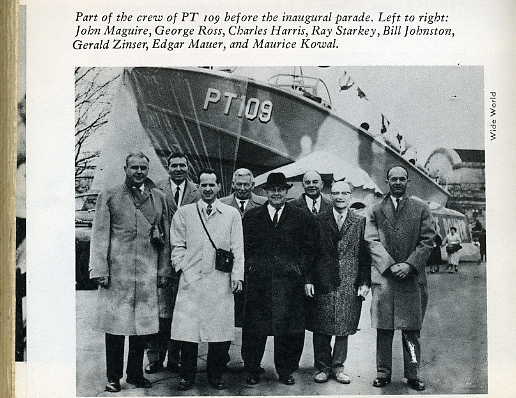
The ship that hit PT-109, Amagiri, hit a mine and sank 8 months later. As a gesture of postwar goodwill, its commanding officer, Lieutenant Commander Kohei Hanami, was invited to JFK's Inauguration in 1961. So were the surviving PT-109 crewmembers. In the Inaugural Parade, a float was decorated to look like PT-109.
In 1963, the film PT-109 was made about the adventure. JFK personally chose Cliff Robertson to play him. Country singer Jimmy Dean sang the theme song, and it hit Number 8 on Billboard magazine's pop chart and Number 3 on its country chart. JFK was assassinated on November 22, 1963.
Of the other PT-109 survivors:
* Seaman 2nd Class Raymond Albert, from Akron, Ohio, a gunner on PT-109, was killed in action on October 8, 1943.
* Ensign Leonard J. Thom, from Sandusky, Ohio, the boat's executive officer, who had been a football player at Ohio State University, was killed in a car accident in Ravenna, Ohio on October 8, 1946.
* Motor Machinist's Mate 2nd Class William Johnston, from Boston. He became a truck driver, attended the Inauguration, and lived until July 5, 1968.
* Torpedoman's Mate 2nd Class Ray L. Starkey, from the Los Angeles suburb of Garden Grove, California. He worked on oil rigs, attended the Inauguration, and lived until October 8, 1970.
* Quartermaster Edman E. Mauer, the quartermaster and cook, from St. Louis. He attended the Inauguration, and lived until September 22, 1974.
* Gunner's Mate 3rd Class Charles A. Harris, from the Boston suburb of Watertown, Massachusetts, was nicknamed "Bucky" Harris, after the baseball manager. He attended the Inauguration, and lived until May 6, 1982.
* Ensign George H.R. Ross, from the Chicago suburb of Highland Park, Illinois, was nicknamed "Barney" Ross, after the champion boxer who had, himself, become a hero in the Pacific Theater of the war. He was not a part of the crew: He had been picked up after his own boat was lost. He went into the insurance business, attended the Inauguration, and lived until July 24, 1983.
* Motor Machinist's Mate 1st Class Patrick H. McMahon, from Wyanet, Illinois, was nicknamed "Pappy" because he was the oldest member of the crew, 37. He worked for the U.S. Postal Service, becoming a postmaster, and lived until February 18, 1990.
* Radioman 2nd Class John E. "Mac" Maguire, from the New York City suburb of Dobbs Ferry. He served as a U.S. Marshal, attended the Inauguration, and lived until December 16, 1990.
* Motor Machinist's Mate Gerard E. Zinser, from the St. Louis suburb of Belleville, Illinois. He was the only one who stayed in the Navy to make it his career, also serving in the Korean War, rising to the rank of Chief Petty Officer. Like McMahon, he later worked for the Postal Service, and attended the Inauguration. He was the last survivor of the ramming, living until August 21, 2001. Like Kennedy, he was buried at Arlington National Cemetery.
Gunner's Mate Maurice Kowal, of Worcester, Massachusetts, had been a member of Kennedy's crew, but had been transferred off before the ramming. Along with Zinser, he also served in the Korean War. He later worked for the U.S. National Park Service, and attended the Inauguration. He outlived all the others, dying on August 30, 2011.
*
August 2, 1943 was a Monday. There were 3 baseball games played that day:
* The Philadelphia Athletics beat the Chicago White Sox, 5-3 at Shibe Park in Philadelphia.
* The Washington Senators beat the St. Louis Browns, 4-3 at Griffith Stadium in Washington.
* And the Pittsburgh Pirates beat the Boston Braves, 5-4 at Forbes Field in Pittsburgh.


No comments:
Post a Comment