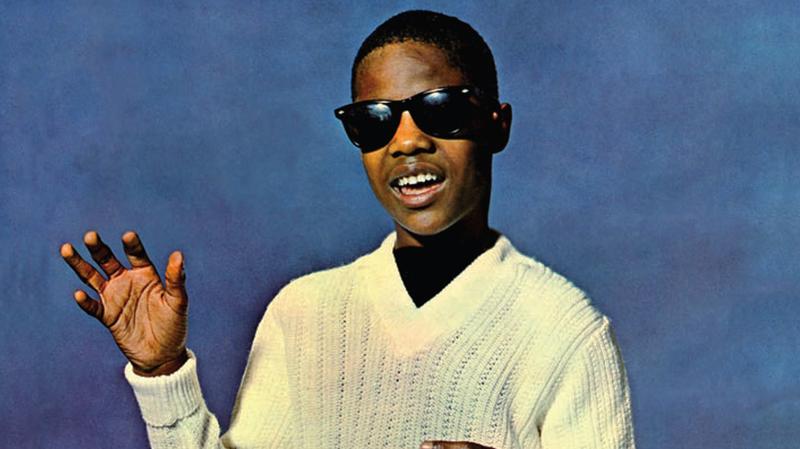
August 10, 1963: Little Stevie Wonder, as he was billed at the time, hits Number 1 on Billboard magazine's Hot 100 chart with "Fingertips -- Part 2," making him, at 13, the youngest performer ever to top that chart.
Performers that young making it big on the charts were rare, and remain so. The most notable examples other than Stevie have been Frankie Lymon, who was 13 when he and his vocal group, The Teenagers, hit Number 6 with "Why Do Fools Fall In Love" in 1956; and Geraldine Pasquale, who, under the name Dodie Stevens, was the same age in 1959 when she hit Number 3 with "Pink Shoe Laces."
Stevland Hardaway Judkins was born on May 13, 1950 in Sagniaw, Michigan, a city of 40,000 people, about 100 miles northwest of Detroit. "Saginaw, Michigan" would be a hit country song by Bill Anderson in 1964.
Stevie -- it seems odd to refer to him by his stage name's surname, "Wonder" -- was born 6 weeks premature, a condition that, along with the oxygen-rich atmosphere in the hospital incubator, resulted in retinopathy of prematurity, a disease that aborts eye growth and often causes the retinas to detach, which left him blind. So, unlike the man who would, naturally, become his hero, Ray Charles, who lost his sight at age 7, Stevie was blind from birth.
When he was 4 years old, his mother divorced his father and moved to Detroit. He began playing instruments at an early age, including piano, harmonica, and drums. He was signed by Detroit's Motown Records in 1961, and his surname was legally changed to Morris, which, according to his mother, was an old family name. Motown founder and chairman Berry Gordy Jr. was responsible for creating the stage name of "Little Stevie Wonder."
In September 1962, his 1st album was released, titled The Jazz Soul of Little Stevie. It's 9 songs, all instrumentals, 1 written by Gordy, the others co-written by Motown producer Clarence Paul. Of those 8, 1, "Soul Bongo," on which Stevie played bongos, was written with Paul by the drummer on the album: Marvin Gaye, who would be a close friend of Stevie for the rest of Marvin's life. (Marvin had already played drums on the 1st Motown song to hit Number 1: "Please Mr. Postman" by The Marvelettes, in 1961.)
Stevie himself was listed as co-writer with Paul on 2 songs: "Wondering" and "Session Number 112." On the other 5, Paul's co-writer was listed as Henry Cosby, a saxophone player who recruited several of Motown's "Funk Brothers" musicians, including bass guitarist James Jamerson and drummer Benny Benjamin. Cosby -- no relation to comedian Bill -- would also be credited as the co-writer on 2 later Motown songs to hit Number 1: "Love Child" by Diana Ross & The Supremes, and "The Tears of a Clown" by Smokey Robinson & The Miracles.
One of the Cosby-Paul compositions was "Fingertips." It's basically an instrumental, but when it was released as a single, it was split into halves, of a recording of a Motortown Revue show at the Regal Theatre in Chicago in June 1962. Stevie played bongos and harmonica, Jamerson played bass, Gaye played drums, and Johnny Allen arranged the horns.
Because of where Part 2 begins, and the fact that the word "Fingertips" is not mentioned anywhere in the song, many people, before they could buy the single, thought the song was titled "Everybody Say Yeah!"
Stevie walked off at the end of the song, but when the master of ceremonies, Bill Murray (not the later white comedian), told the crowd to give him a hand, Stevie misunderstood, and returned to his seat for an encore. The next band, setting up for the next singer, Mary Wells, didn't know what to do. Her bass singer, Joe Swift, yelled out, "What key? What key?"
The live version was included on the album Recorded Live: The 12 Year Old Genius, released on May 21, 1963. The single hit Number 1 on August 10. It had been just 3 months since Little Peggy March hit Number 1 with "I Will Follow Him." At 13 and 15, respectively, Little Stevie and Little Peggy remain the youngest male singer and the youngest female singer ever to hit Number 1 on the Hot 100.
Peggy March only had a few more minor hits. Stevie Wonder would have several more Top 10 hits in the 1960s, but didn't hit Number 1 again until 1973, with "Superstition." It took until 1970, and a team-up with Marvin Gaye, for him to challenge Berry Gordy to let him record more topical material, and to really stretch his songwriting skills.
By 1986, when he was only 36 years old, he was a part of 10 Number 1 hits, 8 of them as the headliner. He hasn't had many hits since. But he has won 25 Grammy Awards, 8 of them after 1987. His 1974 album Innervisions won the Grammy for Album of the Year. Fulfillingness' First Finale won it for 1975. In 1976, Paul Simon won it for Still Crazy After All These Years. At the time, Stevie was known to be working on the album that would become Songs In the Key of Life, and, in his acceptance speech, Paul said, "I'd also like to thank Stevie Wonder, for not releasing an album this year." Sure enough, Songs In the Key of Life won Album of the Year, too.

Stevie also threw himself into activism, including the fight to end apartheid in South Africa, and police brutality at home. His 1980 song "Happy Birthday" is credited with launching the successful campaign to make Dr. Martin Luther King Jr.'s birthday a national holiday to commemorate civil rights.
At times, it was rumored that he would run for Mayor of Detroit or Mayor of Los Angeles -- he maintains homes in both cities -- but he has never run for office. To put it politely, both his health (not just his blindness, but he has also had a kidney transplant) and his personal life (3 marriages, 2 divorces, 9 children with 5 women, and his practice of Transcendental Meditation) would be hurdles for a candidate to overcome.
Nevertheless, he remains one of the most honored musical figures of all time. He was elected to the Rock and Roll Hall of Fame in 1989, his 1st year of eligibility.
UPDATE: The oldest singer ever to hit Number 1, due to the revamping of Billboard's charts to including music streaming, is Brenda Lee, who did so at age 79 in 2023, with her recording of "Rockin' Around the Christmas Tree." But she was only 13 when she recorded it, the same age that Stevie was, give or take a few months, when "Fingertips -- Par 2" was released. She is just 5 1/2 years older than Stevie, despite the fact that they currently hold the opposite poles of this particular record.
*
August 10, 1963 was a Saturday. British-American political scientist Andrew Sullivan was born. Senator Estes Kefauver of Tennessee, the 1956 Democratic nominee for Vice President, died. This was also the day that George Plimpton ran a series at quarterback in a practice session at the Detroit Lions' preseason training camp, forming the basis of one of the most famous books ever written about football: Paper Lion. I have a separate entry for that event.
Football, as I said, was in preseason. The NBA and the NHL were in their off-seasons. These baseball games were played:
* The New York Yankees beat the Los Angeles Angels, 2-1 at Dodger Stadium in Los Angeles, where the Angels were groundsharing with the Dodgers while waiting for their stadium in Anaheim to be built. Whitey Ford outpitched Dean Chance. Bobby Richardson drove in the Yankee runs with a single in the top of the 9th inning. Mickey Mantle appeared as a pinch-hitter, and drew a walk.
* The New York Mets lost to the Chicago Cubs, 4-0 at the Polo Grounds. Larry Jackson pitched a 7-hit shutout. Ron Hunt got 3 of those hits. Ernie Banks did not play for the Cubs, but Ellis Burton hit a home run for them.
* The San Francisco Giants beat the Philadelphia Phillies, 7-6 at Connie Mack Stadium in Philadelphia. Willie Mays went 2-for-5. Harvey Kuenn, Orlando Cepeda and Felipe Alou each got 3 hits.
* The Washington Senators beat the Baltimore Orioles, 6-5 at District of Columbia Stadium (later renamed Robert F. Kennedy Stadium) in Washington. Brooks Robinson appeared as a pinch-hitter, and did not reach base. Despite being so close, and in the same League, neither the Senators nor the Orioles ever considered the other a rival, although they might have if there had ever been a serious Pennant race between them.
* The Pittsburgh Pirates beat the Houston Colt .45's, 3-2 at Forbes Field in Pittsburgh. Roberto Clemente went 1-for-4 with an RBI. The Colts became the Houston Astros in 1965.
* The Kansas City Athletics beat the Cleveland Indians, 6-3 at Cleveland Municipal Stadium.
* The Los Angeles Dodgers beat the Cincinnati Reds, 10-3 at Crosley Field in Cincinnati. Don Drysdale went the distance for the win, striking out 13 and walking none. Frank Robinson went 1-for-4. Pete Rose, soon to be named National League Rookie of the Year, went 2-for-4.
* The Chicago White Sox beat the Detroit Tigers, 5-1 at Comiskey Park in Chicago. Al Kaline went 2-for-4 with an RBI.
* The St. Louis Cardinals beat the Milwaukee Braves, 6-5 at Milwaukee County Stadium. Stan Musial, in his last season as a player, had an RBI on a pinch-hit single. Hank Aaron went 3-for-5 with 2 RBIs.
* And the Minnesota Twins beat the Boston Red Sox, 5-3 at Metropolitan Stadium in the Minneapolis suburb of Bloomington, Minnesota. Harmon Killebrew went 0-for-3, but had an RBI on a sacrifice fly. For the Red Sox, Dick Stuart hit 2 home runs, and even played errorless ball at 1st base; but Carl Yastrzemski went 0-for-4.


No comments:
Post a Comment