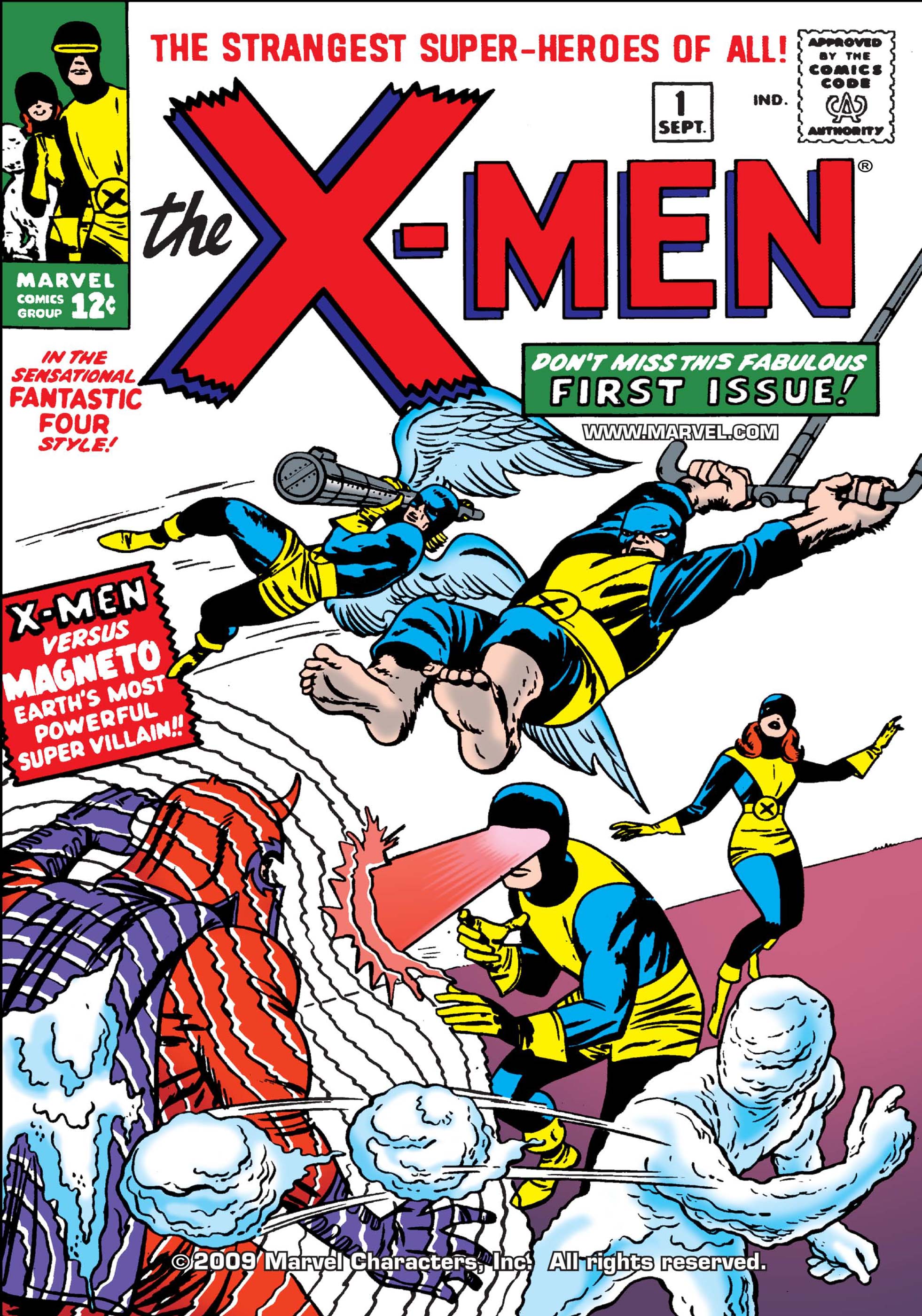
July 2, 1963: X-Men #1, with a date of September 1963, is published by Marvel Comics. The eponymous group eventually become the biggest-selling superhero team in comic books, surpassing Marvel's Avengers and Defenders, and DC's Justice League, Justice Society and Teen Titans.
In 1963, with the success of Spider-Man, the Hulk, and the Fantastic Four, Marvel's writing boss, Stan Lee, wanted to create another group of superheroes. But he did not want to have to write a story, multiple stories, explaining how each of them got their powers.
In 2004, Lee recalled, "I couldn't have everybody bitten by a radioactive spider, or exposed to a gamma ray explosion. And I took the cowardly way out. I said to myself, 'Why don't I just say they're mutants? They are born that way.'"
In a 1987 interview, the group's other creator, Jack Kirby, said:
Lee devised the series title after Marvel publisher Martin Goodman turned down the initial name, "The Mutants," stating that readers would not know what a "mutant" was.
Within the Marvel Universe, the X-Men are widely regarded to have been named after their teacher, the telepathic, but confined to a wheelchair, Charles Xavier, a.k.a. Professor X. The original explanation for the name, as provided by Xavier in the 1st issue, is that mutants "possess an extra power... one which ordinary humans do not!! That is why I call my students... X-Men, for EX-tra power!" Smilin' Stan sure did like him some exclamation points! They made his characters more declarative! And more provocative!
Of course, Stan also liked him some adjectives, to give to his heroes! The Fantastic Four! The Incredible Hulk! The Amazing Spider-Man! The Mighty Thor! The Invincible Iron Man! And so, this group were "The Uncanny X-Men!"
(Stan also liked alliteration. "Uncanny X-Men" didn't quite work, but "Fantastic Four" and "Invincible Iron Man" did. So did several secret identities: Mr. Fantastic was Reed Richards, the Invisible Girl was Susan Storm, Spider-Man was Peter Parker, the Hulk was Bruce Banner, Daredevil was Matt Murdock. But only one X-Man had an alliterative name: Cyclops was Scott Summers.)
DC's Doom Patrol, which debuted several months before X-Men, was suspected by its creator, Arnold Drake, and its fans of having had the basic concept copied to a great degree, including a wheelchair-bound leader.
Early X-Men issues introduced the original team:
* Scott Summers, Cyclops, who had heat vision that could only be controlled by being blocked by a visor or special sunglasses.
* Hank McCoy, the Beast, a brilliant scientist but a large man, simian in appearance, with great strength, and the ability to use his feet to climb walls. He was later redrawn as covered in blue fur.
* Warren Worthington III, the Angel, a patrician rich kid who had wings, and could fly.
* Bobby Drake, Iceman, who had powers over ice, in much the same way that fellow teenager Johnny Storm, a.k.a. the Human Torch of the Fantastic Four, had powers over fire. Drake couldn't fly, but he could cast ice in front of him, and "surf" over the air, predating Marvel's character the Silver Surfer by 3 years.
The first issue introduced Jean Grey, originally named Marvel Girl, a telepath like Xavier, but also an empath, and capable of telekinesis. She would form a love triangle with Cyclops and Angel, and later another with Cyclops and Wolverine.
The first issue would introduce Erik Lensherr, a.k.a. Magneto. As his name suggests, he had power based in magnetism. Like Reed Richards and the Fantastic Four's main enemy, Victor Von Doom, a.k.a. Dr. Doom, Professor X and Magneto were best friends turned arch-enemies. Both Xavier and Magneto wanted to reduce unpowered humans' bigotry toward mutants, making them an analogue for the Civil Rights Movement. But their plans were different: Xavier wanted the mutants to help unpowered humans, and earn their trust; Magneto wanted to eliminate the threat by killing them. Their difference was likened to the split between nonviolence apostle Martin Luther King and "by any means necessary" advocate Malcolm X.
Lensherr was the father of Pietro and Wanda Maximoff, a.k.a. the speedster Quicksilver and the magic-powered Scarlet Witch. They would later turn hero, and join the X-Men against their father. All 3 characters would be retconned as Romani, and Lensherr was retconned as a survivor of the Nazi Holocaust.
By the end of the 1960s, the series stopped selling well, and Marvel stopped producing new stories in March 1970, with issue #66. In Giant-Size X-Men #1, in 1975, a new team was introduced, led by Cyclops, and included mutants from around the world. Four in particular proved popular enough to last:
* James Howlett, a.k.a. Logan, a.k.a. Wolverine, the product of a Canadian program to produce a super-soldier, resulting in adamantium claws that could extend from his hands and cut through just about anything, and a healing factor that could allow him to regenerate from anything short of disintegration. He's only 5-foot-3, but arguably the most dangerous man on Earth. As he says, "I'm the best there is at what I do, but what I do isn't very nice." He also likes to smoke cigars and call people "Bub."
* Piotr Rasputin, a.k.a. Colossus, a Russian who is able to transform himself into living steel, making him the strongest member of the team.
* Kurt Wagner, a.k.a. Nightcrawler, a German who looks like the devil but is a devout Catholic, and whose main power is teleportation.
* Ororo Munroe, a.k.a. Storm, a black woman from Kenya, who could control weather. She would eventually marry, but later divorce, the African superhero Black Panther.
The 1980s began with the team's best-known story arc, The Dark Phoenix Saga, which saw Jean Grey, having taken the name Phoenix, manipulated by the illusionist Mastermind, and becoming corrupted with an overwhelming lust for power and destruction as the evil Dark Phoenix.
By the early 1980s, X-Men was Marvel's top-selling comic title. Its sales were such that distributors and retailers began using an "X-Men index", rating each comic book publication by how many orders it garnered compared to that month's issue of X-Men.
A series of X-Men movies began in 2000, starring Patrick Stewart as Xavier. They helped the jumpstart the superhero genre of films.
A 2019 episode of the YouTube series Epic Rap Battles of History featured "Epic" Lloyd Ahlquist playing Wolverine, against rapper Michael Jones, a.k.a. "Wax," as Nightmare On Elm Street villain Freddy Krueger, the connection being that Freddy's long-bladed gardening glove is as sharp as Wolverine's claws, and that both are practically invincible.
*
July 2, 1963 was a Tuesday. These baseball games were played that day:
* The New York Yankees beat the Chicago White Sox, 3-0 at Yankee Stadium. Al Downing allowed just 1 hit, a single to Cam Carreon in the 7th inning. He also walked 6 batters, but struck out 10. Hector Lopez hit a home run. Roger Maris went 1-for-3. Mickey Mantle was injured. Yogi Berra, in his last full season as a player, also did not play.
* The New York Mets lost to the Chicago Cubs, 4-1 at Wrigley Field in Chicago. Ernie Banks went 1-for-3 with a walk for the Cubs. Duke Snider did the same for the Mets.
* The Pittsburgh Pirates beat the Philadelphia Phillies, 3-2 at Connie Mack Stadium in Philadelphia. Roberto Clemente went 1-for-3 with a walk and an RBI.
* The Baltimore Orioles beat the Los Angeles Angels, 4-3 at Memorial Stadium in Baltimore. Brooks Robinson went 1-for-4.
* The Washington Senators beat the Kansas City Athletics, 7-2 at District of Columbia Stadium in Washington. D.C. Stadium was renamed Robert F. Kennedy Memorial Stadium in 1969.
* The Boston Red Sox beat the Cleveland Indians, 6-1 at Cleveland Municipal Stadium. Carl Yastrzemski went 2-for-4 with a walk and 2 RBIs.
* The Minnesota Twins beat the Detroit Tigers, 7-4 at Tiger Stadium in Detroit. Harmon Killebrew went 1-for-4 with a walk. Al Kaline went 2-for-3 with a home run, a walk and an RBI.
* The Cincinnati Reds beat the Houston Colt .45s, 6-4 at Colt Stadium in Houston. Frank Robinson did not play for the Reds, but rookie Pete Rose did, and went 3-for-5. The Colts became the Houston Astros in 1965.
* And the San Francisco Giants beat the Milwaukee Braves, 1-0 at Candlestick Park in San Francisco. Warren Spahn, age 42, and Juan Marichal, 25, kept pitching a dual shutout until the bottom of the 16th inning, when Willie Mays hit a home run off Spahn to win it for the Giants. This has been called the greatest pitcher's duel of all time, and I have a separate entry for the event.
* And the Los Angeles Dodgers beat the St. Louis Cardinals, 1-0 at Dodger Stadium in Los Angeles. Don Drysdale pitched a 5-hit shutout, outpitching Curt Simmons. Stan Musial, in his final season, got a hit as a pinch-hitter.


No comments:
Post a Comment