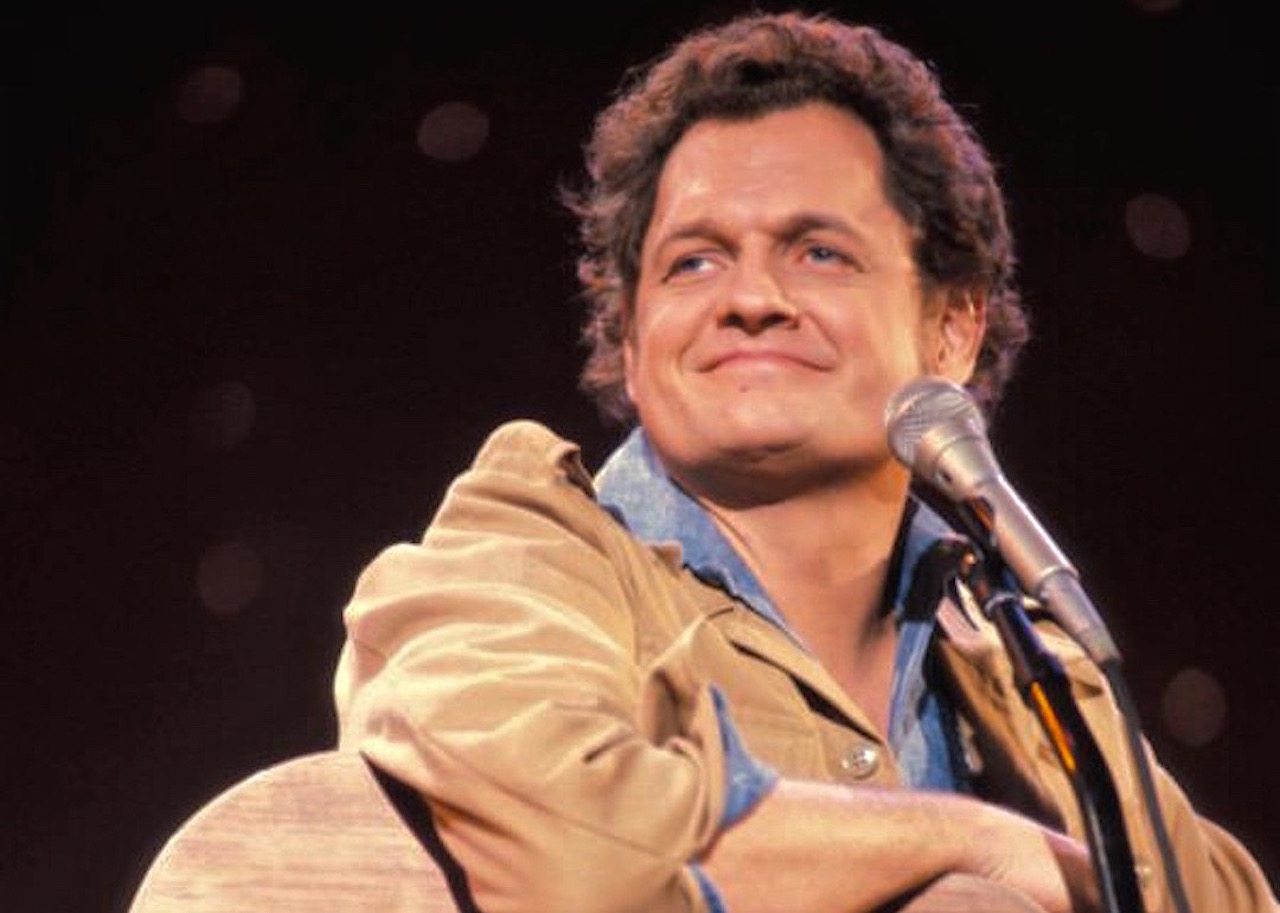
July 16, 1981: Harry Chapin dies on the Long Island Expressway. He was 38 years old.
Harry Forster Chapin was born on December 7, 1942 in Manhattan, and grew up in Brooklyn Heights. He started as a documentary filmmaker, and directed Legendary Champions, a boxing film that was nominated for an Academy Award for 1968.
But his first love was music, and in 1971, he was playing New York nightclubs, with the one man who would remain in his band all the way through, bass guitarist John Wallace, whose amazing range could produce deep bass notes, but also notes as high as those in the "Baby's so high... " bridge in "Taxi."
In 1972, joined by his brother Steve Chapin on keyboards, and a cellist, Tim Scott, he released his 1st album, Heads & Tales. The cover showed him framed by a black-and-white checkerboard, on a yellow field, suggesting the title of the album's single, the 6-minute-44-second "Taxi." He tells of a cabdriver in San Francisco picking up a woman he takes a while to recognize, and vice versa, and finally realizes she's an old flame. The song closes on a down note, showing their dreams did not come true:
She was gonna be an actress
and I was gonna learn to fly.
She took off to find the footlights.
I took off for the sky.
And here, she's acting happy
inside her handsome home
and me, I'm flyin' in my taxi
takin' tips and gettin' stoned.
I go flyin' so high when I'm stoned.
His status as a writer and singer of "story-songs" was set, and at the beginning of concerts, he would tell the audience, "Got a lot o' stories to tell you tonight."
Later in 1972, he released Sniper and Other Love Songs. Perhaps borrowing from Randy Newman -- and either could have inspired Warren Zevon -- "Sniper," running just under 10 minutes, was about Charles Whitman, and his rampage from the clock tower at the University of Texas in 1966.
It also contained "A Better Place to Be," an 8:36 story-within-a-story where a night watchman tells a diner waitress about this one-night-stand he'd had, and how she left him just as lonely as he was before. It became a must for Harry's concerts: He would say, "I always get in trouble when I don't do it." Sniper also included what became his theme song and concert finale: "Circle." And in, "All my life's a... "
In 1973, he released Short Stories, and he sort-of meant it, as the longest song was the 5:15 "W.O.L.D.," about a disc jockey who's "Feelin' all of 45, goin' on 15." It also included "Mr. Tanner," about a Dayton drycleaner who keeps getting told he's a good singer, until he goes to New York, rents Town Hall, and finds out from a reviewer that "his presentation was not up to contemporary professional standards." It includes Wallace, apparently in the title role, singing the refrain from the Christmas carol "O Holy Night."
In 1974, he released Verities & Balderdash. It was his biggest album ever, with his biggest hit ever, "Cat's in the Cradle," an idea suggested to him by his wife Sandy, telling him that, because of all his touring, he wasn't around enough for the kids. It resonated with people in those days immediately after Watergate and the Vietnam War, and it hit Number 1.
The album also included "Thirty Thousand Pounds of Bananas," an allegory about Vietnam. Harry is basically reciting the cold hard facts about a crash, including the statistics of the things the driver hit before he stopped,
While he based it on a real crash in Scranton, Pennsylvania in 1965, he based it on the way the story was told to him, not on how it actually happened. The driver, 33-year-old Eugene Sesky, was not only not "a young driver, just out on his second job," he was actually a hero: Knowing that he was doomed, he hung out of his truck cab and yelled and waved for people to get out of the way, much like train engineer Casey Jones in Mississippi in 1900. As a result, as in Jones' crash, he was the only person to die.
This was followed by the live album Portrait Gallery in 1975, On the Road to Kingdom Come in 1976, Dance Band on the Titanic in 1977, and Living Room Suite in 1978. This last one included "Flowers Are Red," based on a story that a secretary had told him about her son's school artwork, and the teacher's lack of appreciation for it. Harry later said that, when they played it on The Tonight Show Starring Johnny Carson, they got more mail for that one song than for all their previous appearances combined. (He came along too late to appear on The Ed Sullivan Show, but he made 11 appearances on Carson.)
He released another live album in 1979, and released Sequel in 1980. This one included, as you might guess, a sequel, to "Taxi." It's an indeterminate number of years later, and Harry the cabdriver has made it big in music. Before a show in San Francisco, he decides to look up ex-girlfriend Sue. Turns out, she's left her loveless marriage, and she's doing okay, too. Sandy Chapin suggested completing the trilogy with "Hearse."
In the Summer of 1981, Harry was working on an album that would eventually be titled The Last Protest Singer, and was increasing his efforts at raising money for hunger relief. He may have been the least pretentious star in music, still driving a blue 1975 Volkswagen Rabbit. A good car if you want to save gasoline or give off a "man of the people" image, but not a good car if you want to survive a traffic accident.
On July 16, he was scheduled to give a benefit concert at Eisenhower Park in East Meadow, Long Island, New York. At 12:27 PM, his Rabbit crashed into a truck on the Long Island Expressway. He was taken by helicopter to Nassau County Medical Center in Huntington, but was pronounced dead at 1:05. It was determined that he'd suffered a heart attack, although it wasn't clear whether it was after the crash, or before it, possibly causing it.
He was buried at Huntington Rural Cemetery. In 1987, for his anti-hunger efforts, he was posthumously awarded a Congressional Gold Medal.
*
July 16, 1981 was a Thursday. Baseball's Strike of '81 was ongoing. And the other major sports were in their off-seasons. I can't even find any North American Soccer League games played for that day. So there were no scores on this historic day.


No comments:
Post a Comment