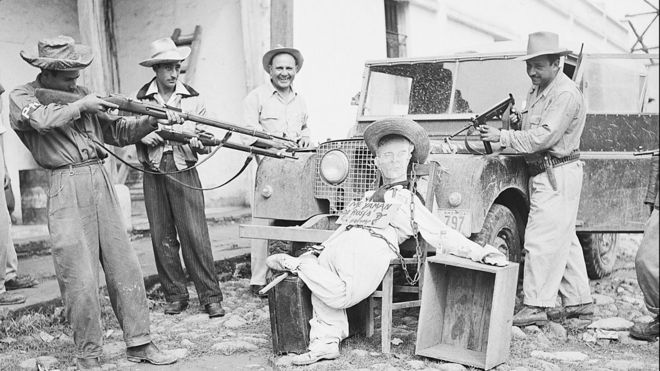
July 14, 1969: "The Football War" breaks out between El Salvador and Honduras, neighboring nations in Central America. It was more war than football.
Although the name implies that the conflict was due to a football match -- or a soccer game, as Americans would say -- the causes of the war went much deeper. Honduras has more than five times the area of neighboring El Salvador, but in 1969 the population of El Salvador, 3.7 million, was 40 percent larger than that of Honduras, 2.6 million. At the beginning of the 20th century, Salvadorans had begun migrating to Honduras in large numbers. By 1969, more than 300,000 Salvadorans were living in Honduras. These Salvadorans made up more than 10 percent of the population of Honduras.
In Honduras, as in much of Central America, a large majority of the land was owned by large landowners or big corporations. The United Fruit Company owned 10 percent of the land, making it hard for the average landowner to compete.
In 1966, United Fruit banded together with many other large companies to create la Federación Nacional de Agricultores y Ganaderos de Honduras (FENAGH; the National Federation of Farmers and Livestock-Farmers of Honduras). FENAGH was anti-peasantry as well as anti-Salvadoran. This group put pressure on the Honduran president, General Oswaldo López Arellano, to protect the property of wealthy landowners.
The countries were set to meet in a 2-leg qualifier for the 1970 World Cup. There was fighting between fans at the first game, in the Honduran capital of Tegucigalpa on June 8, 1969, which Honduras won 1–0. The second game, on June 15, in the Salvadoran capital of San Salvador, which was won 3–0 by El Salvador, was followed by even greater violence.
On June 27, 1969 the play-off match took place on neutral ground, in Mexico City. El Salvador won, 3–2 after extra time. The same day, El Salvador dissolved all diplomatic ties with Honduras, stating that in the 10 days since the game in El Salvador, 11,700 Salvadorans had been forced to flee Honduras. It said that as Honduras had "done nothing to prevent murder, oppression, rape, plundering and the mass expulsion of Salvadorans," there was little point in maintaining relations.
Late in the afternoon of July 14, 1969, the Salvadoran Air Force attacked targets inside Honduras. The larger Salvadoran Army launched major offensives along the two main roads connecting the two nations and invaded Honduras. Initially, rapid progress was made by the Salvadoran army within striking distance of Tegucigalpa.
The momentum of the advance did not last, however. Honduras' Air Force struck back, and turned the war into a stalemate. The Organization of American States (OAS) negotiated a cease-fire on July 18. Honduras had lost 2,100 people, El Salvador 900. Result: Nothing. The status quo ante bellum was re-established.
El Salvador were not punished by FIFA, the governing body for world soccer: They still received the one and only berth in the World Cup allotted to CONCACAF, the region covering North America, Central America, and the Caribbean nations -- aside from the hosts, Mexico. El Salvador lost all 3 of their Group Stage matches.
In spite of their tensions, El Salvador and Honduras have never gone to war with each other again. Of course, El Salvador had a very nasty civil war from 1979 to 1992.
*
July 14, 1969 was a Monday. These Major League Baseball games were played that day:
* The New York Mets lost to the Chicago Cubs, 1-0 at Wrigley Field in Chicago. Bill Hands pitched a 6-hit shutout to outpitch Tom Seaver. But the Mets would beat the Cubs out for the National League Eastern Division title.
* The Montreal Expos beat the Pittsburgh Pirates, 2-0 at Jarry Park in Montreal. Bill Stoneman pitched an 8-hit shutout. Roberto Clemente got 3 of those hits. Willie Stargell didn't get any of them, although he did draw a walk.
* The Washington Senators beat the Detroit Tigers, 3-0 at Robert F. Kennedy Memorial Stadium in Washington. Joe Coleman pitched a 5-hit shutout.
* The Minnesota Twins beat the Chicago White Sox, 4-3 at Metropolitan Stadium in the Minneapolis suburb of Bloomington, Minnesota. Harmon Killebrew went 1-for-4. Rod Carew got a hit as a pinch-hitter.
* The Los Angeles Dodgers beat the Houston Astros, 4-1 at the Astrodome in Houston.
* The California Angels beat the Kansas City Royals, 2-0 at Anaheim Stadium (now Angel Stadium of Anaheim). George Brunet pitched a 2-hit shutout.
* The New York Yankees and the Boston Red Sox were rained out at Yankee Stadium. The game was made up as part of a doubleheader the next day. The Red Sox won the opener, 7-6. Ray Culp outpitched Mel Stottlemyre. Joe Pepitone and Frank Fernandez hit home runs. The Yankees won the nightcap, 4-1. Stan Bahnsen outpitched Sonny Siebert. Over the 2 games, Carl Yastrzemski went 0-for-7, but drew 2 walks.
* The Baltimore Orioles and the Cleveland Indians were rained out at Memorial Stadium in Baltimore. The game was made up as part of a doubleheader 2 days later. The Indians won the 1st game, 6-4. The Orioles won the 2nd game, 6-5. Over the 2 games, Brooks Robinson went 2-for-9, and Frank Robinson went 2-for-4 with a home run, a walk and an RBI.
* And the Atlanta Braves, the Cincinnati Reds, the Philadelphia Phillies, the St. Louis Cardinals, the San Diego Padres, the San Francisco Giants, the Oakland Athletics and the Seattle Pilots were not scheduled.


No comments:
Post a Comment