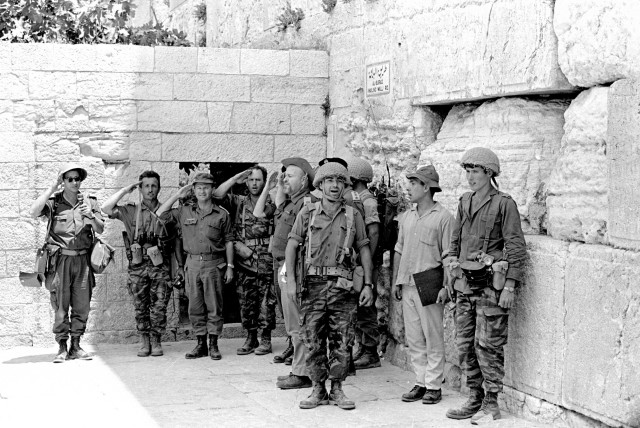
June 10, 1967: One of the most stunning victories in the history of warfare occurs. Israel defeats its Arab neighbors in just 6 days.
Those nations -- Egypt, Syria and Jordan -- had declared war on Israel at the moment of its independence in 1948, and lost. They had fought Israel again in 1956, and lost. The third time would not be the charm, either.
In April 1967, Syria shot at an Israeli tractor ploughing in the demilitarized zone, which Syria considered an ongoing practice of Israeli encroachment on contested land. The event occasioned an escalation into a prewar aerial clash.
In May 1967, following misinformation about Israeli intentions provided by the Soviet Union, President Gamal Abdel Nasser of Egypt expelled United Nations peacekeepers who had been stationed in the Sinai Peninsula since the Suez Crisis of 1956-57, which included the 2nd Arab-Israeli War. Nasser announced a blockade of Israel's access to the Red Sea, which was international waters, via the Straits of Tiran. Israel considered this an act of war. Both sides' armies were mobilized.
In early June, Israeli Foreign Minister Abba Eban flew to Washington, to tell President Lyndon B. Johnson of what was going on. LBJ had intelligence on each side's capabilities, and, despite the numerical advantage for the Arabs, he knew the Israelis were better-equipped to win a war. He told Eban, "You'll lick 'em. If you attack first, you'll lick 'em in 7 days. If they attack first, you'll lick 'em in 10. But if you attack first, we can't help you."
The implication was that the Arab nations had the support of the Soviet Union. And, for the 1st time since its installation in 1963, as a better means of communication after the Cuban Missile Crisis, the Washington-Moscow "hot line" was used. LBJ spoke to Soviet Premier Alexei Kosygin, and asked him to stay out of it, and wait and see what developed.
Kosygin agreed: He was 14 years old when World War I broke out, and a People's Commissar when World War II began. He realized that the falling of alliance "dominoes" had led to those wars, and he knew the damage that was caused in them. He did not want a World War III any more than Johnson did.
On June 5, Israel launched a series of airstrikes against Egyptian airfields, catching Egypt by surprise: Nearly its entire air force was wiped out at a stroke. At the same time, Israel launched ground offensives into the Sinai, and into the Gaza Strip, which Egypt also controlled. Nasser quickly realized that both positions were untenable, and ordered both territories evacuated.
A week earlier, Nasser and King Hussein I of Jordan had signed a defense treaty. The idea was that, if Israel attacked, Jordan would not attack, but would be the main defensive force, tying Israeli forces down. After Egypt was attacked, Egyptian commanders ordered the Jordanian commanders to attack. They did, and it was an absolute fiasco. It took years for relations between Egypt and Jordan to recover.
Syrian troops attacked from the north, and got clobbered, to the point where Israel took Syrian territory, the Golan Heights. It cannot be emphasized enough: It's not just that the Israelis -- in command and in the theater of war -- knew what they were doing, it's that the Arab forces didn't know what they were doing. It was proper training and well-retained know-how vs. near-complete incompetence.
On June 8, the 4th day, Egypt and Jordan agreed to a ceasefire. On June 9, the 5th day, Syria agreed as well. On June 10, Israel had the Sinai, Gaza, the Golan, and, most importantly from their perspective, the West Bank region of Jordan, from the Jordan River to the previous Israeli border. This included the entirety of the city of Jerusalem, the holiest site in Judaism. "Next year in Jerusalem" was finally possible. They lost fewer than 1,000 personnel; the Arabs, over 20,000.
In the tradition of generals becoming heads of government, Yitzhak Rabin, Chief of Staff of the Israeli Defense Forces, and Ariel Sharon, the leading field commander of the Six-Day War, each eventually won election as Prime Minister.
Levi Eshkol, Prime Minister of Israel at the time, died in office in 1969. He was succeeded by Golda Meir, the country's 1st female head of government. Nasser died in 1970, replaced by his Vice President, Anwar Sadat. In 1973, Egypt and Syria tried again, without Jordan: King Hussein wanted no part of another war with Israel.
Sadat and Syrian President Hafez Assad thought that the element of surprise made the difference against them in '67, so it could make the difference for them in '73: They attacked on Yom Kippur, the holiest day on the Jewish calendar, thinking they could catch Israeli soldiers in temple and away from their posts. It didn't work: After initial gains, the war turned into a dangerous stalemate, and American mediation ended it on terms favorable to the Israelis after 3 weeks.
Now, Sadat had had enough, too. In 1977, with Menachem Begin having ended Rabin's 1st tenure as Prime Minister, Sadat approached Begin about a peace treaty. With negotiations led by President Jimmy Carter, the Camp David Accords were signed on the White House lawn in 1978. That peace still holds. It involved Israel returning the Sinai Peninsula -- but not the Gaza Strip -- to Egypt.
A state of war still officially existed between Israel and Jordan. But, following the Gaza-Jericho Accords between Israel and the Palestinian Authority in 1993, signed by Rabin, who had been elected back into office, King Hussein and Rabin signed a peace treaty in 1994. That peace still holds, after the assassinations of Sadat and Rabin, and the natural deaths of Meir, Sharon, Hussein and Assad. However, Assad was succeeded by his son, Bashar Assad, and he has been an even more brutal dictator than his father. And, at least officially, a state of war still exists between Syria and Israel.
*
June 10, 1967 was a Saturday. Darren Robinson, of the rap group The Fat Boys, was born. This was also the day that the Gateway Arch opened in St. Louis. I have a separate entry for that event.
These games were played in Major League Baseball that day:
* The New York Yankees lost nearly as badly as the Arab nations did -- and, like them, on home soil. They lost 9-0 to the Chicago White Sox at Yankee Stadium. Gary Peters went the distance for the Pale Hose, giving up just 4 hits, all singles: To Mickey Mantle, Joe Pepitone, Horace Clarke and Charlie Smith, for whom the Yankees traded Roger Maris to St. Louis, even-up. Dumb trade, although Roger was happier.
Thad Tillotson didn't get out of the 5th inning, giving up home runs to Don Buford and to Peters himself. Peters got 2 hits, and Pete Ward reached base 5 times: 2 doubles, a single and 2 walks.
* The Washington Senators beat the Boston Red Sox, 7-3 at Fenway Park in Boston. The Senators got 2 home runs, both from Frank Howard. The Red Sox got 2 home runs, from George Scott and Rico Petrocelli. Carl Yastrzemski went 1-for-2 with 2 walks, while Tony Conigliaro went 0-for-4.
* The San Francisco Giants beat the Atlanta Braves, 7-4 at Atlanta Stadium. (It was renamed Atlanta-Fulton County Stadium in 1975.) The Giants got homers from Willie McCovey, Tom Haller and Jim Ray Hart. Willie Mays went 1-for-4. The Braves got homers from Felipe Alou and Gary Geiger. Hank Aaron went 3-for-4, but Joe Torre went 0-for-4.
* The Pittsburgh Pirates beat the Philadelphia Phillies, 4-3 at Forbes Field in Pittsburgh. Roberto Clemente went 2-for-4, and Willie Stargell went 1-for-4 with an RBI.
* The Cincinnati Reds beat the Houston Astros, 9-4 at Crosley Field in Cincinnati. Pete Rose went 1-for-4 with an RBI. For the Astros, Jimmy Wynn, a Cincinnati native, hit a home run over the left-field scoreboard, and onto Interstate 75, the Mill Creek Expressway.
* The St. Louis Cardinals beat the Los Angeles Dodgers, 5-2 at Busch Memorial Stadium in St. Louis.
* The Kansas City Athletics beat the Cleveland Indians, 10-1 at Kansas City Municipal Stadium.
* The Minnesota Twins beat the Baltimore Orioles, 8-1 at Metropolitan Stadium in the Minneapolis suburb of Bloomington, Minnesota. Rich Rollins hit 2 home runs, Tony Oliva hit 1, and Harmon Killebrew went 0-for-2, but drew 3 walks. The only Oriole run came on a solo homer by Boog Powell. Frank Robinson went 0-for-4, and Brooks Robinson went 1-for-3.
* The California Angels beat the Detroit Tigers, 2-0 at Anaheim Stadium. (It was renamed Edison International Field in 1997, and Angel Stadium of Anaheim in 2004.) Clyde Wright pitched 7 innings of 4-hit ball, and Minnie Rojas went 2 perfect to finish the shutout. Al Kaline went 0-for-4.
* And the New York Mets and the Chicago Cubs were rained out at Wrigley Field in Chicago. Since a doubleheader was already scheduled for the next day, this game was moved to August 31. The Cubs won, 2-1. Rookie Tom Seaver pitched 9 innings, to no avail. Ernie Banks went 1-for-5, and was replaced for a pinch-runner -- Fergie Jenkins, usually a pitcher. Al Spangler singled home the winning run in the bottom of the 11th inning.


No comments:
Post a Comment