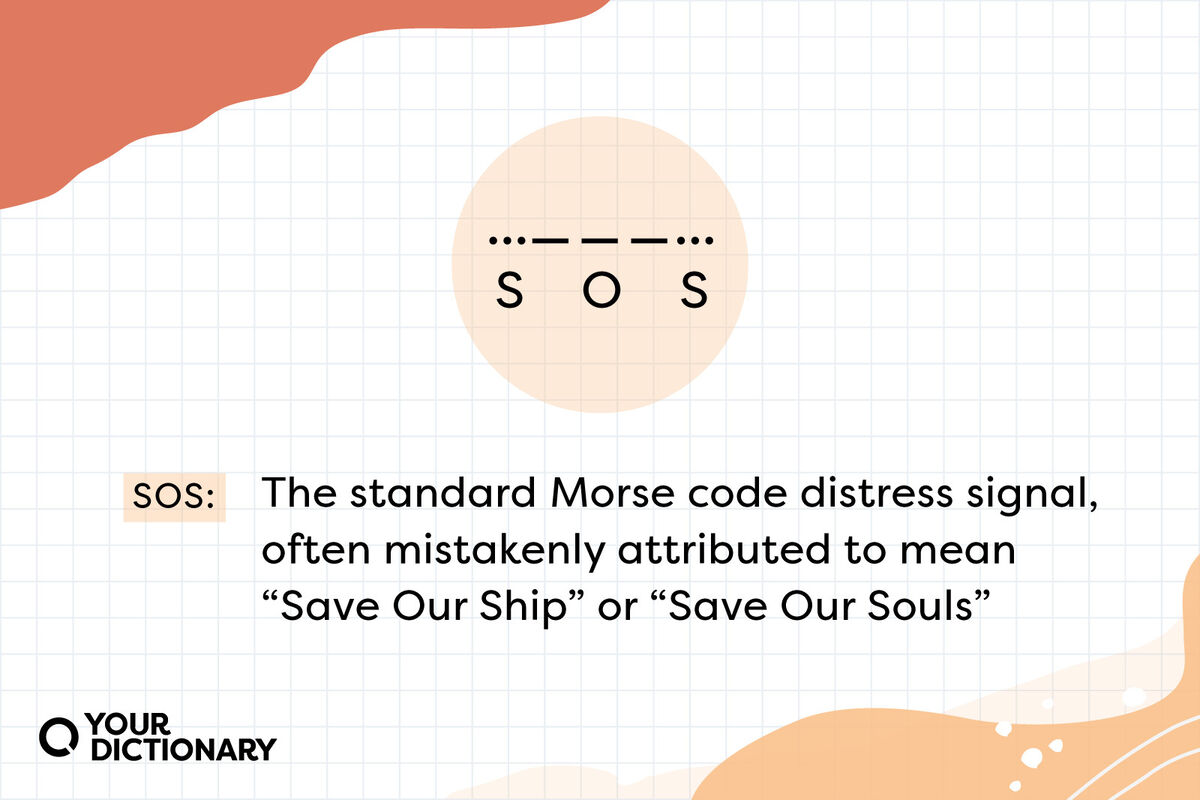
June 10, 1909: The emergency signal "SOS" is used for the 1st time. It works exactly the way it was intended.
On January 7, 1904, the Marconi International Marine Communication Company (founded by radio inventor Guglielmo Marconi) issued a directive that ships in distress would use Morse code to tap out "CQD." The "CQ" stood for "sécu," an abbreviation of the French word sécurité. It had been used on land telegraphs for years to signify an alert. The "D" was added to indicate "distress." But typing it out was long and difficult: -.-. --.- -..
A little over a year later, "SOS" was adopted to replace CQD. Most believe it stands for either "save our ship" or "save our souls." But it was suggested by Germany, so, in German, "Save our ship" would be "Rette unser Schiff"; and "Save our souls" would be "Rettet unsere Seelen" -- either way, the acronym would have been "RUS," which could have been mistaken for an abbreviation for "Russia," already a historic enemy of Germany.
Prior to the invention of radio, ships had to use flags, flares and horns to tell people that a ship was sinking. There were other competing signals to SOS, but it won out do to its simplicity, being easy to type out: Three dots, followed by three dashes, followed by three dots. ...---...
The first recorded use of SOS as a distress signal was on June 10, 1909, when a British passenger ship, the Cunard liner RMS Slavonia, drifted off course in fog, and ran aground at Ponta dos Fenais, in the Portuguese-controlled (then as now) Azores. All 514 people on board were rescued, and much of the ship's cargo was salvaged, although the ship was declared lost.
*
June 10, 1909 was a Thursday. Only 2 baseball games were played that day. The New York Highlanders, the team that would become the Yankees, lost to the Detroit Tigers, 2-1 at Hilltop Park. Ty Cobb went 2-for-3 with a walk and a stolen base. Willie Keeler went 0-for-3.
And the New York Giants lost to the Chicago Cubs, 5-0 at West Side Park in Chicago. Jack Pfeister, who had enough success against New York that he was known as Jack the Giant Killer in reference to the story of Jack and the Beanstalk, allowed 8 hits, but kept the shutout, outpitching Hall-of-Famer Rube Marquard.


No comments:
Post a Comment