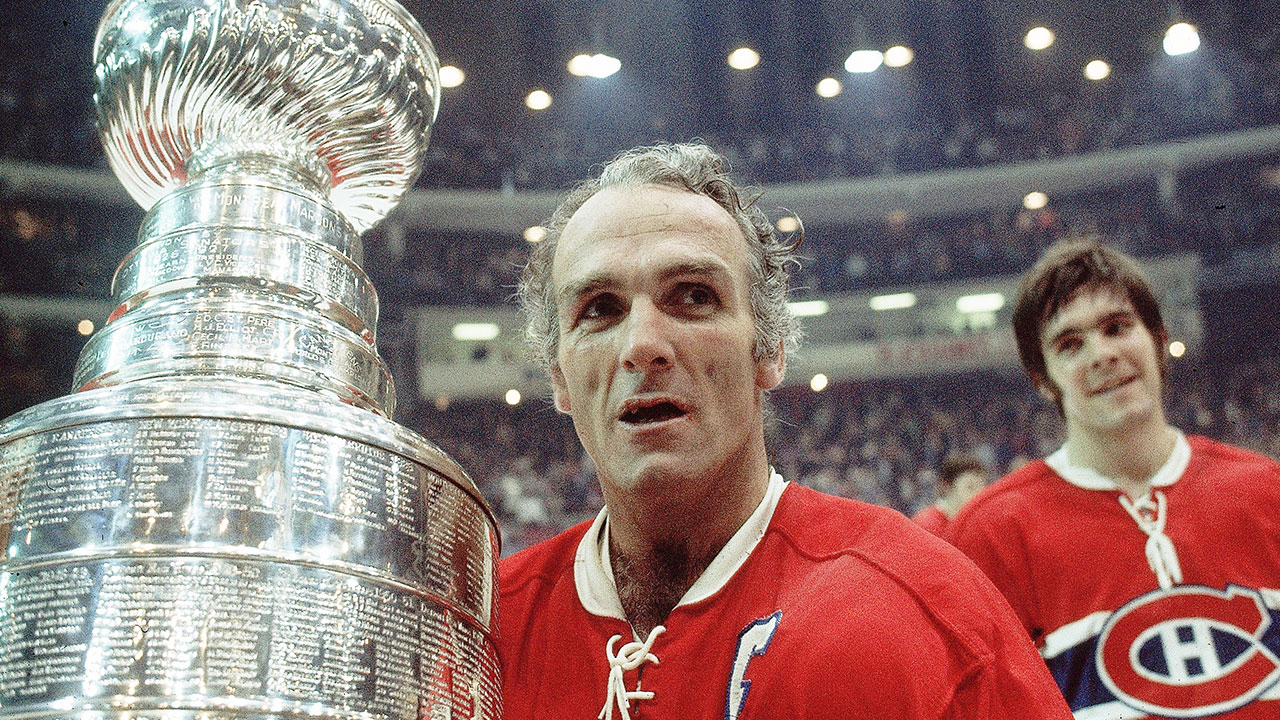
May 18, 1971: Game 7 of the Stanley Cup Finals is played at Chicago Stadium. For most American hockey fans, it was the last and biggest game of the season, to determine the Champions.
For Canadians, it was bigger than that. There was a tension in the air -- and very few Americans even knew about it.
The Montreal Canadiens had won the Stanley Cup 12 times in the preceding 26 years, and had become symbolic of French Canada's struggle to be seen in the larger English-speaking nation, dominated as it was by the federal government in Ottawa and the bankers and broadcasters of Toronto. When Maurice "the Rocket" Richard was suspended following an on-ice incident prior to the 1955 Stanley Cup Playoffs, it was seen by many as a swipe against French-Canadians and their culture, and there was a riot in Montreal.
The election of a Liberal Party government in the Province of Quebec led to some major reforms, whose lack of violence led to it becoming known as the Quiet Revolution. But that wasn't enough for some people, as terrorists began a kidnapping campaign in October 1970, known as the October Crisis. Prime Minister Pierre Trudeau invoked the War Measures Act, which ended the crisis, but there were still tensions.
Meanwhile, the Canadiens kept winning, led by longtime Captain Jean Béliveau, and the Rocket's younger brother, Henri Richard, short and not as sensational, but speedy and effective, and known as "the Pocket Rocket." They made 5 straight Finals, 1965 to 1969, losing only in 1967. The 1969-70 season was something of a transition, but they got back to the Finals in 1971, with a new goaltender, Ken Dryden.
During the season, Claude Ruel, who had coached "Les Habitantes" (the Habitants, or the Farmers, or "the Habs" for short) to the 1969 Cup, resigned, and was replaced by Al MacNeil, who had coached their top minor-league team. He was the 1st man ever to coach the team who did not speak French. In the wake of both the Quiet Revolution and the October Crisis, that made him stick out like a sore thumb. A majority of the players were still of French descent and, while they spoke English, preferred to be spoken to in French.

The Canadiens made a key acquisition, trading 3 players to the Detroit Red Wings for Frank Mahovlich. Mahovlich had been feuding with Wings owner Bruce Norris, a man who won many power struggles, but never a popularity contest. One of the players the Habs gave up, Mickey Redmond, turned into a star, the 1st Wings player ever to score 50 goals in a season, a shocking stat given that the Wings had already had Gordie Howe, Ted Lindsay, Alex Delvecchio and, yes, Mahovlich.
But Montreal never missed Redmond, because Mahovlich -- to this day, perhaps the greatest player in Toronto Maple Leafs history, and seeing his famed Number 27 on the back of a uniform in Canadiens bleu, blanc et rouge must have been a big shock for Canadians west of Ottawa -- became a key reason why they recovered. At 33, he was rejuvenated, playing alongside his 24-year-old brother, Pete Mahovlich, who was just coming into his own.
In the 1st round of the Playoffs, the Canadiens pulled one of the great upsets in NHL history, eliminating the defending Champions, the Boston Bruins, in spite of record-setting seasons by Bobby Orr and Phil Esposito. Then they beat the Minnesota North Stars to get into the Finals.
They faced the Chicago Black Hawks, led by the Golden Jet, Bobby Hull, and the nearly as deadly Stan Mikita. Bobby's younger brother, Dennis Hull, known as the Silver Jet, was also a talented player. In goal was Tony Esposito. No longer merely Phil's younger brother, his shutouts earned him the nickname "Tony O."
The Canadiens had traded him, and also Rogie Vachon, who became a star with the Los Angeles Kings. They also traded the veteran Lorne "Gump" Worsley, who, despite being 41, had something left. They traded 3 future Hall of Fame goalies, 2 of them early in their careers, getting little in return. That's how much they believed in Dryden.
The Hawks swept the Philadelphia Flyers in the Quarterfinals. In the Semifinals against the New York Rangers, they overcome a shocking triple-overtime goal by Pete Stemkowski in Game 6 to win at home in Game 7. They were tested, and favored going into the Finals with the Habs.
That season, Béliveau became the 4th player in NHL history to score 500 goals in a career. The season before, Hull became the 3rd. The 2nd was Howe, in 1962. The 1st was Maurice Richard, in 1957.
The Hawks had the better record, so they had home-ice advantage. They won Game 1 at Chicago Stadium, 2-1, when Pappin scored, 1:11 into overtime. Pappin scored again in Game 2, and Angotti scored twice, as the Hawks won, 5-3.
The next 2 games were at the Montreal Forum, and the Canadiens responded, winning Game 3, 4-2. Frank Mahovlich scored 2 goals, and Pete scored 1. The Habs also won Game 4, 5-2. Pete scored again, and Béliveau scored what turned out to be the last goal of his career.
MacNeil was not happy with the play of Henri Richard. He was 34, and his gray hair made him look a lot older. (His brother Maurice still had jet-black hair when he retired at age 38, and famously did commercials, in English and French, for Grecian Formula men's hair coloring.)
the team's Alternate Captain, he appeared to be on the downside of his career, and MacNeil benched him for Game 5 in Chicago. The Hawks won, 2-0, and were a win away from the Cup.
The noted Richard family temper flared up. Henri told the English-language media outlets, "He's the worst coach I ever played for." He told the French-language outlets, "MacNeil est incompétent." For Anglophone fans, no translation was necessary.
It had been 7 months since the October Crisis, and things had calmed down. But now, the tensions rose again. Going into the Forum for Game 6, MacNeil and his family needed bodyguards, lest another riot break out like it did for Henri's brother in 1955. The Hawks led 3-2 after 2 periods. But in the 3rd period, Frank Mahovlich tied it, and assisted on his brother Pete's goal at 8:55, which turned out to be the winner. The Finals would go to a Game 7 in Chicago.
In the last minute of the 1st period, Dennis Hull scored on his brother Bobby's assist. At 7:33 of the 2nd period, Danny O'Shea made it 2-0 Chicago. The Stadium was packed to the gills, and, with standing-room tickets, it was probably well above its listed capacity of 18,472.
But Hawks coach Billy Reay made his own coaching-benching mistake, as he put Bobby Hull and Mikita on the bench for extended periods, in favor of Angotti and Eric Nesterenko, the latter of whom was, like Bobby and Stan, one of the holdovers from the '61 Cup winners. Reay did this through a pair of 4-on-4 situations, a wide-open format that should have favored the Golden Jet. But rookie Rejean Houle had pretty much shut him down.
With 2:42 left in the 2nd period, Jacques Lemaire put the Habs on the board. With 1:40 to go, Lemaire assisted Richard, who tied the game. Richard had won Game 6 of the Finals, and thus the Cup, with an overtime goal. Now, 2:34 into the 3rd period, assisted by young players Houle and Guy Lapointe, he scored the difference-maker. But it took a spectacular toe-save by Dryden on Pappin, perhaps the most consequential (if not best) save in hockey history, to seal the deal. The Canadiens won, 3-2, and had their 17th Stanley Cup.
At this point, Ken Dryden had played in 6 regular-season games, and 7 games in the Stanley Cup Finals. He was awarded the Conn Smythe Trophy as most valuable player of the Playoffs. The next season, he won the Calder Trophy as NHL Rookie of the Year. He remains the only player in the "big four" North American sports to be named Rookie of the Year after being named a postseason MVP. (Todd Worrell of the St. Louis Cardinals might have been so honored in 1985 and '86, if the Cardinals had hung on to win the World Series.)
For the 10th time, setting a record, Jean Béliveau and Henri Richard were Stanley Cup winners. For a record 5th time, Béliveau received the Cup as team Captain from the President of the NHL, Clarence Campbell, who once again was restored to his place as the most hated man in Montreal.
Richard later admitted, "I should have kept my mouth shut until after the series." And he and MacNeil eventually reconciled. However, Richard wasn't the only Canadiens player unhappy with MacNeil. John Ferguson, a Vancouver Scotsman who spoke not a word of French, and who had just won his 5th Cup as a Canadien, also said that MacNeil was the worst coach he ever played for.
Béliveau retired. Richard was named team Captain. And MacNeil was returned to his previous job, as head coach of the Habs' top farm team, the Montreal Voyageurs. In what had to be a message to MacNeil, the Voyageurs were immediately moved to Halifax, Nova Scotia, in the Maritime Provinces, in Atlantic Canada, certainly in Anglophone Canada, and nearly 800 miles from Montreal. But this is not as much of a punishment as it might appear: MacNeil was from Nova Scotia, and was the 1st native of the Maritimes to be an NHL head coach.
Scotty Bowman was hired to replace MacNeil, and he led the Canadiens to the Cup in 1973, 1976, 1977, 1978 and 1979. That '73 Cup gave Henri Richard a record 11th World Championship. This tied the record for North American sports, set by Bill Russell of the Boston Celtics. They remain the only 2 men to have more championship rings as players than fingers. He retired in 1975, just before Bowman led the team to 4 in a row.
Henri Richard and Jean Béliveau each remained with the Canadiens as a "club ambassador," so each has his name appearing on the Stanley Cup 17 times. But since Maurice Richard was also an Ambassadeur, his name appears on it a record 20 times. Maurice Richard died in 2000, Jean Béliveau in 2014, and Henri Richard on March 6, 2020. (Not from COVID: He had been diagnosed with Alzheimer's disease in 2015.)
MacNeil received only 1 more head coaching job, with the Atlanta Flames in 1979. He moved with them to Calgary in 1980, coached them through the 1982 Playoffs, and remained in their organization as a scout. In the 2002-03 season, he was interim head coach for 11 games. As of May 18, 2022, he is still alive, and Canadien fans seem to have forgiven him for benching Henri in the '71 Finals.
UPDATE: MacNeil died on January 5, 2025, Dryden on September 5, 8 months later.
In 1998, The Hockey News released their list of the
100 Greatest Hockey Players. Béliveau was ranked 7th, Dryden 26th, Mahovlich 27th, Richard 30th, and Savard 81st. For the Black Hawks, Hull was 8th, Mikita 17th, and Esposito 79th. In 2017, all of those men, and also the Canadiens' Lapointe and Lemaire, were named to the NHL's 100th
Anniversary 100 Greatest Players.
*
May 18, 1971 was a Tuesday. Brad Friedel, star American soccer goalkeeper, was born.
Game 7 of the American Basketball Association Finals was played on this day, at the Salt Palace in Salt Lake City, Utah. The Utah Stars beat the Louisville-based Kentucky Colonels, 131-121. I have a separate entry for this event. It would be the only title that the State of Utah could claim as a "major league" championship until Real Salt Lake won the 2009 MLS Cup.
The NBA title had been won by the Milwaukee Bucks 18 days earlier. Football was out of season. These games were played in Major League Baseball:
* The Montreal Expos lost the the Pittsburgh Pirates, 3-2 at Three Rivers Stadium in Pittsburgh, in front of 10,226 fans. I wonder if any of them were from Montreal. I wonder if anyone back in Montreal noticed. Dave Cash, who later played for the Expos, singled Gene Alley home to win the game in the bottom of the 9th inning. Roberto Clemente went 2-for-4 with an RBI. Willie Stargell did not play.
* The New York Yankees lost to the Baltimore Orioles, 6-2 at Yankee Stadium. Mike Cuellar outpitched Fritz Peterson. Bobby Murcer went 3-for-4 with a home run. Brooks Robinson and Paul Blair homered for the O's, while Frank Robinson went 2-for-5 with an RBI.
* The New York Mets lost to the Atlanta Braves, 8-6 at Atlanta Stadium (later renamed Atlanta-Fulton County Stadium). Hank Aaron hit his 605th career home run. The Mets got a home run from Tommie Agee, and 2 from Bob Aspromonte, who, that season, retired as the last active former Brooklyn Dodger.
* The Boston Red Sox beat the Detroit Tigers, 5-3 at Fenway Park in Boston. Carl Yastrzemski went 2-for-4. Al Kaline went 1-for-3 with a walk and 2 RBIs.
* The Cleveland Indians beat the Washington Senators, 7-3 at Robert F. Kennedy Memorial Stadium in Washington.
* The Cincinnati Reds beat the Philadelphia Phillies, 4-3 at Riverfront Stadium in Cincinnati. Pete Rose and Johnny Bench each went 1-for-4, with Rose's hit being a solo home run.
* The San Francisco Giants beat the Chicago Cubs, 7-3 at Wrigley Field in Chicago. Willie Mays went 2-for-4 with a walk. Ernie Banks, in his final season, struck out as a pinch-hitter.
* The St. Louis Cardinals beat the Los Angeles Dodgers, 6-5 at Busch Memorial Stadium in St. Louis. Lou Brock went 2-for-4 with a walk.
* The Houston Astros beat the San Diego Padres, 3-2 at the Astrodome in Houston.
* The California Angels beat the Minnesota Twins, 3-1 at Anaheim Stadium (now Angel Stadium of Anaheim). Harmon Killebrew went 2-for-4. Rod Carew went 1-for-4 with an RBI.
* And the Oakland Athletics beat the Milwaukee Brewers, 5-2 at the Oakland Coliseum. Reggie Jackson went 0-for-4, but the A's got home runs from Rick Monday, Joe Rudi and Sal Bando.


No comments:
Post a Comment