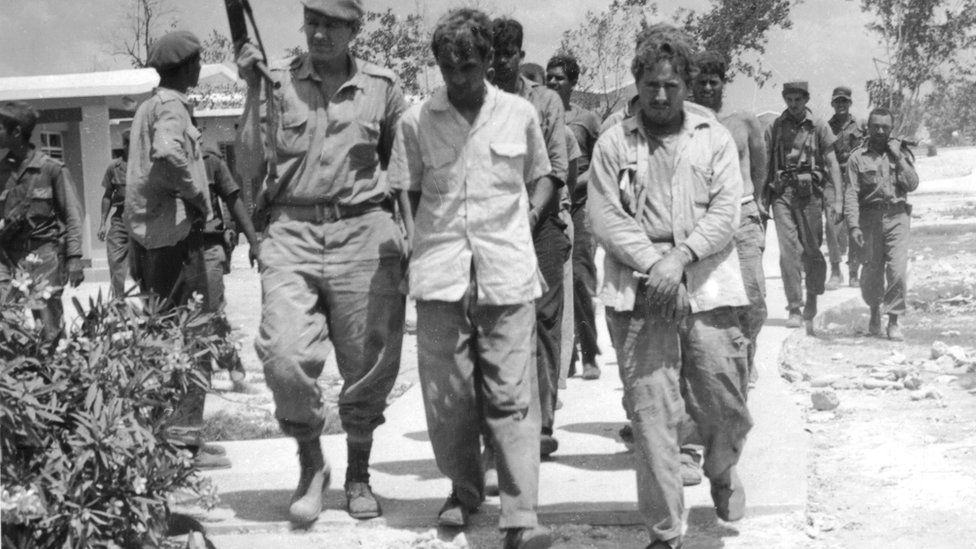
April 17, 1961: Cuban exiles, 1,500 strong, invade Cuba at the Bay of Pigs, in an attempt to overthrow the Communist dictatorship of Fidel Castro. It is a disaster, as 118 of them are killed, and the rest are captured by the Cuban Army.
They were people of influence in Cuba before January 1, 1959, when Castro's revolution overthrew the fascist dictatorship of Fulgencio Batista. They were financed by Americans who had influence there at the time, including organized crime figures.
Among the men involved in the invasion were Bernard Barker and Virgilio González. Frank Sturgis also claimed to have participated, although this has never been officially confirmed. All 3 men would be among the burglars at the Watergate complex in 1972. The other 2 Watergate burglars, Eugenio Martínez and James McCord, appear not to have participated in the Bay of Pigs invasion, and never claimed that they did.
The plan was drawn up by the CIA in the waning days of the Administration of President Dwight D. Eisenhower, but he left office under the 2-term limit of the 22nd Amendment to the Constitution before it could be put in play. The plan was presented to the new President, John F. Kennedy. He approved it, and regretted it.
JFK could have blamed Eisenhower, or CIA Director Allen Dulles, whose brother John Foster Dulles had been Eisenhower's 1st Secretary of State until his death shortly after Castro's takeover. Instead, he took full responsibility for the operation. On April 21, in a press conference, he said, "There's an old saying that victory has a hundred fathers and defeat is an orphan... Further statements, detailed discussions, are not to conceal responsibility, because I'm the responsible officer of the government."
Conservative Americans, with their hatred of Communism, blasted Kennedy for not providing sufficient air support for the invasion. Kennedy knew that, if he had provided what they considered to be sufficient, the Soviet Union might take such an action against their ally as an act of war, and they might retaliate by trying to take West Berlin, or some other Western-held location.
But most Americans, remembering how "Ike" had botched the response to the U-2 spy-plane incident the year before, found JFK's taking of responsibility refreshing, and his approval rating actually went up: It was 78 percent in a poll released on April 11, and 83 percent in one released on May 3. Of course, while many newspaper chains were owned by conservative men, there was no Fox News to take potshots at him 24 hours a day.
In the aftermath of the Bay of Pigs, Kennedy blamed it on a lack of current information. So he had the White House Situation Room created. The facility has secure communications systems; the wood panels over the walls hide audio, video, and other systems. (I would like to do a post solely on the "Sit Room" and its history, but I don't have an exact date as to its opening.)
When the Cuban Missile Crisis occurred a year and a half later, demonstrators gathered outside the White House, demanding that Kennedy take the offensive. One held a picket sign that read, "DON'T CHICKEN-OUT THIS TIME JACK!" That was about as rough as anybody ever got with a protest of a President in the pre-Watergate era. Kennedy did not chicken out: He held firm, and found a peaceful resolution to that conflict.
JFK's approval rating would never be so high again. In the 1st poll taken after the Cuban Missile Crisis, released on November 21, 1962, it was 74 percent. In the last poll taken during his Presidency, released on November 13, 1963, it was 58 percent.
*
April 17, 1961 was a Monday. Norman Julius Esiason, later to be the quarterback and radio show host known as Boomer, was born.
Only 3 games were played in Major League Baseball that day:
* The New York Yankees beat the Kansas City Athletics, 3-0 at Yankee Stadium. Whitey Ford pitched a 3-hit shutout. Mickey Mantle went 3-for-3 with 3 RBIs, including the 1st of 54 home runs he would hit that season. Roger Maris went 0-for-3, and was still looking for his 1st homer. He would go on to hit 61. Yogi Berra went 0-for-2 with 2 walks.
* The Boston Red Sox beat the Los Angeles Angels, 3-2 at Fenway Park in Boston. Carl Yastrzemski, the rookie the BoSox were counting on to succeed Ted Williams in left field, went 0-for-4.
* And the St. Louis Cardinals beat the Los Angeles Dodgers, 9-5 at the Los Angeles Memorial Coliseum. Stan Musial went 1-for-4, and Bob Gibson was the winning pitcher. Duke Snider hit a home run for the Dodgers, who led 4-2 going into the 8th inning, but the Cards scored 3 in the 8th and 4 in the 9th to win it.
Football was out of season. The NHL season had ended the day before, as the Chicago Black Hawks beat the Detroit Red Wings, 5-1 at the Olympia Stadium in Detroit, in Game 6 of the Stanley Cup Finals. It was their 1st Cup win since 1938. It would take until 2010 for them to win another.
The NBA season had ended 6 days before, as the Boston Celtics beat the St. Louis Hawks, 121-112 at the Boston Garden, to take the Finals in 5 games.
Also, Tottenham Hotspur of North London beat visiting Sheffield Wednesday of Yorkshire, 2-1 at White Hart Lane. Bobby Smith and Les Allen scored the goals. This gave "Spurs" their 2nd Football League title, having won their 1st in 1951. By coincidence, that time, their clincher was also a home win over Wednesday. I have a separate entry for this event.
On May 6, Spurs would win the FA Cup Final, beating Leicester City of the Midlands, to become the 1st team to win both the League and the Cup -- "The Double" -- in the 20th Century, since Birmingham's Aston Villa did it in 1897.
As of April 17, 2022, Spurs have never won the League again.


No comments:
Post a Comment