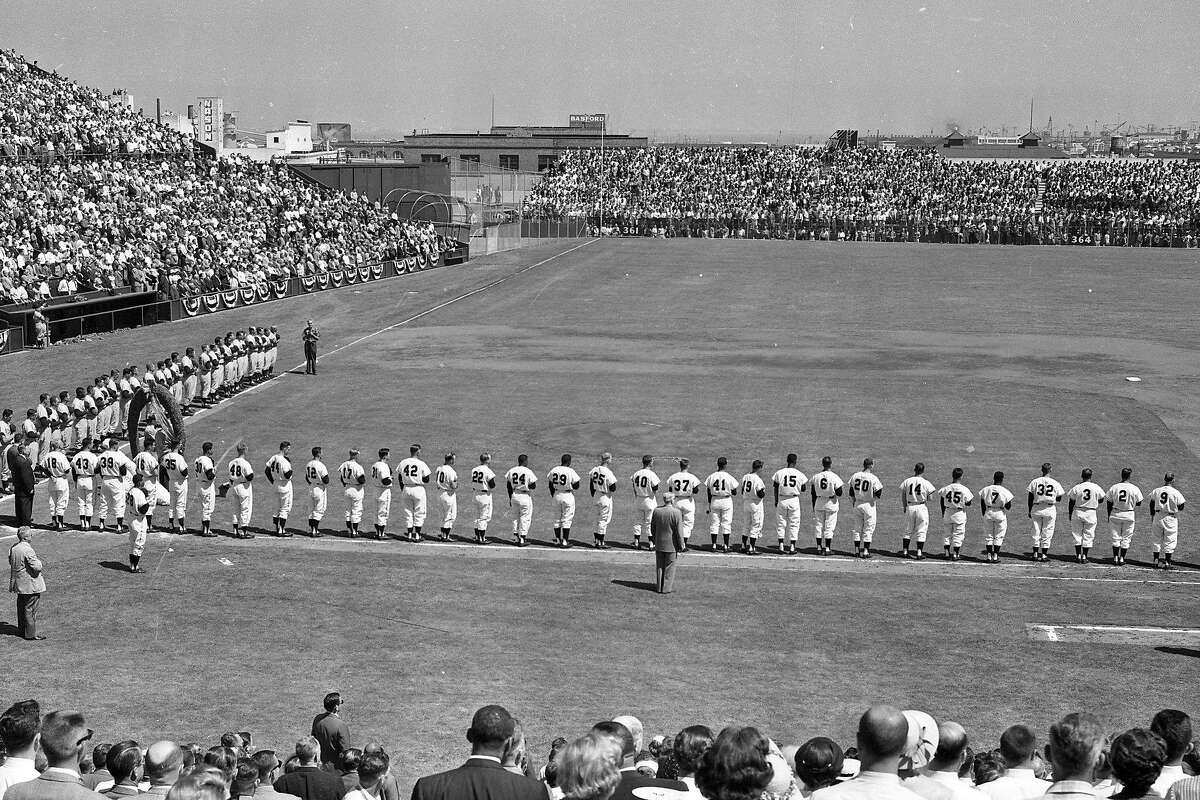
April 15, 1958: For the 1st time, a regular-season Major League Baseball game is played in the State of California. Or on the Pacific Coast. Or even west of Kansas City. And it is the 2 teams that left New York City for California that play each other in it.
The San Francisco Giants, formerly the New York Giants, took up residence at Seals Stadium, which had been the home of the San Francisco Seals of the Pacific Coast League from 1931 to 1957. They would play the 1958 and 1959 seasons until Candlestick Park was ready in 1960. They were taking the place of not just the Seals, but of the Oakland Oaks, who had already moved after the 1955 season.
The Los Angeles Dodgers, formerly the Brooklyn Dodgers, used the Los Angeles Memorial Coliseum as their stopgap facility, until Dodger Stadium could open in 1962. They took the places of the PCL's Los Angeles Angels and Hollywood Stars, rejecting both of those teams' ballparks as too small.
The temporary facilities couldn't have been more different: Seals Stadium was designed for baseball and seated 23,000, while the Coliseum was designed for football and seated 93,000.
The game began with Giant pitcher Ruben Gomez striking out Dodger center fielder Gino Cimoli. It would get no better for the ex-Brooklynites, known sometimes lovingly and sometimes accurately as "Dem Bums": Danny O'Connell led off the bottom of the 3rd with a walk (I seem to recall someone saying that walks can kill you, especially the leadoff variety), Valmy Thomas followed with another, Gomez helped his own cause with a single, Jim Davenport hit a sacrifice fly, and Jim King singled home a run. 2-0 Giants.
In the 4th, Daryl Spencer hit the West Coast's 1st major league home run. Later in the inning, runs were singled home by Gomez and Willie Mays, knocking Don Drysdale out of the box. In the 5th, Orlando Cepeda, making his major league debut, hit a home run to make it 7-0 Giants. The Giants tacked on a run in the 8th, making the final score Giants 8, Dodgers 0.
Aside from Mays, this was a completely different Giants team that had won the World Series just 4 seasons earlier, and another National League Pennant 7 years earlier. The Dodgers were in transition, too: The "Boys of Summer" had been broken up. Jackie Robinson had retired. Roy Campanella had been paralyzed in a car crash. Duke Snider was playing left field instead of his familiar center. Between them, Snider, Pee Wee Reese, Gil Hodges and Carl Furillo went 0-for-12. Gomez went the distance, allowing just 6 hits.
San Francisco is a very provincial city, preferring its own people to outsiders. Cepeda was the 1st Giant hero who began in San Francisco, pitcher Juan Marichal the 2nd, and slugging 1st baseman/left fielder Willie McCovey the 3rd. They've always been more popular there than Mays. Frank Conniff of the New York Journal-American, perhaps the only man ever to interview both men, wrote, "This is the damnedest city. They cheer Khrushchev and boo Willie Mays."
Cepeda would be the NL Rookie of the Year. The next season, McCovey would be called up to the Giants, and would win Rookie of the Year. But the rebuilt Dodgers won the 1959 World Series. They would also win the Series in 1963 and 1965, and the Pennant in 1966. The Giants would win the Pennant in a Playoff from the Dodgers in 1962, but that would be their high-water mark on the West Coast for a long time to come, as they fell just short of the Pennant in 1964, 1965 (to the Dodgers) and 1966 (to the Dodgers again).
In 1962, a new team would be put in the National League, to replace the Giants and the Dodgers: The New York Mets.
But for many people in the New York Tri-State Area, their love of the Giants and the Dodgers would never go away. In 1989, Billy Joel would hit Number 1 with the musical history lesson "We Didn't Start the Fire." The following year, he played the 1st rock concert at Yankee Stadium. When he got to the line, "California baseball," he threw up a middle finger, and the fans -- presumably, including some Mets fans whose parents were Giants and Dodgers fans -- roared their approval.
UPDATE: The Giants have a Wall of Fame. From their 1962 Pennant winners, they have inducted center fielder Willie Mays, 1st basemen and left fielders Orlando Cepeda and Willie McCovey (they switched off, because they both preferred 1st base), 3rd baseman Jim Davenport, right fielder Felipe Alou, catcher Tom Haller; and pitchers Juan Marichal, Gaylord Perry, Mike McCormick, Stu Miller and Bobby Bolin.
They have not, however, inducted manager Alvin Dark. Nor have they inducted his predecessor, the manager at the time of the move from New York to San Francisco, himself a Bay Area native: Bill Rigney. The Bay Area Sports Hall of Fame (BASHOF) has inducted Mays, Cepeda, McCovey, Marichal, Perry and Rigney, but not Dark.
From their 1971 National League Western Division Champions, they have honored Mays, McCovey, Marichal, Perry, 2nd baseman Tito Fuentes, 3rd baseman Jim Ray Hart, right fielder Bobby Bonds, catcher Dick Dietz, and pitcher Jim Barr.
From between their 1971 and 1987 Playoff appearances, they have honored 1st baseman Jack Clark, shortstop Johnnie LeMaster, 3rd baseman Darrell Evans, and pitchers Randy Moffitt (brother of tennis legend Billie Jean King), John Montefusco, Gary Lavelle and Vida Blue. Blue is also in BASHOF, for his previous tenure with the Oakland Athletics.
From their 1987 NL West title, but not their 1989 Pennant, they have honored left fielder Jeffrey Leonard, right fielder Charles "Chili" Davis, and pitcher Greg Minton. From their 1989 NL Pennant, they have honored 1st baseman Will Clark, 2nd baseman Robby Thompson, shortstop Chris Speier, 3rd baseman Matt Williams, left fielder Kevin Mitchell, catchers Bob Brenly and Kirt Manwaring; pitchers Rick Reuschel, Atlee Hammaker, Scott Garelts, Mike Krukow and Jeff Brantley; and team owner Bob Lurie. Clark, Williams, Lurie, and pitcher Dave Dravecky have been inducted into BASHOF.
From their 1993 Playoff near-miss, they have honored pitcher John Burkett. From their 1997 NL West title, they have honored pitcher Rod Beck.From their 2002 Pennant, they have honored left fielder Barry Bonds, right fielder Marvin Benard, 1st baseman J.T. Snow, 2nd baseman Jeff Kent, shortstop Rich Aurilia; pitchers Jason Schmidt, Kirk Rueter, Shawn Estes and Robb Nenn; and team owner Peter Magowan, who saved them from being moved to Tampa Bay in 1993. Manager Dusty Baker has not yet been honored. Bonds, Kent, Magowan and Baker have been inducted into BASHOF.
From their 2010, 2012 and 2014 World Championships, they have honored Magowan, catcher Gerald "Buster" Posey, 1st baseman Brandon Belt, 2nd baseman Joe Panik, shortstop Brandon Crawford, 3rd baseman Pablo Sandoval, right fielder Hunter Pence; and pitchers Matt Cain, Sergio Romo, Jeremy Affeldt, Santiago Castilla, Ryan Vogelsong, Javier López and Brian Wilson. Manager Bruce Bochy has not yet been honored. Magowan, Posey, Cain, Bochy and pitching coach Dave Righetti, a San Jose native who grew up rooting for the Giants before pitching for the Yankees, have been inducted into BASHOF.
Mike Murphy, who started with the Giants as a teenage batboy in 1958, and retired as their clubhouse manager in 2023, is also honored on the Wall. It's also worth noting that Horace Stoneham, who owned the Giants from the death of his father Charles in 1936 until selling them to Bob Lurie in 1976, and who moved the team from New York to San Francisco, is neither on the Giants Wall of Fame or in the Bay Area Sports Hall of Fame.
The Dodgers have retired numbers, and in 2019, they Dodgers established a team hall of fame, "Legends of Dodger Baseball," to include Dodger greats whose numbers had not been retired. The honorees are:
* From their Brooklyn years: Shortstop Harold "Pee Wee" Reese, Number 1 retired; center fielder Edwin "Duke" Snider, Number 4 retired; 1st baseman Gil Hodges, Number 14 retired; 2nd baseman Jim "Junior" Gilliam, Number 19 retired; manager Walter Alston, Number 24 retired; pitcher Don Newcombe, Number 36 not retired; catcher Roy Campanella, Number 39 retired; 2nd baseman Jackie Robinson, Number 42 retired; and broadcaster Vin Scully.
* From the National League Pennants of 1959, 1963, 1965 and 1966, winning the World Series in all but '66: Snider (through 1959), Hodges (through 1959), Gilliam, Alston, Scully, team owner Walter O'Malley, shortstop Maury Wills (Number 30 not retired), pitcher Sandy Koufax (Number 32 retired), pitcher Don Drysdale (Number 53 retired), and Spanish-language broadcaster Jaime Jarrín.
* From the Pennants of 1974, 1977, 1978 and finally winning the World Series in 1981: Alston (retired in 1976), Gilliam (died in 1978), O'Malley (died in 1979), Scully, Jarrín, manager Tommy Lasorda (took office in 1976, Number 2 retired), 1st baseman Steve Garvey (Number 6 not retired), right fielder Reggie Smith (arrived in 1976, Number 8 not retired), 3rd baseman Ron Cey (Number 10 not retired), left fielder and coach Manuel "Manny" Mota (Number 11 not retired), left fielder Johnnie "Dusty" Baker (arrived in 1976, Number 12 not retired), pitcher Don Sutton (Number 20 retired, left after 1980), and pitcher Fernando Valenzuela (arrived in 1980, Number 34 retired).
* From the 1988 World Champions: Scully, Jarrín, Lasorda, Valenzuela, right fielder Kirk Gibson (Number 23 not retired), and pitcher Orel Hershiser (Number 55 not retired). No figures from later Dodger postseason teams have yet been honored.
*
April 15, 1958 was a Tuesday. These other games were played in Major League Baseball that day:
* The New York Yankees beat the Boston Red Sox, 3-0 at Fenway Park in Boston. Not as consequential a season opener for the remaining New York team as for the two former ones, but certainly fun, even if the rivalry with the Red Sox was in a down period.
Don Larsen wasn't perfect this time, but he did go the distance, pitching a 4-hit shutout. Yogi Berra hit a home run. Mickey Mantle was 0-for-2, but he drew 2 walks and scored a run. Ted Williams did not play for the Red Sox.
* The Baltimore Orioles beat the Washington Senators, 6-1 at Memorial Stadium in Baltimore. Gus Triandos hit a home run, and Brooks Robinson went 3-for-3 with an RBI triple.
* The Kansas City Athletics beat the Cleveland Indians, 5-0 at Cleveland Municipal Stadium. (I had to specify the city, because the A's also played home games at a Municipal Stadium.) Ned Garver pitched a 7-hit shutout, while Herb Score, pitching for the 1st time since his awful eye injury the year before, didn't get past the 3rd inning.
* The Philadelphia Phillies beat the Cincinnati Redlegs, 5-4 at Crosley Field in Cincinnati. This would be the 5th and last season under the McCarthyism-inspired name of "Redlegs" instead of "Reds" for the Cincy outfit. Frank Robinson went 2-for-4 with an RBI.
* The Detroit Tigers beat the Chicago White Sox, 4-3 at Comiskey Park in Chicago. For the Pale Hose, Sherm Lollar hit a home run off Jim Bunning. But for the victorious Bengals, Ray Boone -- father of Bob, grandfather of Bret and Aaron -- hit a home run off Billy Pierce.
* The Pittsburgh Pirates beat the Milwaukee Braves, 4-3 at Milwaukee County Stadium. R.C. Stevens singled home the winning run in the top of the 14th inning. For the Pirates, Roberto Clemente went 3-for-6 with an RBI. For the Braves, Eddie Mathews went 2-for-6, with both of his hits being solo home runs. Hank Aaron went 1-for-6.
* And the Chicago Cubs beat their arch-rivals, the St. Louis Cardinals, 4-0 at Sportsman's Park in St. Louis, now named the original Busch Stadium. Jim Brosnan outpitched Wilmer "Vinegar Bend" Mizell, but needed 3 relievers to complete the 7-hit shutout. Stan Musial went 1-for-5. Cal Neeman hit a home run for the Cubs, while Ernie Banks went 2-for-4 with an RBI.
The NFL was out of season. The NBA season had ended 3 days earlier, when the St. Louis Hawks beat the Boston Celtics in Game 6 of the Finals. It remains the only title in the history of the team now known as the Atlanta Hawks.
Game 4 of the Stanley Cup Finals was played at the Boston Garden. The Boston Bruins beat the Montreal Canadiens, 3-1. Don McKenney scored 2 goals for the Bruins, who tied up the series. But the Canadiens won the next 2 games to take the Cup.


No comments:
Post a Comment