
March 26, 1902: Like James Smithson and Alfred Nobel before him, Cecil Rhodes proves to be worth more dead than alive. A lot more.
Of course, the people who thought Smithson was a bad guy were, themselves, not such good guys, in Britain; so he snubbed them, and endowed the Smithsonian Institution for America. A lot of people thought Nobel was a bad guy, and that bothered him to the point that he created the Nobel Prizes, including one for Peace.
Cecil Rhodes didn't care that lots of people knew that he was a horrible person. Born in 1853 in Hertfordshire, England, he moved to Africa, and built a mining fortune on the backs of black laborers that he treated as little more than slaves, calling them "these most despicable specimens of human beings."
In 1890, only 37 years old, he got himself elected Prime Minister of the Cape Colony, which was, essentially, the western half of the Union of South Africa. He held that post for 6 years, and his policies of racism and racial segregation set the tone for the independent nation of South Africa from 1910 to 1994.
In 1896, he left the Premiership following the launch of an attack on the Transvaal, which led to the Second Boer War.
No, he left politics for the same reasons most politicians do: To make more money elsewhere. In 1896, he resumed the leadership of his British South Africa Company, and founded the territory of Rhodesia, which the company graciously named for him. In 1964, Northern Rhodesia became the Republic of Zambia, with the majority blacks self-governing; while Southern Rhodesia became the Republic of Rhodesia, an apartheid state until a 1980 revolution made it the black self-governing nation of Zimbabwe.
Did he do anything good, rather than simply impressive, in his lifetime? Yes, but how he did it was despicable: He built Africa's telegraph network, vital in the era before telephones. And he built the Cape to Cairo Railway, Africa's north-south transcontinental railroad, with tactics that made the building of the east-to-west American transcontinental railroads and Russia's Trans-Siberian Railway look tame by comparison.
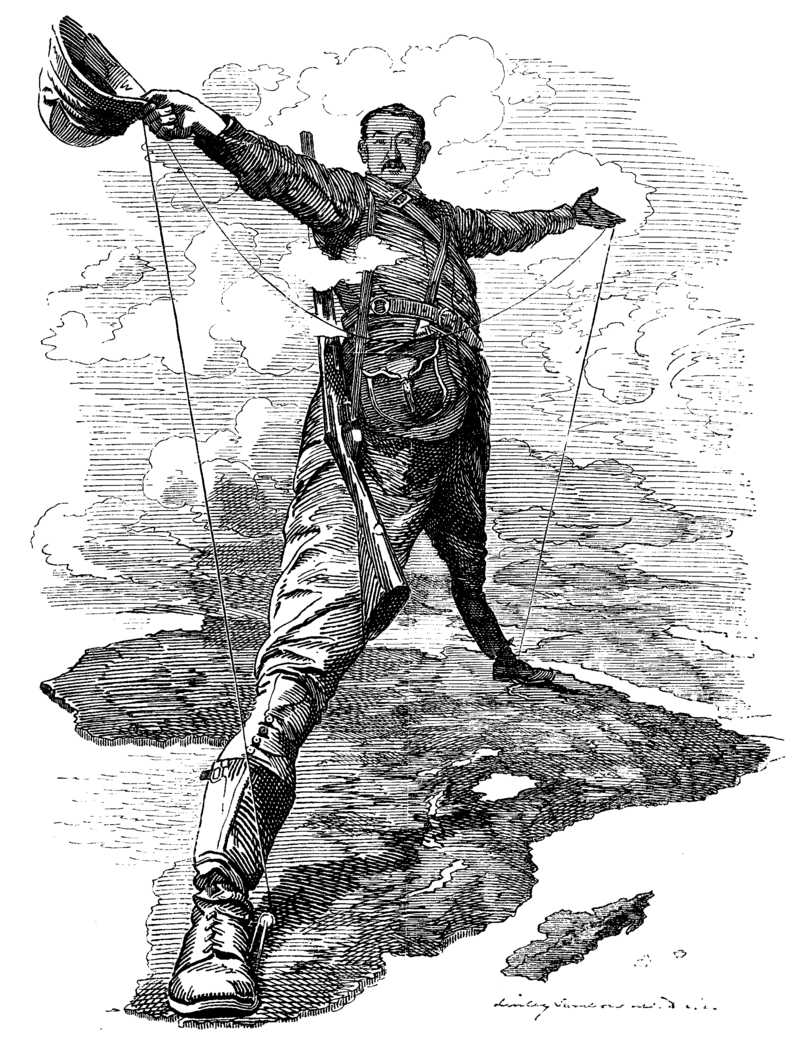
for the British magazine Punch,
following the completion of the telegraph line, 1884
He never married, nor had children, claiming, "I have too much work on my hands." Rumors abounded that he had an affair with a Polish princess and that he was homosexual, but the former was proven false and the latter remains speculation.
Having no wife or children to leave anything to, and knowing that long-term heart trouble would kill him eventually, Rhodes set up the Rhodes Scholarship, which is funded by his estate. He died on March 26, 1902, only 48 years old. Ever since, the Rhodes Scholarship has been an award for students to study at his alma mater, the University of Oxford. Founded in 1096, it is the oldest university in the English-speaking world, located in Oxford, Oxfordshire, in the south of England, about 60 miles northwest of London.
Rhodes wanted to promote unity among English-speaking nations, and instill a sense of civic-minded leadership and moral fortitude in future leaders, irrespective of their chosen career paths. Initially restricted to male applicants from countries that are today within the British Commonwealth, Germany and the United States, the scholarship is now open to men and women from all backgrounds around the world.
In 1960, Lebrecht Hesse of Ghana became the 1st black African awarded a Rhodes Scholarship. He later ran his country's broadcasting system.
Other notable Rhodes Scholars include:
American Politics: President Bill Clinton, Senator J. William Fulbright of Arkansas (who later set up his own Fulbright Scholarship, for U.S.-Soviet cultural exchange), Supreme Court Justice John Marshall Harlan II, Sedretary of State Dean Rusk, Attorney General Nicholas Katzenbach, Speaker of the House Carl Albert of Oklahoma, Representative (his nickname was "Supercongressman") John Brademas of Indiana, Governor and Senator David Boren of Oklahoma, Senator Richard Lugar of Indiana, Senator Paul Sarbanes of Maryland, Representative Tom McMillen of Maryland (also a former pro basketball player), Mayor Kurt Schmoke of Baltimore, Supreme Court Justice David Souter, Senator Russ Feingold of Wisconsin, Secretary of Labor Robert Reich, CIA Director Jim Woolsey, NATO Commanding General Wesley Clark, Senator David Vitter of Louisiana, Governor Bobby Jindal of Louisiana, National Security Advisor Susan Rice, U.S. Ambassador to Russia Michael McFaul, Mayor Eric Garcetti of Los Angeles, NAACP President Ben Jealous, Secretary of Defense Ash Carter, (all before this former, all after it current as of March 26, 2022) Representative Jim Himes of Connecticut, Senator Cory Booker of New Jersey, Governor Gina Raimondo of Rhode Island, National Security Adviser Jake Sullivan, Secretary of Transportation Pete Buttigieg, Representative Tom Malinowski of New Jersey.
(UPDATE: In 2022, Malinowski was defeated for re-election, but Rhodes Scholar Wes Moore was elected Governor of Maryland.)
Politics, Other Countries: Prime Minister Dom Mintoff of Malta, Governor-General Roland Michener of Canada, Premier Norman Manley of Jamaica, longtime Premier Bob Rae of Ontario; and 3 Prime Ministers of Australia: Bob Hawke and Malcolm Turnbull.
Science: Astronomer Edwin Hubble, physician Howard Florey, neurophysicist John Eccles, physicist Robert van de Graaf, economist Lester Thurow, economist Michael Spence.
Literature: Robert Coffin, Robert Massie, Willie Morris, Jonathan Kozol, Richard Flanagan, Naomi Wolf.
Journalism: Charles Collingwood, Howard K. Smith, Edwin Yoder, James Fallows, James Atlas, Michael Kinsley, E.J. Dionne, Nicholas Kristof, Barton Gellman, Jacob Weisberg, Peter Beinart, George Stephanopoulos, Rachel Maddow, Ronan Farrow (son of Mia Farrow and Woody Allen).
Show Business: Studio executive Frank Wells, singer-songwriter-actor Kris Kristofferson, director Terence Malick, actor Robert Joy, screenwriter John Saunders, Disney-ABC Television Group president Ben Sherwood.
Sports: U.S. Olympic Gold Medal runner William Stevenson, New Zealand Olympic Gold Medal runner Jack Lovelock, Heisman Trophy winner and U.S. Army General Pete Dawkins, football player Pat Haden, U.S. Olympic Gold Medal swimmer Annette Salmeen.
*
March 26, 1902 was a Wednesday. Baseball was in Spring Training. Football was out of season. Basketball barely existed. And the hockey season ended 9 days earlier, when the Montreal Hockey Club dethroned the Winnipeg Victorias to win the Stanley Cup. So there were no scores on this historic day.


No comments:
Post a Comment