
December 16, 1951: Dragnet premieres on NBC-TV, after some success on their radio network since 1949. It set the standard for all police dramas to follow.
A "dragnet" is any system of coordinated measures for apprehending criminals or suspects; including road barricades and traffic stops, widespread DNA tests (not yet possible when the series aired), and general increased police alertness. The term derives from a fishing technique of dragging a fishing net across the sea bottom, or through a promising area of open water.
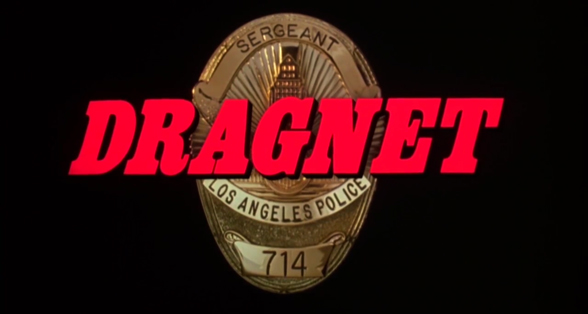
Jack Webb created the series, produced it through his Mark VII Productions, wrote some episodes, and starred as Detective Sergeant Joe Friday. The show would begin with Walter Schumann's composition, which became perhaps the most famous TV theme song of all time, with a photograph of Friday's badge, featuring the image of Los Angeles City Hall, and the number 714.
The common explanation for Friday's badge number is that Webb was a fan of baseball legend Babe Ruth, who hit 714 home runs. That had nothing to do with it. Another story was that Webb wanted 777, because 7 is considered a lucky number; but, for some reason or another, the LAPD wouldn't authorize that, but that they let him have 714, which was fine with Webb, since 14 is a multiple of 7. The real story is that there was a Sergeant Dan Cooke who helped Webb with material for the show, and he wore badge 714.
George Fenneman would begin each episode with this narration: "The story you are about to hear is true. The names have been changed, to protect the innocent." And Webb would begin to narrate, over a sweeping overhead shot of downtown: "This is the city: Los Angeles, California." He would set up the case with some mild exposition, and then say, "I was working the (day/night) shift out of (whatever the division was, which was unusual, as most detectives stay in one division). My partner is Frank Smith. My name's Friday. I carry a badge." And then the story would begin.
Friday's 1st partner, carried over from radio, was Sergeant Ben Romero, played by Barton Yarborough. But he died of a heart attack just 3 days after the pilot episode aired, and had completed only 1 other episode. For the rest of the 1951-52 TV season, Friday's partner was Sergeant Ed Jacobs, played by Barney Smith. Thereafter, Friday's partner was Sergeant Frank Smith, played first by Herb Ellis, then, for most of the show, by Ben Alexander.
Starting in Season 2, Olan Soule played Ray Pinker, the show's forensic scientist, a precursor to such roles on shows like Quincy and the CSI and NCIS franchises. Soule would go on to voice Batman in the 1970s Super Friends cartoons.
At the end of each show, "mug shots" would be shown, explaining the crimes with which the arrestees were charged, the verdicts in their trials, and, if convicted, their sentences. Their names were changed from the real stories, "to protect the innocent" -- not just the defendants, in case they were wrongly convicted, but their loved ones, who did not deserve to have viewers seek them out in anger.
The show ran 8 seasons, until August 23, 1959. It was the 1st police drama that real cops thought bore any resemblance to actual police work. There weren’t a lot of sensational car chases, and Webb had a rule that each cop could fire his gun a maximum of once per episode. Most of it was actual detective work: Interviewing complainants, suspects, and witnesses, and tracking down leads, before making the case. Friday frequently asked for "the facts," sometimes, "just the facts." He never once used the exact words so often attributed to him: "Just the facts, ma'am."
A Dragnet feature film, the first installment of the franchise in color, was released in 1954. In 1967, Webb, Mark VII and NBC relaunched the series in color. Alexander was on another police series on ABC, Felony Squad, and thus unavailable. So Harry Morgan, a veteran of the sitcoms December Bride and Pete and Gladys, and later the commanding officer Colonel Sherman T. Potter on M*A*S*H, became Friday's new partner, Bill Gannon.
The show took advantage of advances in technology, and took on the social issues of the late 1960s, including gangs, drugs, and teenage runaways coming to the Pacific Coast for the "Summer of Love" atmosphere. It ran for 3 seasons.
In 1968, Webb appeared on The Tonight Show Starring Johnny Carson, and parodied his show, telling of a theft at the Acme School Bell Company, whose boss Carson played. It became known as "The Copper Clapper Caper," and the ability of Webb and Carson to keep straight faces with all the alliteration made it one of the funniest bits in Tonight Show history. It is one of the few bits from Carson's New York years (1962-72) that has been preserved in color.
Webb died in 1982. The LAPD subsequently retired badge number 714. The badge and ID that Webb used as Friday were real LAPD equipment, and are on display at the city's police academy.
In 1987, a Dragnet film was released, with Dan Cooke as a technical advisor, but it was a comedy, almost a parody of the series. Morgan returned as Gannon, now a Captain. Dan Aykroyd played Sgt. Joe Friday, the nephew and namesake of the original. (The original Friday was famously a bachelor, the kind of man who was "married to his work," unlike Frank Smith, who frequently mentioned his own wife.) Tom Hanks played his unwanted new partner, Pep Streebeck, a slob -- an "Oscar Madison" to Joe's "Felix Unger." This dynamic would be reversed 2 years later, as Hanks played a neat-freak cop who had to take on a lovable but ill-behaved, messy dog in Turner & Hooch.
In 1989, The New Dragnet ran in syndication, but with entirely new characters. You might say the names had been changed, to protect the legendary. It didn't catch on, and was canceled less than a year after the pilot. In 2003, ABC paired with Dick Wolf, the producer of the Law & Order franchise, to create L.A. Dragnet, with Ed O'Neill as Joe Friday and Ethan Embry as Frank Smith. This didn't work, either, and after 22 episodes, albeit spread over almost 2 full years, it was canceled.
*
December 16, 1951 was a Sunday. Baseball was out of season. The NFL was in the final week of its regular season, and these games were played:
* The New York Giants beat the New York Yanks (not "Yankees"), 27-17 at Yankee Stadium.
* The Cleveland Browns beat the Philadelphia Eagles, 24-9 at Shibe Park in Philadelphia.
* The Pittsburgh Steelers beat the Washington Redskins, 20-10 at Griffith Stadium in Washington.
* The Chicago Cardinals beat their arch-rivals, the Chicago Bears, 24-14 at Comiskey Park in Chicago.
* The Los Angeles Rams beat the Green Bay Packers, 42-14 at the Los Angeles Memorial Coliseum.
* And the San Francisco 49ers beat the Detroit Lions, 21-17 at Kezar Stadium in San Francisco.
The following week, the Rams beat the Browns in the NFL Championship Game at the L.A. Coliseum, avenging their loss to the Browns in the previous year's title game.
There were 5 games played in the NBA that day:
* The New York Knicks beat the Fort Wayne Pistons, 80-71 at North Side High School in Fort Wayne, Indiana. Yes: Until the Allen County War Memorial Coliseum opened the following September 28, an NBA team was playing home games in a high school gymnasium. This was a long time ago.
* The Boston Celtics beat the Philadelphia Warriors, 92-90 in overtime at the Boston Garden.
* The Indianapolis Olympians beat the Syracuse Nationals, 96-92 at the Onondaga County War Memorial (now the Upstate Medical University Arena) in Syracuse, New York.
* The Rochester Royals beat the Baltimore Bullets, 99-95 at the Edgerton Park Arena in Rochester, New York.
* And the Minneapolis Lakers beat the Milwaukee Hawks, 99-52 at the Minneapolis Auditorium.
And the NHL's entire "Original Six" were in action:
* The New York Rangers lost to the Detroit Red Wings, 3-1 at the old Madison Square Garden.
* The Montreal Canadiens beat the Boston Bruins, 4-2 at the Boston Garden.
* And the Chicago Black Hawks beat the Toronto Maple Leafs, 4-3 at the Chicago Stadium.


No comments:
Post a Comment