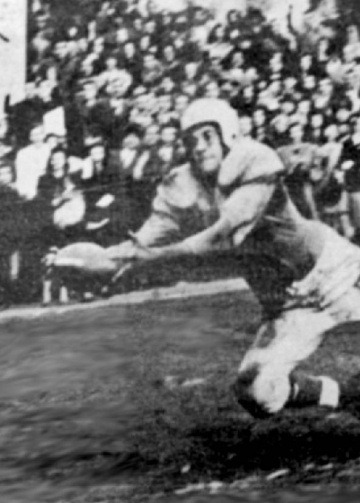
Bill Swiacki's touchdown catch
October 25, 1947: There was a time when New York City had college football programs that meant something. That time is long past. Let me tell you of what may have been the last great college football game played within the Five Boroughs.
(This was also the day that the Commissioner of Baseball, Happy Chandler, suspended the Chicago White Sox franchise -- briefly, as it turned out. I have a separate entry for that.)
The football team of the United States Military Academy in West Point, New York, hereafter referred to for simplicity's sake as "Army," played many big games in New York City, at the last version of the Polo Grounds, and at the first version of Yankee Stadium.
In 1943, they were ranked Number 3 in the country as they went into Yankee Stadium to play Number 1 Notre Dame, and lost. Then they lost to Navy in Philadelphia. Then they went on an 25-game winning streak, including beating Notre Dame at Yankee Stadium in 1944 (when the Fighting Irish were ranked Number 5) and 1945 (when they were Number 2).
The streak was stopped at Yankee Stadium when Number 2 Notre Dame came in to face them on November 9, 1946, in what was billed as "The Game of the Century," but didn't live up to the hype, and ended in a 0-0 tie. The Cadets (the team name was changed to "Black Knights" in 1999) eventually extended the unbeaten streak to 32 straight games, going 30-0-2, also being tied by Illinois on October 11, 1947 -- also at Yankee Stadium. Army hadn't allowed a point all season, outscoring their 4 opponents 93-0.
In contrast, Columbia University, one of the earliest schools to play college football, hadn't been doing so well. They won the 1934 Rose Bowl, still the last bowl game won by a team now in the Ivy League (which doesn't permit its football teams to play in any postseason games). But it had been rough after that. The Lions did recover somewhat as World War II came to an end, going 8-1 in 1945 and 6-3 in 1946. Coming into the Army game, they were 2-2, having opened the season by beating Rutgers at home and Navy away, but following that with losses at home to Yale and away to Penn.
Columbia were not ranked going into their game with Army. Army were ranked Number 6. As the teams, and 35,000 fans, walked into Baker Field, at 218th Street and Broadway at the northern tip of Manhattan Island, 100 blocks north of the main Columbia campus, it looked like Red Blaik's Cadets would easily defeat Lou Little's Lions.

Baker Field
Army needed only 9 plays from scrimmage to score their 1st touchdown. They scored another early in the 2nd quarter, and led 14-0. Only then did Columbia show signs of life, with the passing combination of Gene Rossides to Bill Swiacki taking them into Army territory, before Lou Kusserow put the Lions on the board.
But Army scored again just before halftime, as Rip Rowan scored, as he had on the 1st touchdown. Jack Mackmull had kicked Army's 1st 2 points-after-touchdown. This time, he missed. But with the teams heading into the locker room with the Cadets up 20-7, that 1 point didn't look like it would matter much.
There was no scoring in the 3rd quarter. That seemed to suit Army just fine. But it also seemed to boost Columbia's confidence: They hadn't let Army widen their lead. Early in the 4th quarter, Swiacki made a great catch of a Rossides pass, and it was 20-14.
Army tried to put the game away, but they stalled at the Lions' 34-yard line. Rather than attempt a field goal that might have put the game away, they punted. A high snap resulted in Rowan, also their punter, barely being able to control the ball at all before being tackled. This resulted in good field position for Columbia, on their own 39.
Columbia marched -- a word more often associated with Army. Rossides was methodical in approaching the Army goal line. Finally, from the Army 2, Kusserow scored. Ventan Yablonski came on for the all-important extra point. It was good. Columbia led, 21-20.
There were still 6 minutes and 37 seconds to go. And, while the Heisman Trophy-winning running backs Doc Blanchard and Glenn Davis had graduated into active service, this was still Red Blaik's Cadets that Columbia were playing. And Rowan took the kickoff and almost broke away, but was tackled at his own 26.
But Kusserow intercepted a pass from Arnold Galiffa, and Columbia was able to run the clock out. It was perhaps the biggest upset in college football since Harvard were beaten by Centre College in 1921.
Although Columbia's home ground, Baker Field (rebuilt in 1984, and now Robert Kraft Field at Lawrence A. Wien Stadium), is at the northern tip of Manhattan, in a neighborhood called Inwood, the game is nicknamed for Columbia's location, 100 blocks south: The Miracle of Morningside Heights.
No Ivy League team, not even the undefeated Dartmouth squad of 1970, has had such a memorable victory since. ("Harvard Beats Yale 29-29" in 1968 doesn't count.)
Columbia was the only New York City team doing well. Elsewhere on October 25, 1947, Fordham beat the Merchant Marine Academy, 12-0 at Tomb Memorial Field in Kings Point, Long Island, New York. But that was the only game the Rams would win all year, going 1-6-1.
New York University (NYU) fared little better. The night before, they traveled to Washington, and lost 25-0 to Georgetown at Griffith Stadium. They finished 2-5-1, including a season-ending 13-13 tie with Fordham at the Polo Grounds. City College (CCNY) beat Wagner College, 12-6 on the Wagner campus on Staten Island. But, like NYU, they went 2-5-1. (Although a great rivalry in basketball at this point, NYU and CCNY did not play each other in football in 1947.)
In New Jersey, Rutgers beat Lehigh, 46-13 at Rutgers Stadium in Piscataway. And Princeton lost to Cornell, 28-21 at Palmer Stadium in Princeton.
Gene Rossides went on to serve in various posts in the Eisenhower and Nixon Administrations. He died in 2020, the last surviving player from this game.
Columbia finished the 1947 season at 7-2. But they wouldn't have another winning season until 1951, and another one after that until 1961. From 1983 to 1988, they lost 44 straight games, at the time a record for an NCAA Division I football team. From 1979 to 1991, 13 seasons, they went 11-116-2, a "winning" percentage of .093.
In 1996, coach Ray Teller led the Lions to an 8-2 record, their best performance since Lou Little's 8-1 in 1945, over half a century earlier. But it was a false dawn: They didn't have another plus-.500 record until another 8-2 in 2017, under Al Bagnoli. He followed that with 6-4 in 2018, and it looked like Columbia might have something. But they fell to 3-7 in 2019, and the Ivy League canceled football for 2020 due to COVID.
In 2021, they did very well under Bagnoli, going 7-3. They are 3-3 thus far in 2022. And there is talk of building a new stadium on the site of Baker Field/Wien Stadium, possibly to groundshare with soccer team New York City FC. There may just be hope for Columbia football after all.
*
October 25, 1947 was a Saturday. So there was lots of other college football action:
* Number 1 Michigan beat Minnesota, 13-6 at Michigan Stadium in Ann Arbor. The Wolverines won the Big Nine Conference title. (It was the Big Ten until the University of Chicago dropped football in 1940, and took that name again with the addition of Michigan State in 1953.)
* Number 2 Notre Dame beat Iowa, 21-0 at Notre Dame Stadium in South Bend, Indiana. The Fighting Irish did not accept a bowl invitation.
* Number 3 Texas beat Rice, 12-0 at Memorial Stadium in Austin, Texas.
* Number 4 California lost to Number 10 USC, 39-14 at Memorial Stadium in Berkeley, California. USC went on to win the Pacific Coast Conference title, but got crushed 49-0 by Michigan in the Rose Bowl.
* Number 7 Georgia Tech beat The Citadel, 38-0 at Grant Field in Atlanta.
* Number 9 Penn State beat West Virginia, 21-14 at Beaver Field in State College, Pennsylvania. This was before Joe Paterno was involved with the program, and before Beaver Stadium was built.
* Number 12 Southern Methodist (SMU), led by running back Doak Walker, beat Number 16 UCLA, 7-0 at the Los Angeles Coliseum. The following week, SMU welcomed Texas into the Cotton Bowl stadium in Dallas, and beat them to win the Southwest Conference title. SMU and Penn State played to a tie in the Cotton Bowl Classic.
* Alabama beat Georgia, 17-7 at Sanford Stadium in Athens, Georgia. Neither team was ranked at the time. Although 'Bama did not win the Southeastern Conference title, they were invited to play in the Sugar Bowl, where they lost to Texas.
* Arkansas, then in the Southwest Conference, beat Mississippi, 19-14 on neutral ground, in neither team's State, at Crump Stadium in Memphis. Despite the win, didn't come close to the SWC title. Despite the loss, Ole Miss did win the SEC, and went back to Crump Stadium, and beat Texas Christian (TCU) in the Delta Bowl.
* Kansas, then unranked, had the week off. They went on to win the Bix Six Conference (forerunner of the Big Eight/Twelve), and lost to Georgia Tech in the Orange Bowl.
The baseball season had ended 19 days earlier, with the New York Yankees beating the Brooklyn Dodgers in Game 7 of the World Series. And the NBA (or, rather, BAA, Basketball Association of America) season wouldn't start for another 18 days.
But there were 2 NHL games played that day. The Boston Bruins beat the Chicago Black Hawks, 3-2 at the Boston Garden. And the Montreal Canadiens beat the Detroit Red Wings, 4-2 at the Olympia Stadium in Detroit.
Also, Arsenal and Everton played to a 1-1 draw at Highbury in North London.


No comments:
Post a Comment