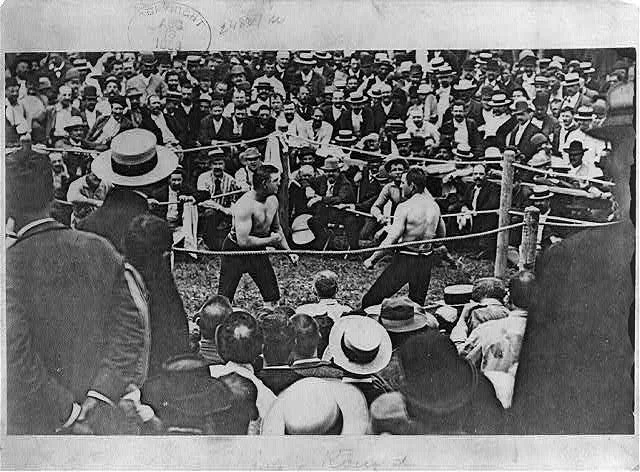
July 8, 1889: For the last time, boxing's Heavyweight Championship is contested by men fighting without gloves: "Bare-knuckle boxing."
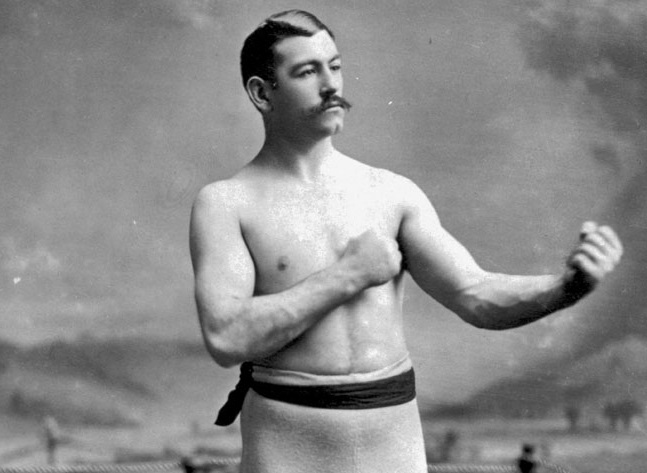
John Lawrence Sullivan was the son of an Irish immigrant, and became recognized as Heavyweight Champion of the World on February 7, 1882, by knocking out Patrick "Paddy" Ryan. "The Great John L." became one of America's earliest sports heroes, especially among the ever-growing Irish community. The vaudeville halls developed a song for him, expressing both his American and his Irish pride:
His colors are the Stars and Stripes,
He also wears the green,
And he’s the grandest slugger that
the ring has ever seen.
No fighter in the world can beat
our true American.
The champion of all champions
is John L. Sullivan!
He also wears the green,
And he’s the grandest slugger that
the ring has ever seen.
No fighter in the world can beat
our true American.
The champion of all champions
is John L. Sullivan!
But there was a problem: Professional boxing, a.k.a. prizefighting, was illegal in most States and Territories in America. Amateur boxing was legal, but, around the world, competing in sports for money was considered sacrilege by polite society. Baseball players of the time were considered very low by the decent people. And boxers, lower still.
In the 1960s, Bill Mazer, New York's pioneer of sports-talk on radio, received a call on his show, and a woman asked him, "What makes a good boxer?" Without thinking, Mazer said, "Poverty." He knew: Like any other sport, boxing offered a way off the farm, out of the factory, out of the mill, out of the mine, away from jobs that were physically dangerous, or mentally draining, or both.
Or, as Edd Roush, an Indiana farmboy who became a Hall of Fame outfielder for the Cincinnati Reds in the 1910s, said, "One of my chores was to milk the cows, which meant getting up before dawn, and going out to that cold, dark barn. I didn't expect to make it all the way to the big leagues, but I didn't care. I just had to get away from those damn cows."
So the big prizefights couldn't be held in the big cities. Boxing fans, or "fancy men," as they called themselves, tended to belong to special clubs whose leaders would negotiate where to have the fights, usually in big open fields in out-of-the-way places, and then hired special trains to those places, and the fancy men (and their women) would go out there.
One such club was the Olympic Club in New Orleans, Louisiana. Boxing was illegal in Louisiana, but, as history has shown us, when the people of Louisiana want something, they can get it, regardless of the law. So the Sullivan-Ryan fight was held 80 miles away, in Mississippi City, Mississippi, on the Gulf of Mexico. (The city has since been absorbed by the City of Gulfport.)
From April 1882 to March 1888, John L. Sullivan, a.k.a. The Boston Strong Boy, made 45 official defenses of the Heavyweight Championship of the World. Some were declared draws, because there was a set round limit and both fighters were still standing at the end. Most were declared victories for Sullivan, because he was still standing and the other man wasn't.
Most of his fights were under the new Marquis of Queensberry rules, which required padded gloves and had set 3-minute rounds. In other words, the boxing rules we know today. Previously, boxing was under the London Prize Ring rules, with bare knuckles, and a knockdown ended the round.
This included 5 fights (including a rematch with Ryan in 1885) at the original Madison Square Garden, which stood from 1879 to 1890 at 26th Street and 5th Avenue, on the northeast corner, across from Madison Square Park. The 2nd one stood there from 1890 to 1925, and was torn down to make way for the New York Life Building. The 3rd one stood at 49th Street and 8th Avenue from 1925 to 1968. And the 4th and current one has been at 32nd Street and 7th Avenue since 1968.
At the time, boxing was legal in the State of New York, but that would come to an end with the Frawley Law in 1895. It was repealed by the Walker Law in 1920.
But mixed in with all those official fights were unofficial ones, sometimes labeled as "exhibitions," to demonstrate boxing, a.k.a. "the manly art." It would be many more decades before sportswriter A.J. Liebling gave the sport the nickname "the sweet science."
And there were still other fights, not in the slightest bit official, where Sullivan would indulge in the stereotype of the hard-drinking, hard-fighting Irishman, by walking into a bar, and yelling, at the top of his lungs, "My name is John L. Sullivan, and I can lick any son of a bitch in the house!" He would offer $10,000 to any man who could "lick" him. He never had to pay up. (Good thing: It would be about $300,000 in 2022 money, a big sum even by the standards of America's highest-paid athletes.)
By 1888, Sullivan was winning fights on brute strength alone. Not speed, and not technique. He had none left, because he had put on a lot of weight, and lost a lot of his conditioning. Like his contemporary, Boston baseball star Mike "King" Kelly, and later baseball icon Babe Ruth, he unceasingly indulged his appetites for food, drink and women, until he was no longer in shape to compete.
He knew it, too. Because he was ducking the top contender for his title, Jake Kilrain, born in Brooklyn but raised outside Boston, one year his junior. Kilrain, a fellow Irishman, had beaten the British champion, Englishman Jem Smith. And Richard K. Fox, author of the country's leading sports publication of the time, The Police Gazette, declared Kilrain the heavyweight champion of the world. And lots of people sided with the Gazette, not with the world's various governing bodies for boxing, which still recognized Sullivan as such.
Finally, Sullivan could ignore the ridicule of the public no longer. The fight was scheduled for July 8, 1889, for somewhere near New Orleans. Somehow, Sullivan got himself back into shape. The secret location for which 3,000 people boarded the special trains turned out to be Richburg, Mississippi, 100 miles northeast of New Orleans.
It was July, and it was Mississippi, so it was broiling hot. And these two men hit each other with bare knuckles for three hours. Finally, after 75 rounds, Kilrain's corner threw in the towel (a term which soon came to be a universal expression meaning "quit"), and everyone, including Fox, had to recognize Sullivan as the Champion.
Sullivan went back to his old ways. So did Fox, eventually finding a new would-be champion, Gentleman Jim Corbett, who seemed to be everything that Sullivan wasn't, other than a very good boxer of Irish descent. Sullivan hadn't fought in 3 years, but agreed to fight Corbett, 8 years younger, thinner, and from San Francisco. He tried to get himself back into shape.
But there was too much to do, too soon. In the 1st official Heavyweight Championship fight under the Marquess of Queensberry rules, gloves and all, fully legalized (I guess the State government realized it was better to make money off brutality than to uphold "morality"), at the Olympic Club's stage, with 10,000 people watching on September 7, 1892, Corbett ended Sullivan's reign, knocking him out in the 21st round.
Sullivan was only 33 at the time of the Corbett fight, but had put his body through so much, both pleasure and pain, that he seemed to be a much older man. He turned to stage acting, and a lecture tour, and eventually gave up booze and became a temperance lecturer. He died in 1918, only 59 years old. Kilrain lived until 1937.
*
July 8, 1889 was a Monday. The only major team sport to have turned professional by that point was baseball. In the National League:
* The New York Giants beat the Pittsburgh Pirates, 7-5 at the St. George Cricket Grounds on Staten Island. They had to leave the original version of the Polo Grounds, and its replacement hadn't been built yet. The Cricket Grounds were next to the St. George Ferry Terminal, and the Richmond County Bank Ballpark was built roughly on the site.
* The Boston Beaneaters beat the Cleveland Spiders, 6-1 at the South End Grounds in Boston. The Beaneaters eventually became the Braves. The Spiders went out of business after the 1899 season.
* The Philadelphia Quakers beat the Indianapolis Hoosiers, 11-1 at the Huntingdon Avenue Grounds in Philadelphia. By the time the next season began, the Hoosiers had gone out of business, and the Quakers had become the Philadelphia Phillies. The Grounds burned down in 1894, and were replaced by Baker Bowl.
* The Washington Nationals beat the Chicago White Stockings, 4-3 at the Swampoodle Grounds in Washington. Those White Stockings became the Cubs, and those Nationals folded at the end of this season, bearing no relationship to the current team of the same name. The Swampoodle Grounds were demolished, and replaced by Union Station in 1907.
In the American Association:
* The Brooklyn Bridegrooms beat the Kansas City Cowboys, 8-4 at Exposition Park in Kansas City. The Cowboys went out of business after the season. "Bridegrooms"? Six players had gotten married during the 1888 season. They would join the NL in 1890, and, of course, eventually be known as the Dodgers.
* The Cincinnati Red Stockings beat the Philadelphia Athletics, 11-3 at League Park in Cincinnati. These Red Stockings were not connected to the 1st openly professional baseball team, the 1869-70 Cincinnati Red Stockings, but they did become the Cincinnati Reds we know. These Athletics folded with the AA in 1891, and were not connected to the American League team of the same name.
* The Louisville Colonels beat the Baltimore Orioles, 5-2 at Eclipse Park in Louisville. Both teams joined the NL in 1892, and went out of business after the 1889 season.
* And the St. Louis Browns beat the Columbus Solons, 14-0 at Sportsman's Park in St. Louis. These Browns became the Cardinals, and bear no connection to the later Browns of the AL, who became the Baltimore Orioles. The Solons went out of business with the AA in 1891.


No comments:
Post a Comment