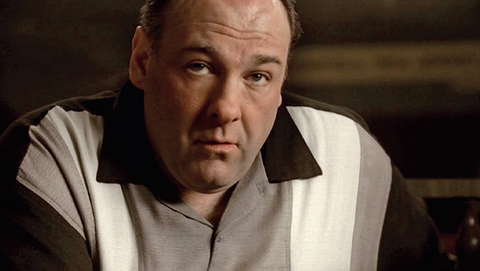
Premiering on January 10, 1999, it's been called one of the greatest shows in television history. It even caused Yankee broadcasters John Sterling and Michael Kay, and WFAN hosts Mike Francesa and Chris "Mad Dog" Russo (which sure sounds like the name of a Mob guy, but he'd never have made it as one -- nor would I), to stop talking about sports on the radio, and talk about the show instead.
It made stars out of James Gandolfini, Edie Falco, Michael Imperioli, Vincent Pastore, Robert Iler, Jamie-Lyn Sigler, Tony Sirico, Drea de Matteo, David Proval, Aida Turturro and Steve Schirripa; boosted the careers of Lorraine Bracco, Joe Pantoliano and Steve Buscemi; revived those of older actors Dominic Chianese and Nancy Marchand; showed that legendary Four Seasons singer Frankie Valli could act as well as sing; and showed that Steven Van Zandt could be more than Bruce Springsteen's guitarist and arranger.
And the opening sequence, showing Gandolfini as Tony driving home from New York through North Jersey, is iconic. Though an observant New Jerseyan such as myself will note that the familiar images are a bit out of order. Sure, he could go through the Lincoln Tunnel, be able to see the Statue of Liberty (and, until 2001, the World Trade Center), and Newark's Cathedral of the Sacred Heart, and go through the Ironbound section of Newark and see planes taking off from Newark Airport, before reaching home in North Caldwell, Essex County.
But he wouldn't get that close to Lady Liberty, or go over the Newark Bay Bridge, unless he left Manhattan via the Holland Tunnel. And he wouldn't pass the Goethals Bridge (which finally closed for a long-needed replacement in 2017), Elizabeth or the Linden oil refinery, all of which are south of the Airport.
The show was rough. It was violent. It was profane. It was ugly, no matter how many people on it were good-looking. Still, it was beloved, and it was epic.
When the aforementioned Michael Kay had Van Zandt on as a guest on his YES Network talk show CenterStage, Little Steven commented on how it was to be a part of two things -- the band and the show -- that helped to ingrain New Jersey into America's pop-culture consciousness.
But that last scene...
Just as Journey sing, "Don't stop... " it stops, the screen goes black (no fade), and there's nothing on the screen for 10 whole seconds, before the closing credits start.
It was filmed at Holsten's, in my original hometown of Bloomfield, Essex County, not far from the North Caldwell house that stood in for those of Tony and his brooding brood. It's not actually a diner: It's an ice cream parlor. I've been there 4 times, but only once since the episode aired, and they do embrace the connection.
That last scene has been parodied a few times (notice Tony Romo and Mark Cuban in this Dallas-based one for ESPN), partly because it's so recognizable, and partly because of the mystery surrounding it.
Was Tony Soprano killed as the screen blacked out? If so, who did it -- and why? Why did series creator David Chase choose that as, as Bob Seger would say, The Famous Final Scene?
Let's face it: Tony deserved it. He was not a hero. He was not even an "antihero." He was murdering scum who treated everybody (except his kids) badly. Not just his enemies, but his friends, his wife, his sisters, his mother (admittedly, no saint herself), his therapist.
If Tony was hit, whacked, dispatched, rubbed out, taken out, taken down, taken care of, whatever expression you want to use, his wife and kids didn't deserve to see him killed right in front of them. But, in the words of the immortal Velma Kelly, "He had it comin'. He had it comin'. He only had himself to blame."
Also, death is the show's main "character." Not Tony. The Sopranos is about organized crime, and about how changing times affect the people who choose, as they call it, "the life," even those who think they're in control, or think they should be in control. Like Tony.
There are a few examples -- Uncle Junior on the show, Joe Bonnano in real life -- of mobsters who die both out of prison and elderly. But most of them die either in prison or well before they get old (or both). Indeed, the fact that Tony's father, John "Johnny Boy" Soprano, died of emphysema, probably (the continuity gets contradicted at times) before he was the last age at which we saw Tony (48), is an outlier.
The thing that most influenced the show from Day One was death. The next-most? Uncertainty. Put those 2 factors together, and the show could have ended no other way than the way it did: Not with Tony being killed right after the screen went black, but with its fans wondering if that was what had happened.
And let's not forget: On June 19, 2013, only a little over 6 years after the show ended, James Gandolfini died. A heart attack, while in Rome with his family, to accept an acting award. We're led to believe that Tony was born in 1959, making him 48 years old when we last saw him. Gandolfini was born in 1961, so death came to him shortly before he would have turned 52.
Indeed, if the show had ended with Tony definitively alive, it would have been out of character for the show.
Gandolfini's death certainly eliminates the possibility of a reunion show, as such a show would have to acknowledge the death of both Gandolfini and Tony. Although we have now seen the prequel film The Many Saints of Newark. (The name Moltisanti means "many saints.")
There are a few examples -- Uncle Junior on the show, Joe Bonnano in real life -- of mobsters who die both out of prison and elderly. But most of them die either in prison or well before they get old (or both). Indeed, the fact that Tony's father, John "Johnny Boy" Soprano, died of emphysema, probably (the continuity gets contradicted at times) before he was the last age at which we saw Tony (48), is an outlier.
The thing that most influenced the show from Day One was death. The next-most? Uncertainty. Put those 2 factors together, and the show could have ended no other way than the way it did: Not with Tony being killed right after the screen went black, but with its fans wondering if that was what had happened.
And let's not forget: On June 19, 2013, only a little over 6 years after the show ended, James Gandolfini died. A heart attack, while in Rome with his family, to accept an acting award. We're led to believe that Tony was born in 1959, making him 48 years old when we last saw him. Gandolfini was born in 1961, so death came to him shortly before he would have turned 52.
Indeed, if the show had ended with Tony definitively alive, it would have been out of character for the show.
Gandolfini's death certainly eliminates the possibility of a reunion show, as such a show would have to acknowledge the death of both Gandolfini and Tony. Although we have now seen the prequel film The Many Saints of Newark. (The name Moltisanti means "many saints.")
And the biggest reason the ending that Chase chose was the right one for the series? People are talking about it. Still. Think about it. Suppose Chase had decided to end all ambiguity, and filmed a death scene for Tony.
Or, suppose he had read the Song of Ice and Fire books, written by fellow North Jerseyan George R.R. Martin, who knows a thing or two about killing off beloved characters. (The joke is that he can't go on Twitter because he's already killed 140 characters.) The TV series based on it, Game of Thrones, was still 4 years away from premiering (also on HBO), but A Storm of Swords (the 3rd book in the series) had appeared 7 years earlier.
Suppose Chase had "gone Red Wedding" and let one of Tony's enemies, or representatives of more than one of them, wipe Tony, Carmela, A.J. and Meadow out in a single stroke. (Or maybe have Meadow escape, to seek revenge in a new show later on, a la Arya Stark.)
Sure, it would have shocked people, and we'd still be talking about it. After all, half a century later, we still talk about how all the Cartwright wives died (only one of them violently) on Bonanza. And it's been 47 years since M*A*S*H killed off Henry Blake, but we still talk about it.
We wouldn't talk about Henry's death nearly as much if the last episode of I Love Lucy had Lucy cradling Ethel in her arms after Fred beat her to death, then asking Desi to call some of his Cuban friends to exact revenge. But that didn't happen. We don't talk about the I Love Lucy finale, because that episode was an ordinary episode. (Plus, even Lucille Ball couldn't have gotten a murder-and-revenge episode past the censors in 1957.)
But what would have generated more buzz: The most shocking ending The Sopranos could have given us, or seeing no ending at all? Clearly, having no ending at all has more people talking about the last episode of this show than of any other -- even the finale of Seinfeld, which was fucked up six ways to Sunday.
Go ahead: Name one other show whose final episode, whose final scene, generates more discussion and speculation than that of The Sopranos. There isn't one.

Or, suppose he had read the Song of Ice and Fire books, written by fellow North Jerseyan George R.R. Martin, who knows a thing or two about killing off beloved characters. (The joke is that he can't go on Twitter because he's already killed 140 characters.) The TV series based on it, Game of Thrones, was still 4 years away from premiering (also on HBO), but A Storm of Swords (the 3rd book in the series) had appeared 7 years earlier.
Suppose Chase had "gone Red Wedding" and let one of Tony's enemies, or representatives of more than one of them, wipe Tony, Carmela, A.J. and Meadow out in a single stroke. (Or maybe have Meadow escape, to seek revenge in a new show later on, a la Arya Stark.)
Sure, it would have shocked people, and we'd still be talking about it. After all, half a century later, we still talk about how all the Cartwright wives died (only one of them violently) on Bonanza. And it's been 47 years since M*A*S*H killed off Henry Blake, but we still talk about it.
We wouldn't talk about Henry's death nearly as much if the last episode of I Love Lucy had Lucy cradling Ethel in her arms after Fred beat her to death, then asking Desi to call some of his Cuban friends to exact revenge. But that didn't happen. We don't talk about the I Love Lucy finale, because that episode was an ordinary episode. (Plus, even Lucille Ball couldn't have gotten a murder-and-revenge episode past the censors in 1957.)
But what would have generated more buzz: The most shocking ending The Sopranos could have given us, or seeing no ending at all? Clearly, having no ending at all has more people talking about the last episode of this show than of any other -- even the finale of Seinfeld, which was fucked up six ways to Sunday.
Go ahead: Name one other show whose final episode, whose final scene, generates more discussion and speculation than that of The Sopranos. There isn't one.
James Gandolfini and David Chase
For David Chase, mission accomplished.
*
June 10, 2007 was a Sunday. Football was out of season. Hockey had ended 4 days earlier, when the Anaheim Ducks beat the Ottawa Senators in Game 5 of the Stanley Cup Finals. Game 2 of the NBA Finals was played that Sunday, and the San Antonio Spurs beat the Cleveland Cavaliers, 103-92 at the AT&T Center in San Antonio. (The arena is now named the Frost Bank Center.) Tony Parker led the scoring with 30 points. The Spurs completed the sweep 4 days later. This was the 1st time that LeBron James appeared in an NBA Finals. There would be more.
A full slate of Major League Baseball games was played, most of them Interleague:
* The New York Yankees beat the Pittsburgh Pirates, 13-6 at Yankee Stadium. Sean Henn was the winning pitcher, in relief of Tyler Clippard. Future Yankee Shawn Chacon was the losing pitcher. Alex Rodriguez hit 2 home runs, and had 5 RBIs. Bobby Abreu went 4-for-4 with 3 RBIs. Derek Jeter went 1-for-5.
* The New York Mets lost to the Detroit Tigers, 15-7 at Comerica Park in Detroit.
* The Colorado Rockies beat the Baltimore Orioles, 6-1 at Camden Yards in Baltimore.
* The Atlanta Braves beat the Chicago Cubs, 5-4 at Turner Field in Atlanta. (It's now named Center Parc Stadium.)
* The Tampa Bay Rays beat their cross-State rivals, the Florida Marlins, 9-4 at Dolphin Stadium in Miami Gardens, Florida. (It's now named Hard Rock Stadium.)
* The Cincinnati Reds beat their cross-State rivals, the Cleveland Indians, 1-0 at Great American Ball Park in Cincinnati. Alex Gonzalez singled home the only run of the game in the bottom of the 12th inning. The Reds used 6 pitchers, who allowed 7 hits in 12 innings.
* The Chicago White Sox beat the Houston Astros, 6-3 at U.S. Cellular Field in Chicago. (It's now named Rate Field.)
* The Minnesota Twins beat the Washington Nationals, 6-3 at the Metrodome in Minneapolis.
* The St. Louis Cardinals beat the Los Angeles Angels, 9-6 at Busch Stadium in St. Louis.
* The Kansas City Royals beat the Philadelphia Flyers, 17-5 at Kauffman Stadium in Kansas City.
* The Milwaukee Brewers beat the Texas Rangers, 9-6 at Ameriquest Field in the Dallas suburb of Arlington, Texas. (It's now named Choctaw Stadium.) Geoff Jenkins won it with a home run in the top of the 12th innings.
* The Arizona Diamondbacks beat the Boston Red Sox, 5-1 at Chase Field in Phoenix.
* The Seattle Mariners beat the San Diego Padres, 4-3 at Petco Park in San Diego.
* The Toronto Blue Jays beat the Los Angeles Dodgers, 11-5 at Dodger Stadium in Los Angeles.
* And the Oakland Athletics beat their cross-Bay rivals, the San Francisco Giants, 2-0 at AT&T Park in San Francisco. (It's now named Oracle Park.) Three A's pitchers combined on a 5-hit shutout.


No comments:
Post a Comment