
April 15, 1947: Opening Day at Ebbets Field in Brooklyn, New York, home of the Brooklyn Dodgers of Major League Baseball's National League. The Dodgers take the field with this lineup:
12 2B Eddie Stanky
42 1B Jackie Robinson
7 CF Pete Reiser
11 RF Fred "Dixie" Walker
22 LF Gene Hermanski
10 C Bruce Edwards
21 3B Johnny "Spider" Jorgensen
1 SS Harold "Pee Wee" Reese
19 P Joe Hatten
This lineup is unusual. In fact, for most baseball fans, it is completely unprecedented: Robinson is black, the 1st member of his race to appear in an MLB game in 63 years. Dodger president and part-owner Branch Rickey had decided that the timing was right to desegregate the game.
He decided that he was the man to do it, because of something that happened to him in 1903. He was the head coach at Ohio Wesleyan University, and they were traveling from their campus in Delaware, Ohio to South Bend, Indiana to play the University of Notre Dame. This was before Notre Dame became known for football.
OWU's best player was their catcher, Charlie Thomas, and he was black. One by one, the OWU players signed the hotel register, until Thomas reached the head of the line. The clerk pulled it back from him, saying, "We don't register (N-word)s at this hotel!" Rickey explained to the clerk that they were there as guests of the University of Notre Dame, and the clerk said he didn't care.
Rickey, who also had a law degree from the University of Michigan, was one of the smartest men ever to be involved in baseball. He came up with an idea: "There's two beds in each room, right? He can have the other bed in my room, without signing the register." The bigoted clerk accepted this compromise, since there would be no record of a black man having stayed at the hotel, and handed Rickey the key. Rickey handed Thomas the key, and told him to go up to the room while Rickey finished checking everyone in.
When Rickey got up to his room, he saw Thomas sitting on the bed, crying, and pulling on his hands. "It's my skin, Mr. Rickey," he said. "If I could just pull it off, I'd be like everyone else." Thomas persevered, became a dentist, and lived until 1971. (It appears that he and Jackie Robinson never met.)
Rickey played in the major leagues, not well; became a manager, not a good one; and became a general manager, a brilliant one, building the St. Louis Cardinals into the dominant team in the National League from 1926 to 1946; and, while not quite "inventing" the farm system, expanded the idea to what it would later become.
In 1942, he was named president of the Brooklyn Dodgers, and was looking to build them into a great team, following their NL Pennant of 1941.
He knew that the death of Kenesaw Mountain Landis, the racist Commissioner of Baseball, after the 1944 season meant that the biggest roadblock to integration was gone. He knew that bringing black players to the Dodgers would help the team competitively, and at the box office, bringing in black fans. It was good politics, good competitiveness, and good capitalism. All he needed was the right man.
And he decided that Robinson was the right man, because he had already played on integrated sports teams, as a star running back at UCLA. Baseball was only his 4th-best sport: He was also a record-setter in track and a letterman in basketball, a generation before coach John Wooden made UCLA basketball a legend. Indeed, if integration had not been necessary, and Robinson could have had his choice, he probably would have joined fellow UCLA football stars Kenny Washington and Woody Strode on the NFL's Los Angeles Rams, "staying home." (At the time, the Rams, UCLA and USC all played home games at the Los Angeles Coliseum.)
Robinson was playing for the Kansas City Monarchs of the Negro Leagues when Dodger scout Clyde Sukeforth watched him, and reported back to Rickey on him. Rickey brought him in, and told Robinson, "I want a Negro with courage enough not to fight back." He was sure that, if the 1st black player in the major leagues since 1884 did fight back, it would set the movement back a generation.
Robinson was signed to the Dodgers' top farm team, the Montreal Royals, and he led them to the 1946 International League Pennant. He was promoted to the Dodgers on April 11, 1947, despite a petition drawn up by the Southern players on the team. Manager Leo Durocher -- soon to be suspended for reasons that had little to do with his behavior within baseball -- told them they could wipe their asses with the petition. Notably, the Dodgers' captain, shortstop Harold "Pee Wee" Reese, a native of the Southern State of Kentucky, refused to sign it, and stood with Robinson.
*
The Dodgers played the Boston Braves, whose starting pitcher that day was Johnny Sain. In the bottom of the 1st inning, Jackie grounded out to 3rd base. In the 3rd, he flew out to left. In the 5th, he grounded into a double play: Shortstop to 2nd base to 1st base.
But Stanky led off the bottom of the 7th with a walk. Jackie was told to bunt, and he did. Braves 1st baseman Earl Torgeson fielded it, and made a bad throw to Sain, who was trying to cover 1st base. Jackie made it to 2nd on the error, Stanky to 3rd. Reiser then doubled both of them home.
So Jackie finished the game 0-for-3, but scored what turned out to be the winning run. He also fielded 11 chances without an error, despite never having played 1st base prior to that season's Spring Training. The final score: Dodgers 5, Braves 3.
The season would be more difficult for Jackie, and the racist abuse far worse than anyone could have prepared him for. But he held it together, batted .297, won the NL's Rookie of the Year award, and the Dodgers won the Pennant. Rickey's "Great Experiment" worked, and there was no turning back: Baseball was now a game for any boy, regardless of race. (Still not for girls, though, despite the All-American Girls Professional Baseball League still being in business for another few years.)
Other MLB games played on this epochal Tuesday:
* The New York Yankees lost to the Philadelphia Athletics, 6-1 at the original Yankee Stadium. Spurgeon "Spud" Chandler did not have it for the Pinstripes that afternoon, and was outpitched by Phil Marchildon. Eddie Joost had 3 hits and an RBI for Connie Mack's A's.
* The Philadelphia Phillies beat the New York Giants, 4-3 at Shibe Park. Bobby Thomson hit a home run for the Giants. This was the 1st Major League Baseball game in Philadelphia to be televised, on WPTZ-Channel 3, now KYW.
It was also the major league debut of Clint Hartung, from Hondo, Texas, known as the Hondo Hurricane. He had gone 25-0 pitching for a military team in World War II, and was hailed as the greatest combination of pitching and power hitting since Babe Ruth. Playing right field, he got 2 hits and an RBI in this game. But he flamed out, and last appeared in the majors in 1952.
* The Boston Red Sox beat the Washington Senators, 7-6 at Fenway Park in Boston.
* The Chicago White Sox beat the Cleveland Indians, 2-0 at Cleveland Municipal Stadium.
* The Cincinnati Reds beat the St. Louis Cardinals, 3-1 at Crosley Field in Cincinnati.
* The Pittsburgh Pirates beat the Chicago Cubs, 1-0 at Wrigley Field in Chicago.
* And the Detroit Tigers beat the St. Louis Browns, 7-0 at Sportsman's Park in St. Louis.
April 15, 1947 was also the day of Game 4 of the Stanley Cup Finals, played at Maple Leaf Gardens in Toronto. An overtime goal by team Captain Syl Apps gave the Toronto Maple Leafs a 2-1 win over the Montreal Canadiens. Four days later, the Leafs would win Game 6 and take the Cup. This would be the last year of the "cigar-shaped," or "elephant leg" version of the Cup: The following season would see the debut of the "barrel-shaped" Cup that has been used ever since.

Syl Apps with the 1947 Stanley Cup
The NBA, then still in its 1st season and known as the Basketball Association of America, began its Finals the very next day -- which also turned out to be a New York-based beginning for another African-American sports legend. Ferdinand Lewis Alcindor Jr. was born in Manhattan. He became Kareem Abdul-Jabbar, and one of the greatest basketball players of all time.
At any rate, the BAA's Eastern Division Champions were the Philadelphia Warriors, and its Western Division Champions were the Chicago Stags. The Warriors won Game 1 at the Convention Hall of the Philadelphia Civic Center, 84-71. They also won Game 2 there, 85-74.
The series moved out to the Chicago Stadium, but the Stags weren't much luckier, as the Warriors won Game 3, 75-72. The Stags avoided the sweep by the narrowest of margins, winning Game 4 at home, 74-73. On April 22, back in Philly, the Warriors won 83-80, and took what is now recognized as the 1st NBA Championship.
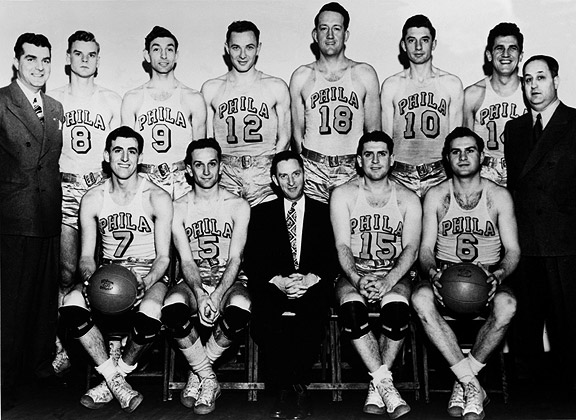
The 1947 Philadelphia Warriors
The Stags made the Playoffs again in 1948, 1949 and 1950, but lost money every year, and folded in 1950.
The Warriors also won the NBA Championship in 1956. George Senesky, a player on their '47 titlists, coached the '56 edition. They moved to the San Francisco Bay Area in 1962, and changed their name from "San Francisco Warriors" to "Golden State Warriors" upon moving to Oakland in 1971. Although they moved back to San Francisco in 2019, they have kept the "Golden State" name.
Also, actress Lois Chiles, who played Dr. Holly Goodhead in the 1979 James Bond film Moonraker, was born on this day.


No comments:
Post a Comment