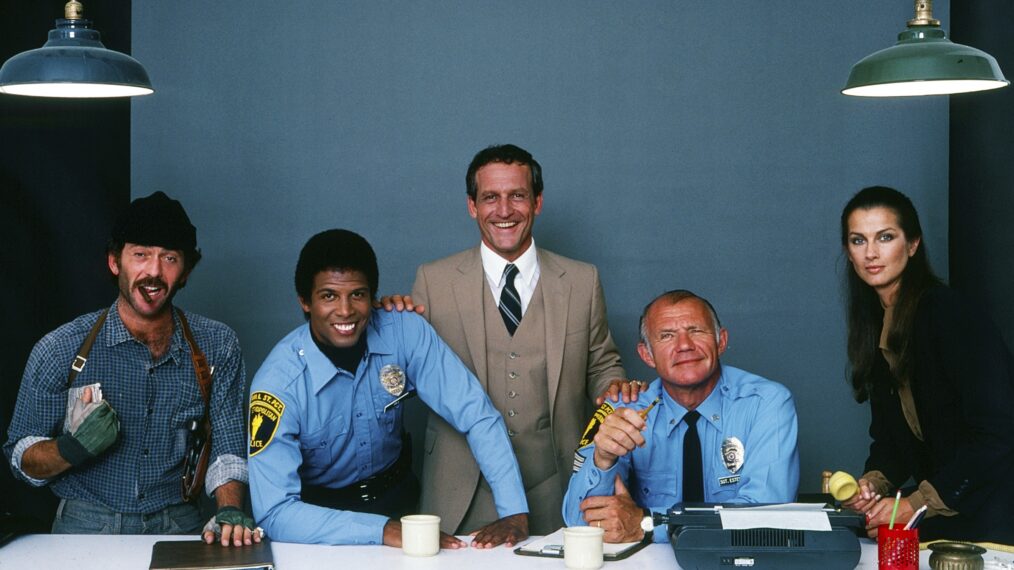
Left to right: Bruce Weitz, Michael Warren,
Daniel J. Travanti, Michael Conrad, Veronica Hamel
January 15, 1981: Hill Street Blues premieres on NBC. It ran for 6 years, and was nominated for 96 Emmy Awards, winning 24, both records at the time.
It was directly inspired by the 1981 Paul Newman movie Fort Apache, the Bronx, in which Newman plays an NYPD officer. Then-NBC President Fred Silverman was a fan and he asked television producers Steven Bochco and Michael Kozoll to create a cop show for the network with the movie in mind. They came up with Hill Street Blues.
Writers for the show included Dick Wolf, later to create the Law & Order, One Chicago and FBI franchises; Anthony Yerkovich, later to create Miami Vice; Mark Frost, who created Twin Peaks with David Lynch; John Romano, who wrote The Lincoln Lawyer; and one of the era's top playwrights, David Mamet.
The city in which Hill Street Blues was never specified, but the police cars with "METRO POLICE" on them were almost identical to the Chicago police cars of the era. The elevated railway and the nasty Winter weather would seem to back that up. The weather always seemed to be bad on that show, and it was one reason why Sergeant Phil Esterhaus (Michael Conrad) had good reason to conclude his morning announcements to his cops by telling them, "Let's be careful out there!" (Sometimes, it was "very careful," or even, "extra careful.")
Hill Street Blues had an ensemble cast, led by Daniel J. Travanti, who played the precinct's commander, Captain Frank Furillo. He dates, and later marries, public defender Joyce Davenport (Veronica Hamel). Because of their first date, she calls him "Pizza Man," while he calls her "Counselor" for her job. His ex-wife, Fay (Barbara Bosson), is a complication. Frank and Fay have a son, Frank Jr.
The show looked at police work at both a management level and a street level. Frank's right-hand man was Lieutenant Ray Calletano (Rene Enriquez), and he has to deal with the Chief of Police, Fletcher Daniels (Jon Cypher).
The Detectives included Michael "Mick" Belker (Bruce Weitz), a scruffy tough guy who called even his friends "Dog Breath." Nevertheless, he is loyal to Furillo, and sees Esterhaus as a father figure. When Conrad died of cancer in 1983, his character was written out, and Belker took it harder than anybody. When he later married, he named his son Philip after Esterhaus.
Sergeant (later Lieutenant) Henry Goldblume (Joe Spano) was the precinct's hostage negotiator, on the phone so often that they even showed him on one in the show's opening credits. A white detective, J.D. LaRue (Kiel Martin), was partnered with a black one, Neal Washington (Taurean Blacque). The characters were probably named after LaRue Washington, who played center field for the Texas Rangers in 1978 and '79. Like Los Angeles Dodgers outfielder (and later manager) Dusty Baker and Kansas City Royals shortstop U L Washington, Neal Washington's trademark was constantly chewing on a toothpick. LaRue's was his womanizing, and his flaw was that he liked them young.
At first, the only female Officer was Lucy Bates (Betty Thomas), who was paired with Joe Coffey (former Cornell football star Ed Marinaro), until he was shot and killed while off-duty. An unlikely Officer pairing is Bobby Hill (formerly UCLA basketball star Michael Warren) and Andy Renko (Charles Haid). Hill was a native of the neighborhood, while Renko acted as country as you could get, had a Southern accent, and Hill called him "Cowboy"; yet Renko said he was born in New Jeresey and had never been west of Chicago. Yet they worked well together. (Warren recorded a much-imitated promo for the series' halfway commercial break: "Hill Street Blues will be riiiight back!"
And then there was Lieutenant Howard Hunter (James B. Sikking), commander of the Emergency Action Team (EAT). Smart, with a Ph.D., a Vietnam War veteran and an expert hand-to-hand combatant; but the Archie Bunker of Hill Street, always yapping about how things are going wrong, often with bigotry. Hates criminals, but compassionate toward victims.
After Conrad's death, the next desk Sergeant was the even older Stan "Stosh" Jablonski (Robert Prosky). In 1984, there was a gender-bending detective pairing, Harry Garibaldi (Ken Olin) and Patrica "Patsy" Mayo (Mimi Kuzyk). But that only lasted 2 seasons: Garibaldi was a compulsive gambler, and was stabbed to death by a mobster.
Dennis Franz played 2 different morally compromised detectives: First, the ill-fated Sal Benedetto; then, the somewhat smarter Norman Buntz. Anybody old enough to have watched him play Detective Andy Sipowicz on the later Bochco series NYPD Blue, but not old enough to have watched Hill Street Blues, will see a lot of Sipowicz in both characters.
This was yet another TV show with a theme song composed by Mike Post. Although he had been writing for TV for years, this was the 1st show created by Steven Bochco. Bosson was then his wife. Their son Jesse Bochco also became a writer, producer and director, and is married to Kate Danson, daughter of Cheers star Ted Danson.
The list of guest stars who appeared in small roles before they found fame is extensive and impressive. They included Tim Robbins, Joaquin Phoenix, Forest Whitaker, Andy Garcia, Linda Hamilton, Don Cheadle, Laurence Fishburne, and many more.
Pretty much everybody (except for Conrad) would go on to star in at least one other show, including some done by Steven Bochco. Those of you who only know Joe Spano as Tobias Fornell on NCIS may be shocked to see him so young.
The show was nominated for 96 Emmy Awards, winning 24, both records up to that point. This included winning Outstanding Drama Series the 1st 4 seasons, and being nominated for that title the next 2. Travanti (twice), Conrad (twice), Weitz, Thomas, Barbara Babcock (as the girlfriend who gave Esterhaus a sex-induced fatal heart attack) and Alfre Woodard (as the drug-addicted mother of the child that Bates adopted) each won the Emmy for acting,
*
January 15, 1981 was a Thursday. Hill Street Blues may have been NBC's original "Must See TV" Thursday night show. Rapper Pitbull and controversial soccer star El Hadji Diouf were born on the day.
Baseball was out of season. The NFL was between the Conference Championship Games and Super Bowl XVI, which the San Francisco 49ers would win over the Cincinnati Bengals.
There were 2 games played in the NBA. The Washington Bullets beat the Detroit Pistons, 106-89 at the Silverdome in the Detroit suburb of Pontiac, Michigan. And the Milwaukee Bucks beat the Philadelphia 76ers, 113-110 at the Milwaukee Exposition & Convention Center Arena, a.k.a. The MECCA, now the UW-Milwaukee Panther Arena.
There were 6 games in the NHL:
* The New York Rangers lost to the Colorado Rockies, 4-3 at the McNichols Arena in Denver. In the 1982 off-season, the Rockies moved to the Meadowlands, becoming the New Jersey Devils.
* The Montreal Canadiens beat the Winnipeg Jets, 7-3 at the Montreal Forum. Pierre Larouche scored 3 goals.
* The Quebec Nordiques beat the Philadelphia Flyers, 4-1 at The Spectrum in Philadelphia.
* The Washington Capitals beat the Los Angele Kings, 3-0 at the Capital Centre in the Washington suburb of Landover, Maryland.
* In an "Original Six" matchup, the Chicago Black Hawks beat the Boston Bruins, 3-2 at the Chicago Stadium.
* And the Calgary Flames beat the Detroit Red Wings, 10-0 at the Stampede Corral in Calgary. Kent Nilsson had 3 goals and 3 assists.


No comments:
Post a Comment