
February 19, 1910: Old Trafford, the home stadium of Manchester United Football Club, opens in Stretford, in the Borough of Trafford, 2 miles west of downtown Manchester. It is half a mile north of Old Trafford Cricket Ground. United lost to Liverpool, 4-3.
Founded in 1878 as Newton Heath Football Club, and known as Manchester United since 1902, they had begun playing at the Bank Street ground in 1893. By 1908, when United won its 1st Football League title, and 1909, when they won their 1st FA Cup, 2 things became obvious: The team had outgrown Bank Street; and, even if they hadn't, it was unsuitable, with one end practically being an open sewer.
Old Trafford hosted another League title by United in 1911. But the next trophy would not come until 1948, when they won the FA Cup. The stadium suffered bombing damage from Nazi Germany's Luftwaffe in 1941, and so Man United had to share the Maine Road stadium with Manchester City until repairs were completed in 1949.
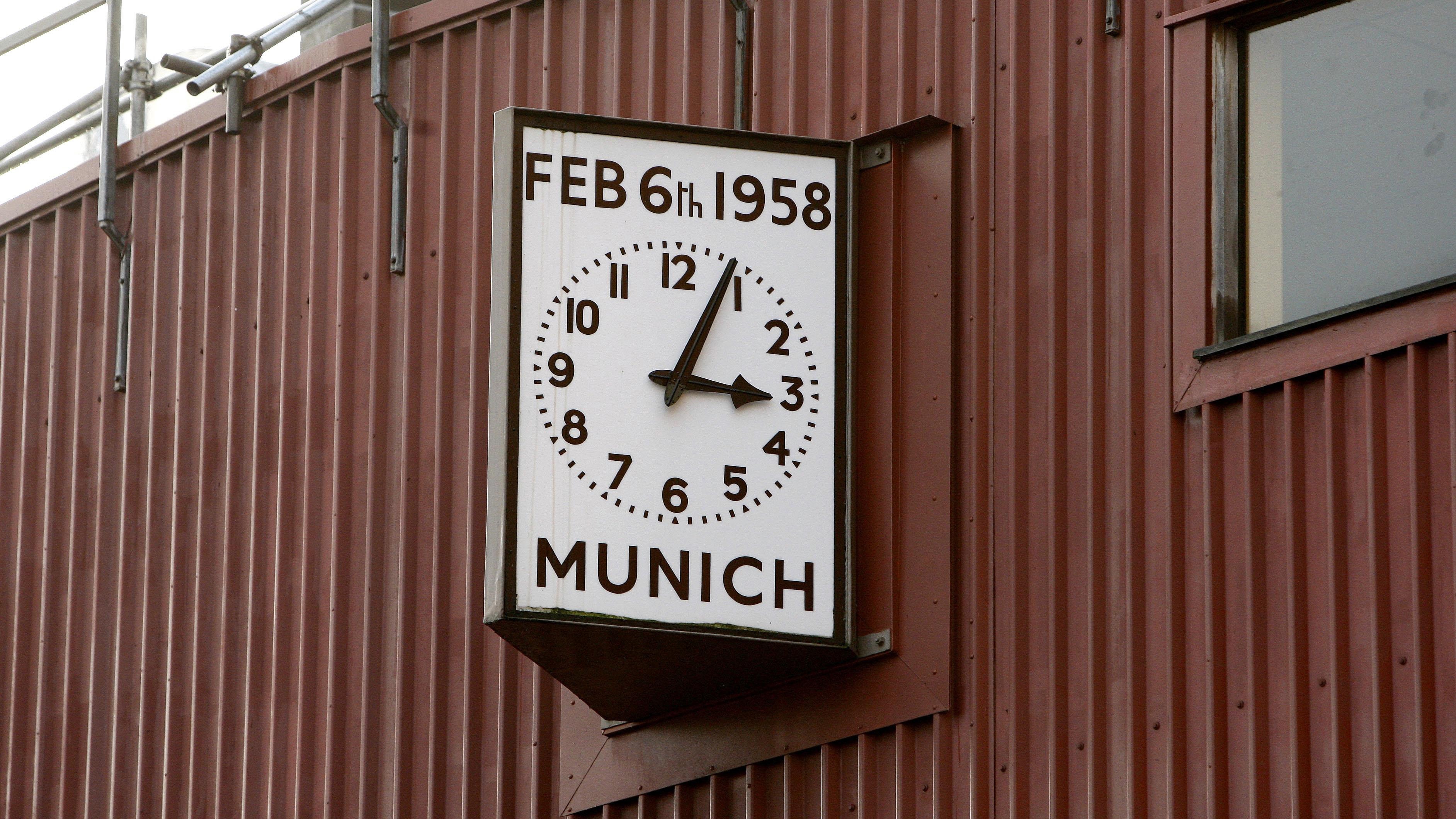
Manager Matt Busby built a young team known as the Busby Babes, winning the League title in 1952, 1956 and 1957, before the Munich Air Disaster led to the forced rebuilding of the team, winning the FA Cup in 1963. The Munich Clock, with the date of the crash, 6th February 1958, and frozen forever at the time of the crash, 3:04 PM, was placed outside, at the junction of the South and East Stands.
In 1970, when Chelsea F.C. and Leeds United played the FA Cup Final to a draw at the original Wembley Stadium in London, the replay was moved to Old Trafford. Chelsea won, 2-1. As the FA Cup Semifinals were usually played at neutral sites prior to the opening of the new Wembley in 2007, Old Trafford was frequently a site for them.
United won Football League titles in 1965 and 1967, with the "Trinity" of Bobby Charlton (English), Denis Law (Scottish) and George Best (Northern Irish). A joint statue now stands outside the stadium, as does one of their manager, Busby. One of the streets outside is now named Sir Matt Busby Way. This team also became the 1st English (though not the 1st British) team to win the European Cup, in 1968. The tournament is now known as the UEFA Champions League. All this made United the most popular team in England, and Old Trafford, with a capacity of 80,000, the most popular stadium.
They didn't win another until 1992-93, the 1st season of the new Premier League. In the meantime, they won the FA Cup in 1977, 1983 and 1985. And United fans got frustrated, developing hooligan "firms," including one based in London, the Cockney Reds. This period made the stadium's west end, the Stretford End, very dangerous for visiting fans: You were among hardcore fans, who would think nothing of defending their turf with fists, bricks, and other objects.

The Stretford End, as a standing terrace
The Taylor Report, mandating all-seater stadiums, resulted in a reduction of Old Trafford's capacity to about 44,000. Then came the dawn of the Premier League, and United won it, then couldn't stop winning. Just as the original League title of 1908 led to the building of the original Old Trafford, the new success led to a rebuilding.
The South Stand is the last remaining part of the stadium from before the expansion, dating to the rebuilding of 1949. It was renamed the Sir Bobby Charlton Stand in 2016. A new Stretford End opened in 1993, and was double-decked in 2000. A new North Stand opened in 1996, a new East Stand in 2000, and expansions of the Northwest and Northeast quadrants in 2006, bringing capacity back to 75,000, the largest stadium in Britain except for Wembley. In 2011, the North Stand was renamed the Sir Alex Ferguson Stand, for the manager who won all those titles from 1993 to 2013. Like Busby and the "Trinity," he has a statue outside.
But, as with hockey's New York Rangers in 1994 and baseball's Boston Red Sox in 2004, finally winning another title in 1993 did nothing to turn United fans from sore losers into gracious winners. Quite the opposite: It made the existing fans more arrogant, and nastier.
As the won the League and the Cup together, "The Double," in 1994 and 1996, another League title in 1997, and completed England's 1st European Treble -- the League the Cup, and the Champions League -- in 1999, followed by more League titles in 2000, 2001, 2003, 2007, 2008, 2009, 2011 and 2013, plus the FA Cup in 2004, and the Champions League a 3rd time in 2008, they gained fans from all over the world.
These were seen by old-line English fans as "plastic," not real. Not all of them were rich tourists, but the stereotype was that they sat in the new luxury boxes, eating "prawn sandwiches." The old chant of "Who ate all the pies? Who ate all the pies? You fat bastard, you fat bastard, you ate all the pies!" became "You Manc bastard, you Manc bastard, you ate all the prawns!"
With a capacity of 74,310, the away fans at Old Trafford sometimes chant, "Seventy thousand muppets!" And the joke, especially among Man City fans, became that all real people from Manchester supported City, while United fans came from Middlesex, Manhattan, Moscow, Mombassa, Mumbai, Melbourne... everywhere but Manchester.

Charlton, perhaps United's greatest player, called it "The Theatre of Dreams." But, while United are the most loved team in England, there are even more people who hate them (as is customary for teams with similar levels of success), and they have called the stadium less conciliatory names: "Old Trashdump," "Old Tramsheds," "The Theatre of Cheats," "The Swamp," and so on.
And since Ferguson retired after the 2013 title, what have United won? The 2016 FA Cup, the 2017 UEFA Europa League, and the League Cup in 2017. That's it. Their average finish in the Premier League from 2013-14 through 2020-21 has been 4th. Their average FA Cup run has ended in the Quarterfinal, and they haven't gotten past the Quarterfinals of the Champions League. "Theatre of Cheats," indeed.
(UPDATE: From the Football Association's 2019 acceptance of video-assisted refereeing (VAR) through the 2023-24 season, they've won 1 more trophy: The 2023 League Cup.)
*
February 19, 1910 was a Saturday. Baseball and football were out of season. And professional basketball and hockey barely existed. So, in North America, there were no scores on this historic day.


No comments:
Post a Comment