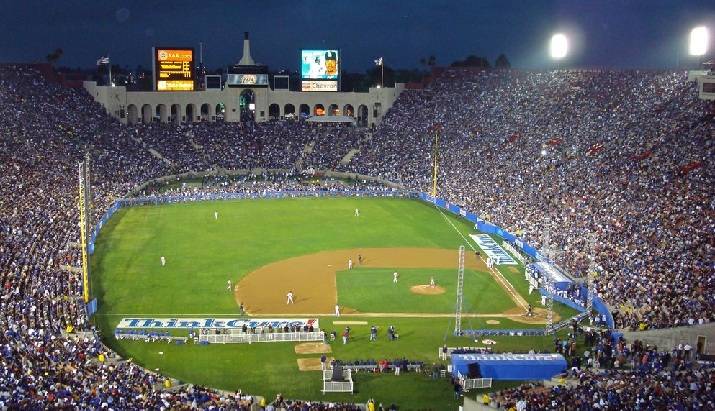
March 29, 2008: The biggest crowd ever to attend a baseball game, anywhere, at any level, is a matchup that celebrates not one, but two things that never should have happened.
After the 1957 season, Walter O'Malley, owner of the Brooklyn Dodgers, moved the team to Los Angeles. He set about building what would become Dodger Stadium, a facility he was unwilling to do what it took to get built in Brooklyn, or elsewhere in the New York Tri-State Area. He could have found a way around New York City building czar Robert Moses. Instead, he took the easy way out, and went where he would have made more money.
No one is saying that Los Angeles, then the 3rd-largest city and metropolitan area in America and soon to become the 2nd-largest, did not deserve an MLB team. But it would have happened in the next few years anyway. Indeed, it soon happened again, with the American League's Angels joining the National League's Dodgers in 1961.
But Brooklyn was home to 3 million people, and there were even more Dodger fans in the other Boroughs of New York City and their suburbs. O'Malley was taking the Dodgers away from their fans, for no reason other than the chance to make more money.
But his new Dodger Stadium -- by the 2009 season, the 3rd-oldest in MLB -- wouldn't be ready until 1962. O'Malley needed a place to play the 1958, '59, '60 and '61 seasons, and it was not going to be Brooklyn's 31,497-seat Ebbets Field. The Los Angeles version of Wrigley Field, home to the Los Angeles Angels of the Pacific Coast League, who gave their name to the AL team, was even smaller, at 22,000 seats, although it had more parking than Ebbets Field.
So he had the Dodgers play at the Los Angeles Memorial Coliseum, home of the USC and UCLA football teams, the NFL's Los Angeles Rams, and the 1932 Olympics. It seated 93,000 people and had plenty of parking. But in order to fit a baseball field inside a stadium built for football, a chain-link fence was put up to cut across the gridiron, so center and right field wouldn't be impossibly far away; and the left field foul pole was just 251 feet away.
This led to many cheap home runs, or, in the politically incorrect parlance of the time, "Chinese home runs." Thinking of Grauman's movie theater in Hollywood, decorated in Chinese style and having hosted some of the biggest movies' premieres, the Coliseum became known as O'Malley's Chinese Theater before a single baseball game was played there.
A 42-foot-high screen (5 feet higher than the Green Monster, the left-field wall at Fenway Park) was put up, and it became known as the Chinese Wall. Dodger left fielder Wally Moon not only became adept at playing balls hit off the screen, but, as a lefthanded hitter, hitting to the opposite field to get balls over it. These became known as "Moon Shots," before so much as a single human being had flown in space, let alone landed on the Moon.
The Dodgers were terrible in their 1st season in the Coliseum, as the players who had been the Brooklyn "Boys of Summer" began to face Autumn. But it was a transition year: Some of the players who would be stars for them in Los Angeles had already made their debuts in Brooklyn. In 1959, their 2nd season on the Coast, the Dodgers won the World Series. They nearly won another Pennant after moving into Dodger Stadium in 1962, and won them in 1963, 1965 and 1966.
On May 7, 1959, an exhibition game was held at the Coliseum between the Dodgers and the New York Yankees. In the Dodgers' last 11 seasons in Brooklyn, they had been to 6 World Series, all against the Yankees, winning only in 1955.
It was Roy Campanella Night, what soccer fans would call a testimonial, with some of the gate receipts going toward Campy's medical care, after a 1958 car crash left him paralyzed. Although this meant that the future Hall-of-Famer would never come to bat in Los Angeles, 93,103 people came, the biggest crowd ever to attend a baseball game, anywhere. The Yankees won, 6-2.
When the Dodgers won the Pennant that year, they hosted Games 3, 4 and 5 of the World Series, against the Chicago White Sox. All 3 games had a paid attendance of over 92,000, the highest-attended competitive games in baseball history, topping out at 92,706 for Game 5.
In 2008, the Dodgers decided that an appropriate celebration of their 50th Anniversary in Los Angeles would be to close their Spring Training by playing an exhibition game at the Coliseum, in an effort to break the record.
They invited the Boston Red Sox, defending World Champions. The Sox had just ridden the steroid-induced performances of sluggers David Ortiz and Manny Ramirez (and, most likely, several others) to their 2nd World Series win in the last 4 seasons. So a team that never should have been in Los Angeles played a team was defending a title it never should have won.
For this game, the Coliseum's track had been removed, so that additional seats could be put in. But that put the left field fence even closer: 201 feet. A 60-foot-high screen -- equal to the height of the Green Monster plus the screen that was atop it until the "Monster Seats" were installed in 2003 -- was put up, but was expected to prove insufficient. Since it was an exhibition game, not counting in the regular-season standings, MLB Commissioner Bud Selig allowed it.
The official paid attendance was 115,300, breaking the old record by over 22,000 -- in other words, the Coliseum plus Wrigley Field West. There were 4 home runs hit, all over the screen: By Kevin Cash and Kevin Youkilis of the Red Sox, and by James Loney and Blake DeWitt of the Dodgers. Loney had 2 hits, and Matt Kemp of the Dodgers had 3.
No Red Sock had more than 1 hit, but the Sox got their runs early enough that the Dodgers couldn't come back, and Boston won, 7-4. Knuckleballer Tim Wakefield, at 41 not quite old enough to remember the Dodgers originally playing at the Coliseum, was the starting and winning pitcher for the Red Sox.
No serious attempt to break this record has taken place since. When the MLB London Series was set for 2019, it could have been held at the new Wembley Stadium, whose usual seating capacity is 90,000, but the London Stadium, built for the 2012 Olympics, was used instead, probably to avoid a short-fence situation like the Coliseum, and attendance for the 2 games was 59,629 and 59,059. Impressive for any country, but understandable given the novelty, and nowhere near a record.
It should be noted that the March 29, 2008 game at the Coliseum might not have been a record, nor might the Roy Campanella Night game, or the 1959 World Series games. On August 12, 1936, there was a demonstration game for the Olympics, at the Olympiastadion in Berlin, Germany. A team of U.S. amateurs lost to a team of amateurs when the rest of the world, 6-5. There was no official attendance taken, but the crowd was estimated to be between 90,000 and 125,000.
At the very least, it was the biggest crowd in baseball history, anywhere, at any level, until Roy Campanella Night. At the most, it remains the biggest baseball crowd ever, while the 2008 exhibition game is the biggest crowd for a major league game, and Game 5 of the '59 World Series is the biggest crowd for a competitive game.
UPDATE: In 2025, Major League Baseball, inspired by a record attendance for college football at Bristol Motor Speedway in Tennessee, set up a regular-season game there, with the intent of breaking this record. They didn't make it, but they did set a record for a competitive (non-exhibition) game, getting 91,032 on August 3. The Atlanta Braves beat the Cincinnati Reds, 4-2.
*
March 29, 2008 was a Saturday. As I said, baseball was in Spring Training. Football was out of season. There were 6 games played in the NBA that day:
* The New Jersey Nets lost to the Phoenix Suns, 110-104 at the Izod Center at the Meadowlands. Amar'e Stoudamire had 33 points and 15 rebounds for the Suns.
* The Detroit Pistons beat the Cleveland Cavaliers, 85-71 at The Palace in the Detroit suburb of Auburn Hills, Michigan.
* The Chicago Bulls beat the Milwaukee Bucks, 114-111 at the United Center in Chicago.
* The Denver Nuggets beat the Golden State Warriors, 119-112 at the Pepsi Center in Denver. (It's now named the Ball Arena.)
* The Los Angeles Clippers beat the Memphis Grizzlies, 110-97 at the Staples Center in Los Angeles. (It's now named the Crypto.com Arena.) Al Thornton led all scorers on the day with 39 points.
* And the Charlotte Hornets beat the Portland Trail Blazers, 93-85 at the Rose Garden in Portland. (It's now named the Moda Center.)
There were 8 games played in the NHL:
* The Philadelphia Flyers beat the New York Islanders, 4-3 in a shootout at the Nassau Coliseum. (The New York Rangers and the New Jersey Devils were not scheduled.)
* In the Canadian Broadcasting Corporation's opening game of a doubleheader on Hockey Night In Canada, and also in an "Original Six" matchup, the Toronto Maple Leafs beat the Montreal Canadiens, 4-2 at the Air Canada Centre in Toronto. (It's now named the Scotiabank Arena.)
* The Boston Bruins beat the Ottawa Senators, 4-0 at the TD Banknorth Garden in Boston. (It's now named just the TD Garden.)
* The Tampa Bay Lightning beat the Carolina Hurricanes, 2-1 at the St. Pete Times Forum in Tampa. (It's now named the Benchmark International Arena.)
* The Washington Capitals beat the Florida Panthers, 3-0 at the BankAtlantic Center in the Miami suburb of Sunrise, Florida. (It's now named the Amerant Bank Arena.)
* In a rivalry game, the Chicago Blackhawks beat the St. Louis Blues, 4-3 at the Scottrade Center in St. Louis. (It's now named the Enterprise Center.)
* In the nightcap of Hockey Night In Canada, another rivalry game, the Edmonton Oilers beat the Calgary Flames, 2-1 at the Saddledome in Calgary.
* And the Dallas Stars beat the Los Angeles Kings, 7-2 at the Staples Center. (Meaning it hosted an NBA game and an NHL game on the same day.)
Also, Arsenal went to the Manchester area, and beat Bolton Wanderers 3-2, at what's now named the University of Bolton Stadium.


No comments:
Post a Comment