
May 25, 1937: The New York Yankees beat the Detroit Tigers, 4-3 at Yankee Stadium. However, for once, a Yankee win is overshadowed: The playing career of Mickey Cochrane comes to an awful end.
Gordon Stanley Cochrane was born on April 6, 1903, in Bridgewater, outside Plymouth, Massachusetts. Because someone who thought he looked Irish (Cochrane is a common name in both Ireland and fellow Gaelic land Scotland), he was nicknamed Mickey.
He starred at Boston University as a catcher in baseball and a quarterback in football. He chose baseball, and by 1925 had debuted with the Philadelphia Athletics. He was part of a team that won 3 straight American League Pennants, in 1929, 1930 and 1931. They almost won 3 straight World Series, but the A's lost in 1931 in 7 games.
By that point, Cochrane was already considered one of the best catchers the game had ever seen. But after the 1933 season, needing money, A's owner-manager Connie Mack sold Cochrane to the Detroit Tigers. They named him player-manager, and he led them to the Pennant in 1934 and the World Series in 1935.
So well was Cochrane regarded that, in 1934, he won the AL's Most Valuable Player award, despite hitting only 2 home runs (though he did bat .320 with 75 RBIs), and despite the Yankees having both Lou Gehrig, who won the Triple Crown, and Lefty Gomez, who went 26-5.
On the morning of May 25, 1937, Cochrane was 34, and batting .306 for the season, .320 for his career. Nobody knew about OPS+ back then, but his, for his career, was 129. On-base percentage was known, but not widely; his .419 remains the highest ever for a catcher. By this point, he was already widely regarded as the best catcher ever. The Tigers fell a little short of the Yankees in 1936, but looked ready to challenge for the Pennant again in 1937.
Irving "Bump" Hadley was the starting pitcher for the Yankees, and Lynwood "Schoolboy" Rowe was pitching for the Tigers. Cochrane came to bat in the top of the 1st inning, and popped up to 1st base, where Gehrig caught the ball. In the bottom of the 1st, Bill Dickey, soon to approach Cochrane as the best catcher in the game in fans' minds, drove in Frank Crosetti with a sacrifice fly. In the top of the 3rd, Cochrane hit a home run to tie the game, 1-1.
It was still 1-1 when Cochrane came to bat again in the top of the 5th, with 2 out and Marv Owen on 1st. But Hadley threw inside, and hit Cochrane in the head. He was taken off the field on a stretcher, and taken to a hospital.

To make matters worse for the Tigers, Hadley was the Yankees' leadoff hitter in the bottom of the 5th, and singled. And Joe DiMaggio hit a home run to make it 3-1 Yankees. Tony Lazzeri hit a home run leading off the bottom of the 7th, to make it 4-1. Singles by Charlie Gehringer and Hank Greenberg got the Tigers to within 4-3 in the 9th, but they got no closer.
Cochrane was diagnosed with a fractured skull. The fact that Cochrane had homered off Hadley in his previous at-bat was suspicious. Hadley insisted that he hadn't beaned Cochrane on purpose, and he was not previously known as a pitcher who would do that. The nickname probably didn't help, making people think of a bump on Cochrane's head. (It came from "Bumps," as he contracted the mumps while in the minor leagues.) Cochrane and his teammates refused to blame Hadley for the incident.
Nevertheless, Cochrane's doctors warned him that continuing to play baseball might lead to further head injury. So he retired. Del Baker, who had previously filled in for him following a nervous breakdown in 1936, became the temporary manager again. After a poor 1st half of the 1938 season, Cochrane resigned, and Baker became the full-time manager, leading the Tigers to the American League Pennant in 1940 -- the only one between 1936 and 1943 that the Yankees didn't win.
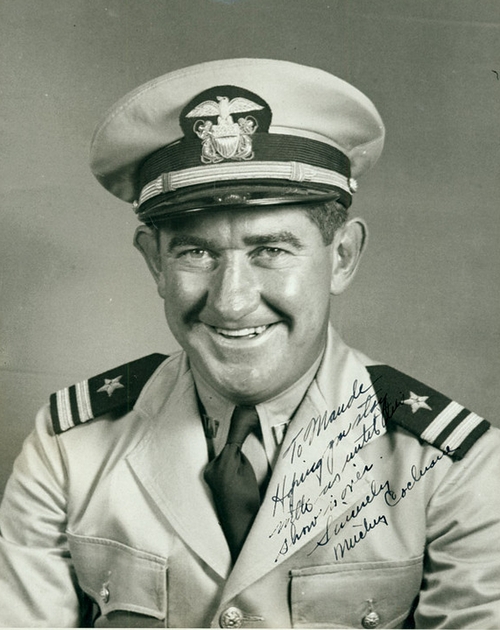
Cochrane was too young to have served in World War I, and was too old to serve in combat in World War II. But, in spite of his head injury, he enlisted in the U.S. Navy, and was assigned to lead the physical training of recruits at Naval Station Great Lakes in Chicago. This station had its own baseball team, and Cochrane coached it. It included Bob Feller and Pee Wee Reese, and was nicknamed "the 17th major league team."
A cartoon appeared in The Sporting News, featuring Dickey, who had gone into the Navy after leading the Yankees to victory in the 1943 World Series: "Dickey means the two greatest catchers ever are wearing the Blues (Mickey Cochrane's the other), but if you want to see to it that the Axis does the catching in this war, BUY MORE WAR BONDS!"
Little did anyone know that Seaman Lawrence Berra (yes, Yogi) would not only serve in the Navy on D-Day -- the only major league ballplayer, past or future, to do so -- but surpass both of them as the greatest catcher of all time. Johnny Bench, since then the only other major contender for the title of "greatest catcher who ever lived," served in the U.S. Army Reserve during the Vietnam years.
After the war, Cochrane was discharged with the rank of Lieutenant Commander. He briefly worked as a coach with the Athletics, and then sold cars, but died as a result of smoking on June 28, 1962, only 59 years old. There's no way to know if his head injury hastened his death. (Hadley, also a Massachusetts native, from Lynn, died only a year later, and younger, 58, of heart trouble.)
Cochrane was elected to the Baseball Hall of Fame in 1947. The Philadelphia Athletics moved to Kansas City in 1955, and to Oakland in 1968.
In 1982, the Philadelphia Phillies named Cochrane to the Philadelphia Baseball Wall of Fame. Until 2018, the A's had no team Hall of Fame. In 2021, they elected all 10 of the members of the Baseball Hall of Fame who had spent significant time with the Philadelphia Athletics, including Cochrane. In 2000, the Tigers put his name on the wall at the new Comerica Park, although with the other Tigers in the Hall of Fame whose numbers they hadn't retired. The A's still haven't retired 2 for Cochrane, nor the Tigers 3 for him, although they did retire 3 for Alan Trammell. When Tiger Stadium stood, National Avenue, behind the 3rd base stands, was renamed Cochrane Avenue.
In 1999, The Sporting News ranked him 65th on their list of the 100 Greatest Baseball Players. Among catchers, he trailed Bench (16th), Negro Leagues legend John Gibson (18th), Berra (40th) and Roy Campanella (50th).
Coming in at 17th on that list was Mickey Mantle. Mantle's father, Elvin, known as "Mutt," was a baseball fanatic. Cochrane was his favorite player, and so he named his eldest son Mickey Mantle. Years later, Mantle found out Cochrane's real name was Gordon, and was glad his father named him Mickey instead.
*
May 25, 1937 was a Tuesday. These games were played in what we would later call Major League Baseball. In addition to Yankees vs. Tigers:
* The New York Giants beat the Cincinnati Reds, 9-3 at Crosley Field in Cincinnati. Mel Ott went 1-for-5.
* The Brooklyn Dodgers beat the Pittsburgh Pirates, 2-1 at Forbes Field in Pittsburgh.
* The Boston Red Sox beat the St. Louis Browns, 4-2 at Fenway Park in Boston. Jimmie Foxx went 0-for-3, but Lefty Grove pitched a complete-game win, anyway. Like Cochrane, Foxx and Grove had both been sold off by A's manager-owner Connie Mack, because he needed the money.
* The Cleveland Indians beat the Philadelphia Athletics, 4-2 at Shibe Park in Philadelphia.
* The Chicago White Sox beat the Washington Senators, 9-2 at Griffith Stadium in Washington.
* The Chicago Cubs beat the Philadelphia Phillies, 5-3 at Wrigley Field in Chicago.
* The Boston Bees -- as the Braves were known from 1936 to 1940 -- and the St. Louis Cardinals were supposed to play at Sportsman's Park in St. Louis, but the game was rained out, and rescheduled as part of a doubleheader. On June 20, the Cardinals swept that doubleheader, 6-2 in the 1st game and 9-1 in the 2nd game.


No comments:
Post a Comment