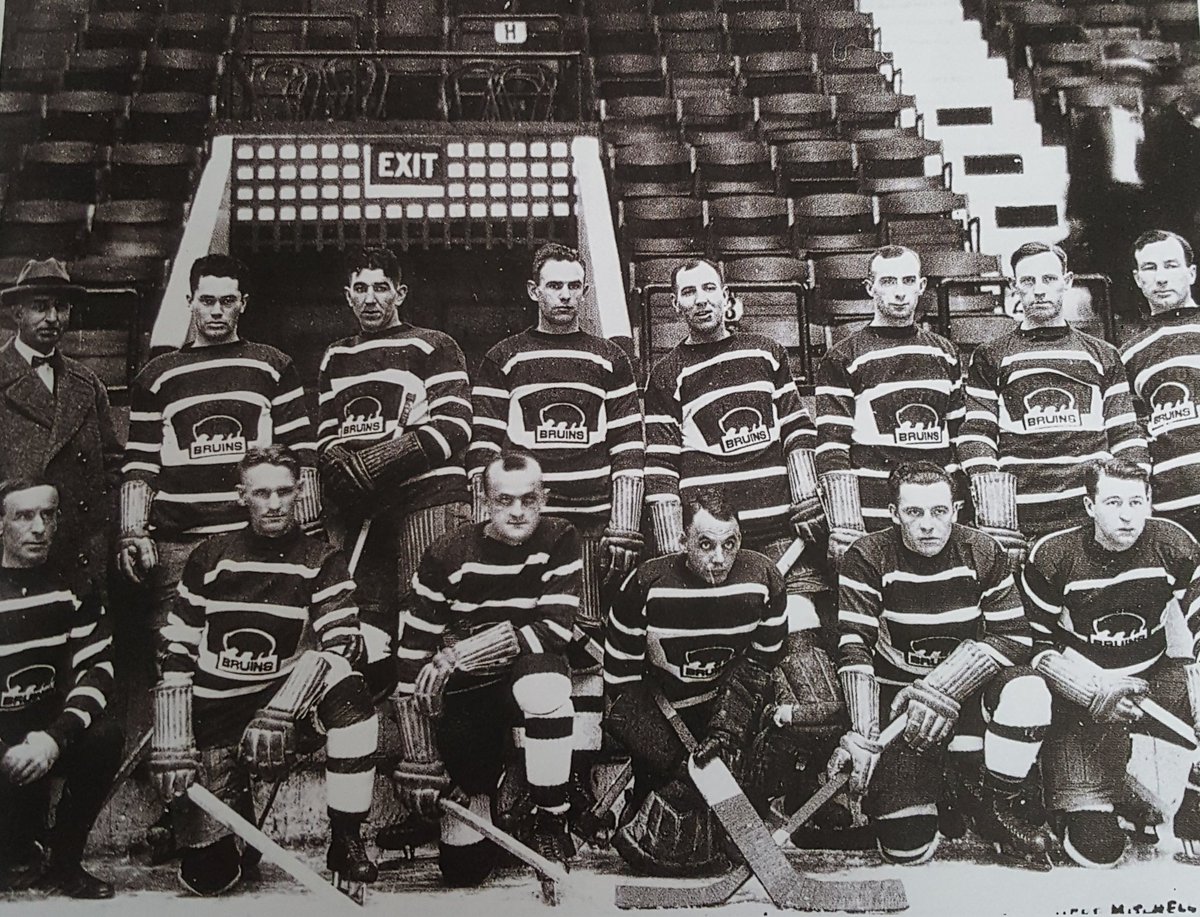
December 1, 1924: The National Hockey League's 2 new expansion teams debut against each other, at what was then named the Boston Arena. The Boston Bruins defeat the Montreal Maroons, 2-1.
Frank Ryan, a sportswriter for the Boston Traveler newspaper, announced the game on Boston radio station WBZ. He remained the Bruins' main radio announcer, and the team's publicity director, until 1952.
Chuck Dinsmore opened the scoring, tallying for the Maroons 9 minutes into the game. Thomas "Smokey" Harris tied it with the 1st-ever Bruins goal, 3:30 into the 2nd period. And Carson Cooper scored the winning goal, 9:50 into the 3rd period.
The Bruins were the 1st American-based team in the NHL. Their owner was Charles Francis Adams. Despite his name and his location, he was not related to the family that produced 2 Presidents and 2 other notable politicians named Charles Francis Adams. This one owned the First National grocery store chain. Its colors, brown and gold, would be given to the Bruins, who later switched to black and gold.
Adams would also have part-ownership of baseball's Boston Braves, and full ownership of Boston's Suffolk Downs racetrack, which opened in 1935. He died in 1947, and baseball team owner Bill Veeck would own the track from 1968 to 1971. It closed in 2019, and has been torn down to make way for apartments.
Although Jack Adams, the longtime head coach and general manager of the Detroit Red Wings, is the namesake of the NHL's coach of the year trophy, the NHL's Adams Division, which existed from 1974 to 1993 and included the Bruins, was named for Charles F.
The League's trophy for the leading scorer was named, ironically, for a defenseman, Art Ross, who had starred for the Montreal Wanderers. He was the Bruins' 1st general manager, from 1924 to 1954; and their 1st head coach, from 1924 to 1928, hiring former Ottawa Senators star Cy Denneny as player-coach for the 1928-29 season, which would be the Bruins' 1st Stanley Cup win. Ross coached them again from 1929 to 1934, again from 1936 to 1939, winning another Cup in 1939; and again from 1941 to 1945. The Bruins also won the Cup in 1941, coached by former Bruin Captain Ralph "Cooney" Weiland.
Among American teams, the Bruins were followed in 1925 by the Pittsburgh Pirates, who became the Philadelphia Quakers in 1930 and folded in 1931; also in 1925 by the New York Americans, who folded in 1942; and in 1926 by 3 teams still in existence: The New York Rangers, the Detroit Red Wings and the Chicago Black Hawks.
The Ottawa Senators became the St. Louis Eagles in 1934, and folded a year later. The Maroons folded in 1938. And the folding of the Amerks left the NHL with what has erroneously been called "The Original Six": The Montreal Canadiens, the Toronto Maple Leafs, the Bruins, the Rangers, the Red Wings, and the Blackhawks. (In 1986, the Chicago team's original charter was found, and it was discovered they were officially registered with the League as the "Blackhawks." The League office was notified, and it's officially been one word ever since.)
The Boston Arena still stands, under the name Matthews Arena, home to Northeastern University sports. Built in 1910, it is the oldest standing facility used by any hockey team, anywhere in the world. The Bruins moved to the Boston Garden in 1928, and to its adjacent replacement, now named the TD Garden, in 1995.
Their legends have included Eddie Shore, Dit Clapper, Milt Schmidt, Bobby Orr, Phil Esposito, Ray Bourque and Zdeno Chara. They've reached the Stanley Cup Finals 20 times, winning the Cup in 1929, 1939, 1941, 1970, 1972 and 2011.
UPDATE: Due to concerns over structural integrity, in May 2024, Northeastern University filed a letter of intent to the Boston city government to demolish Matthews Arena, and to construct a new multi-purpose athletics facility on the site.
*
December 1, 1924 was a Monday. This was the only game scheduled in the NHL that day. Baseball was out of season. Football was in midweek. And the NBA hadn't been founded yet. So there were no other scores on this historic day.


No comments:
Post a Comment