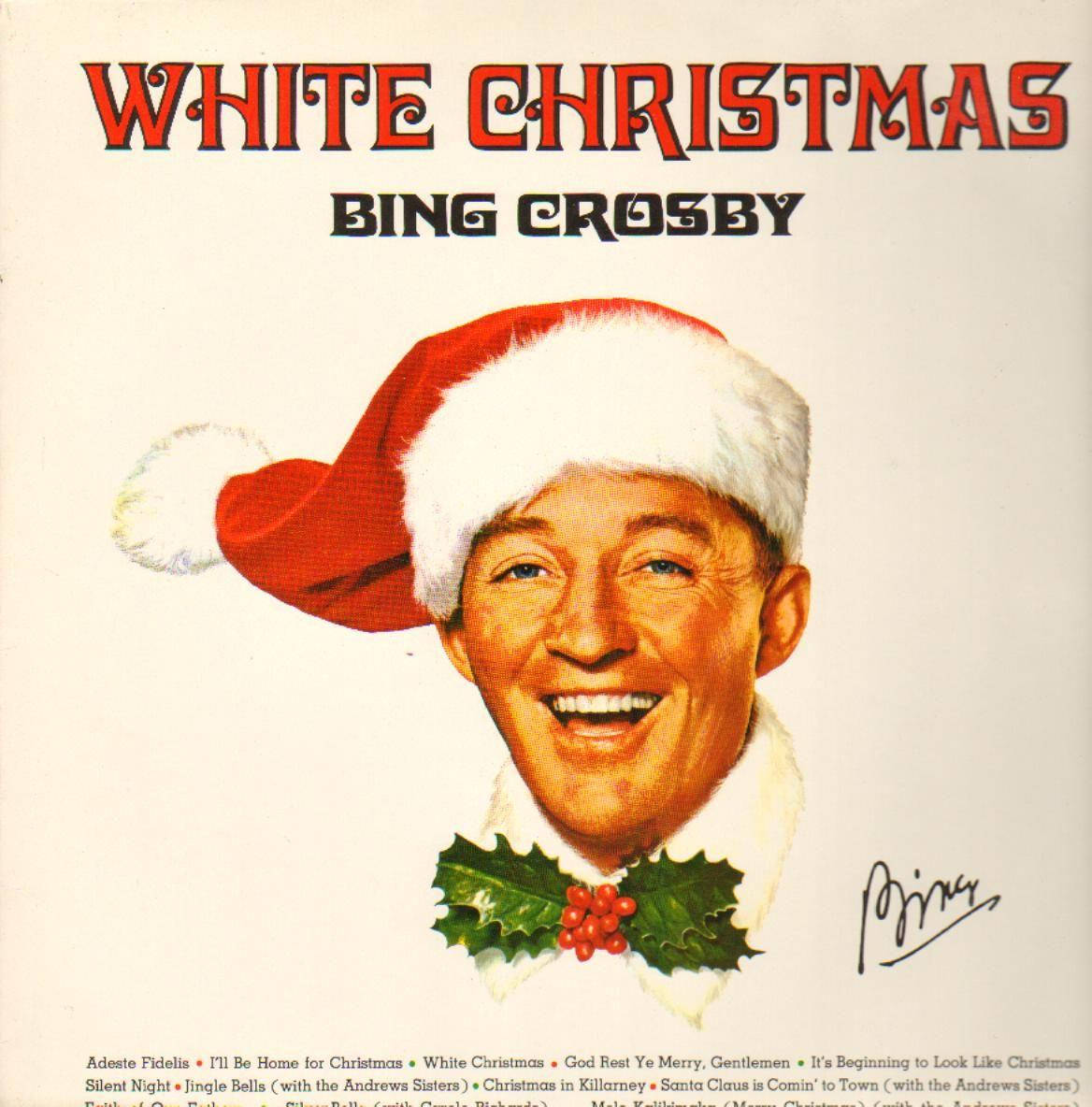
July 30, 1942: Bing Crosby releases "White Christmas," written by Irving Berlin. It becomes the most famous secular Christmas song of all time, and sells more copies than any single record in history.
Like a song written a few years later, "The Christmas Song" (a.k.a. "Chestnuts Roasting On an Open Fire"), it was written in Los Angeles during a Summer. Berlin was Jewish, but he told his secretary, "I want you to take down a song I wrote over the weekend. Not only is it the best song I ever wrote, it's the best song anybody ever wrote."
On December 25, 1941, just 18 days after the attack on Pearl Harbor brought America into World War II, Crosby sang the song on his NBC radio show The Kraft Music Hall. He recorded it for Decca Records in Los Angeles, with the John Scott Trotter Orchestra and the Ken Darby Singers, on May 29, 1942. It was released on July 30, and included in his next film, Holiday Inn, which premiered on September 4. (The hotel chain of the same name was started 10 years later.)
Israel Baline had grown up in New York in the 1890s, and made his professional name (Irving Berlin) in New York, and had remembered snow falling during the Christmas season, and that everyone seemed to be happier at that time. So he wrote:
I'm dreaming of a white Christmas
just like the ones I used to know
where the treetops glisten
and children listen
to hear sleigh bells in the snow.
On a personal note: I grew up in New Jersey, a short ride from Midtown Manhattan. From the 1970s onward, the weather tendency has been to not have the Winter's 1st big snowfall until after the New Year. We've had 2 pre-Halloween blizzards, and one blizzard actually on Thanksgiving Day. But as far back as I can remember, we've only had snow on the ground on December 24 and 25 maybe 6 or 7 times. Occasionally, we'd get a snow flurry on Christmas Eve or Christmas Day, which was nice, but rarely does it stick. We're just a little too far south to get that "postcard-perfect" "White Christmas" so often associated with New England, further north. More often, it rains, and we get a wet Christmas.
The timing was just right for the song: World War II was underway, and millions of servicemen were away from home, many of them for the 1st time -- but not yet sent overseas, so they could still buy American records, listen to American radio, and visit American movie theaters, thus hearing the song through all 3 media.
By Halloween, October 31, 1942, "White Christmas" was already the Number 1 song in in America. It remained Number 1 all through the holidays: Thanksgiving, Christmas, New Year's, all the way until January 16, 1943, when it was replaced on top of the charts by "There Are Such Things" by the Tommy Dorsey Orchestra.
As Ronald Lankford wrote in a book about Christmas songs: "During the 1940s, 'White Christmas' would set the stage for a number of classic American holiday songs steeped in a misty longing for yesteryear... The popular culture industry had not viewed the themes of home and hearth, centered on the Christmas holiday, as a unique market."
Dave Marsh and Steve Propes wrote, "'White Christmas' changed Christmas music forever, both by revealing the huge potential market for Christmas songs and by establishing the themes of home and nostalgia that would run through Christmas music evermore."
"White Christmas" won Berlin the Academy Award for Best Original Song. Bing's version hit the Top 10 again during the Christmas seasons of 1945 and 1946. His original 1942 recording was damaged through overuse, so he recorded it again on March 19, 1947, with all of the same people, to make it sound as similar as possible.
In 1954, Crosby and Danny Kaye starred in a film titled White Christmas, and sang the song in it. It tells the story of a pair of World War II veterans-turned-entertainers, and their girlfriends (played by singer Rosemary Clooney and dancer Vera-Ellen, respectively), trying to reunite their old Army unit to save the Vermont hotel run by their former Sergeant.
In 1955, the Clyde McPhatter version of The Drifters had the first rock-and-roll version of the song, bringing the dichotomy of black men singing "White Christmas." In 1963, Darlene Love's version opened A Christmas Gift for You from Philles Records. It includes a brief midsong monologue, reflecting the fact that, like the Bing original, her version was recorded in Los Angeles:
The sun is shining.
The grass is green.
The orange and palm trees sway.
There's never been such a day in old L.A.
But it's December the 24th
and I'm longing to be up north
so I can have my very own white Christmas.
The grass is green.
The orange and palm trees sway.
There's never been such a day in old L.A.
But it's December the 24th
and I'm longing to be up north
so I can have my very own white Christmas.
So, San Francisco? Well, maybe Lake Tahoe or the adjacent Olympic Valley (formerly known as Squaw Valley), where the 1960 Winter Olympics were held.
*
July 30, 1942 was a Thursday. These baseball games were played:
* The Brooklyn Dodgers beat the Chicago Cubs, 9-2 at Ebbets Field. Pete Reiser went 3-for-5.
* The Cleveland Indians beat the Boston Red Sox, 4-3 at League Park in Cleveland. Ted Williams, on his way to the Triple Crown, hit a home run. After the season, he would enlist in the U.S. Marine Corps.
* A doubleheader was split at Briggs Stadium in Detroit. (The ballpark was renamed Tiger Stadium in 1961.) The Detroit Tigers won the 1st game, 11-5. The Philadelphia Athletics won the 2nd game, 7-6.
* The Philadelphia Phillies beat the Cincinnati Reds, 4-2 at Shibe Park in Philadelphia. (The ballpark was renamed Connie Mack Stadium in 1953.)
* And the Washington Senators beat the St. Louis Browns, 11-6 at Sportsman's Park in St. Louis. (The ballpark was renamed Busch Stadium in 1953.)


No comments:
Post a Comment