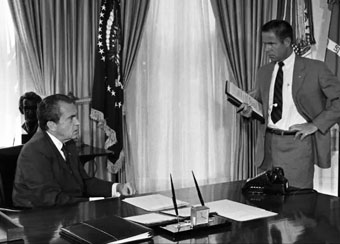
Richard Nixon (left) and Bob Haldeman
June 23, 1972: President Richard Nixon signs the Education Amendments of 1972 into law. This includes Title IX, which prohibits sex-based discrimination in any school, or any other education program, that receives funding from the federal government. I have a separate entry for this event.
But it wasn't the most consequential thing Nixon did that day. Nixon's signing of the bill wasn't his only notable action of the day. He also sealed his doom as President.
Six days earlier, 5 men working for the Committee to Re-Elect the President had broken into the headquarters of the Democratic National Committee, at the Watergate hotel and office complex in Washington. Whether Nixon knew that this was going to happen, and approved of it, or not, only he knew for sure.
But on June 23, he met with his White House Chief of Staff, Harry Robbins "Bob" Haldeman. The conversation was captured on an audiotape, in a system Nixon had installed in the Oval Office of the White House, for the purpose of historical records, because he didn't want anything to be distorted by outside historians. Ironically, this taping system would, instead, be his downfall.
The tape recorder, now in the National Archives
The conversation with Haldeman lasted from 10:04 to 11:39 AM. Haldeman made the point that J. Edgar Hoover, Director of the FBI since 1924, had died on May 2; and, since then, the FBI had been run by an acting director, L. Patrick Gray III. The FBI was investigating the break-in, and Haldeman suggested that the Administration tell the FBI to back off, because this was a CIA operation (which was a lie), and that this would protect the Administration from prosecution. And Nixon agreed to this.
This was obstruction of justice, a felony. And Nixon had committed that felony. And a recording of him doing so existed.
The others mentioned on the tape, in the order of their mention:
* Bernard Barker, one of the Watergate burglars.
* John Mitchell, Chairman of the Committee to Re-Elect the President; before that, the Attorney General of the U.S.; before that, Nixon's 1968 campaign manager.
* John Dean, White House Counsel; in other words, the chief lawyer for the Administration, not the personal lawyer of the holder of the Presidency.
* Vernon Walters, Deputy Director of the CIA. He was never charged with any wrongdoing, and later served as U.S. Ambassador to the United Nations.
* Mark Felt, by this point Gray's deputy at the FBI. Felt would turn out to be "Deep Throat," Washington Post reporter Bob Woodward's source on what was going on in the Watergate scandal.
* Kenneth H. Dahlberg, a businessman who was paying Barker off; before that, in World War II, one of America's top fighter pilots. He was never charged with any wrongdoing.
* Maurice Stans, finance chairman for the Committee to Re-Elect the President; before that, the U.S. Secretary of Commerce.
* Richard Helms, Director of the CIA.
* John Ehrlichman, Domestic Policy Adviser to the President.
* E. Howard Hunt, a former CIA officer who was one of Nixon's secret operatives intended to stop information from getting out of the White House, known as the "Plumbers" because they were meant to stop "leaks."
* G. Gordon Liddy, a former FBI Agent who worked under Hunt, and organized the Watergate burglary. And Nixon understated the case: Liddy turned out to be more than "a little nuts."
* Chuck Colson, Special Counsel to Nixon; in other words, Nixon's personal lawyer.
Here is the transcript:
Haldeman: Now, on the investigation, you know, the Democratic break-in thing, we're back to the-in the, the problem area because the FBI is not under control, because Gray doesn't exactly know how to control them, and they have, their investigation is now leading into some productive areas, because they've been able to trace the money, not through the money itself, but through the bank, you know, sources – the banker himself. And, and it goes in some directions we don't want it to go.
Ah, also there have been some things, like an informant came in off the street to the FBI in Miami, who was a photographer or has a friend who is a photographer who developed some films through this guy, Barker, and the films had pictures of Democratic National Committee letter head documents and things. So I guess, so it's things like that that are gonna, that are filtering in.
Mitchell came up with yesterday, and John Dean analyzed very carefully last night and concludes, concurs now with Mitchell's recommendation that the only way to solve this, and we're set up beautifully to do it, ah, in that and that…the only network that paid any attention to it last night was NBC…they did a massive story on the Cuban thing.
Nixon: That’s right. Right.
Haldeman: That the way to handle this now is for us to have Walters call Pat Gray and just say, "Stay the hell out of this… This is ah, business here, we don't want you to go any further on it." That's not an unusual development…
Nixon: Um huh.
Haldeman: …and, uh, that would take care of it.
Nixon: What about Pat Gray, ah, you mean he doesn't want to?
Haldeman: Pat does want to. He doesn't know how to, and he doesn't have, he doesn't have any basis for doing it. Given this, he will then have the basis. He'll call Mark Felt in, and the two of them… and Mark Felt wants to cooperate because…
Nixon: Yeah.
Haldeman: ...he's ambitious.
Nixon: Yeah.
Haldeman: Ah, he'll call him in and say, "We've got the signal from across the river to, to put the hold on this." And that will fit rather well, because the FBI agents who are working the case, at this point, feel that's what it is. This is CIA.
Nixon: But they’ve traced the money to 'em.
Haldeman: Well they have, they've traced to a name, but they haven't gotten to the guy yet.
Nixon: Would it be somebody here?
Haldeman: Ken Dahlberg.
Nixon: Who the hell is Ken Dahlberg?
Haldeman: He's ah, he gave $25,000 in Minnesota and ah, the check went directly in to this, to this guy Barker.
Nixon: Maybe he's a …bum. He didn’t get this from the Committee though, from Stans.
Haldeman: Yeah. It is. It is. It's directly traceable, and there's some more through some Texas people in–that went to the Mexican bank which they can also trace to the Mexican bank…they'll get their names today. And...
Nixon: Well, I mean, ah, there's no way... I'm just thinking, if they don’t cooperate, what do they say? They they, they were approached by the Cubans. That's what Dahlberg has to say, the Texans too. Is that the idea?
Haldeman: Well, if they will. But then we're relying on more and more people all the time. That's the problem. And ah, they'll stop if we could, if we take this other step.
Nixon: All right. Fine.
Haldeman: And, and they seem to feel the thing to do is get them to stop?
Nixon: Right, fine.
Haldeman: They say the only way to do that is from White House instructions. And it's got to be to Helms and, ah, what’s his name? Walters.
Nixon: Walters.
Haldeman: And the proposal would be that Ehrlichman (coughs) and I call them in, and say, ah...
Nixon: All right, fine. How do you call him in? I mean you just, well, we protected Helms from one hell of a lot of things.
Haldeman: That's what Ehrlichman says.
Nixon: Of course, this is a, this is a Hunt, you will -- that will uncover a lot of things. You open that scab there's a hell of a lot of things and that we just feel that it would be very detrimental to have this thing go any further. This involves these Cubans, Hunt, and a lot of hanky-panky that we have nothing to do with ourselves. Well what the hell, did Mitchell know about this thing to any much of a degree.
Haldeman: I think so. I don't think he knew the details, but I think he knew.
Nixon: He didn't know how it was going to be handled though, with Dahlberg and the Texans and so forth? Well, who was the asshole that did? (Unintelligible) Is it Liddy? Is that the fellow? He must be a little nuts.
Haldeman: He is.
Nixon: I mean, he just isn't well screwed on, is he? Isn't that the problem?
Haldeman: No, but he was under pressure, apparently, to get more information, and as he got more pressure, he pushed the people harder to move harder on.
Nixon: Pressure from Mitchell?
Haldeman: Apparently.
Nixon: Oh, Mitchell. Mitchell was at the point that you made on this, that exactly what I need from you is on the...
Haldeman: Gemstone, yeah.
Nixon: All right, fine. I understand it all. We won't second-guess Mitchell and the rest. Thank God it wasn't Colson.
Haldeman: The FBI interviewed Colson yesterday. They determined that would be a good thing to do.
Nixon: Um hum.
Haldeman: Ah, to have him take a…
Nixon: Um hum.
Haldeman: ...an interrogation, which he did, and that, the FBI guys working the case had concluded that there were one or two possibilities. One, that this was a White House, they don't think that there is anything at the Election Committee, they think it was either a White House operation and they had some obscure reasons for it, non-political…
Nixon: Uh huh.
Haldeman: ...or it was a…
Nixon: Cuban thing-
Haldeman: Cubans and the CIA. And after their interrogation of, of…
Nixon: Colson.
Haldeman: Colson, yesterday, they concluded it was not the White House, but are now convinced it is a CIA thing, so the CIA turn off would…
Nixon: Well, not sure of their analysis. I'm not going to get that involved. I’m (unintelligible).
Haldeman: No, sir. We don’t want you to.
Nixon: You call them in. Good. Good deal! Play it tough. That's the way they play it, and that’' the way we are going to play it.
Haldeman: O.K. We'll do it.
Nixon: Yeah, when I saw that news summary item, I of course knew it was a bunch of crap, but I thought, ah, well, it's good to have them off on this wild hair thing, because when they start bugging us, which they have, we'll know our little boys will not know how to handle it. I hope they will, though. You never know. Maybe, you think about it. Good!
When you get in these people when you…get these people in, say: "Look, the problem is that this will open the whole, the whole Bay of Pigs thing, and the President just feels that," ah, without going into the details... Don't, don't lie to them to the extent to say there is no involvement, but just say this is sort of a comedy of errors, bizarre, without getting into it, "The President believes that it is going to open the whole Bay of Pigs thing up again. And, ah, because these people are plugging for, for keeps, and that they should call the FBI in and say that we wish for the country, don't go any further into this case, period!"
Haldeman: OK.
In spite of the reporting of Woodward and his Post partner, Carl Bernstein, Watergate wasn't much of an issue in the 1972 election. The Democratic nominee, Senator George McGovern of South Dakota, tried to make it one: In his acceptance speech at the Democratic Convention, he said, "From secrecy and deception in high places, come home, America!" But, between Nixon's legitimate accomplishments and the McGovern campaign's general-election incompetence, Nixon was overwhelmingly re-elected.
But the scandal broke out at the start of his 2nd term, and Nixon thought sacrificing some staff would help: He fired Haldeman, Ehrlichman, Dean and Attorney General Richard Kleindienst. It didn't work. The Senate began holding hearings. Alexander Butterfield, Director of the Federal Aviation Administration and a former Nixon White House aide, was asked by the Senate committee if he had installed a taping system in the Oval Office. He told the truth: He had.
The fight by Congress to get those tapes, and the fight by Nixon to keep Congress from getting them, went all the way to the Supreme Court. On August 5, 1974, the Court unanimously ruled that they had to be released. When the June 23, 1972 tape featuring Nixon agreeing to Haldeman's plan to get the FBI to back off was released, it was proof of felonious guilt. It became known as "The Smoking Gun Tape."
All 11 Republicans on the House Judiciary Committee who voted against drawing up Articles of Impeachment said they would now vote for impeachment in the full House. On August 7, the Republican leaders of Congress told Nixon they couldn't save him from impeachment and removal. He announced his resignation the next day. On September 9, the new President, Gerald Ford pardoned Nixon for any and all crimes he committed, or may have committed, while President. As for the other men mentioned on the tape, only Walters and Dahlberg avoided criminal prosecution. The rest were convicted, and most served time in prison.
*
June 23, 1972 was a Friday. Soccer legend Zinedine Zidane was born. And these Major League Baseball games were played:
* The New York Yankees beat the Cleveland Indians, 4-1 at Cleveland Municipal Stadium. Fritz Peterson outpitched Milt Wilcox. Bernie Allen hit a home run.
* The Montreal Expos beat the Philadelphia Phillies, 2-1 at Jarry Park in Montreal.
* The Cincinnati Reds beat the Houston Astros, 7-1 at Riverfront Stadium in Cincinnati. Pete Rose went 1-for-2 with 2 walks. Johnny Bench hit a home run.
* The Pittsburgh Pirates beat the Chicago Cubs, 4-2 at Wrigley Field in Chicago. Steve Blass outpitched Fergie Jekins. Roberto Clemente went 1-for-3 with a walk and 2 RBIs. Willie Stargell went 0-for-3 with a walk.
* The Milwaukee Brewers beat the Boston Red Sox, 8-1 at Milwaukee County Stadium. Carl Yastrzemski went 0-for-2 with a walk.
* The Kansas City Royals beat the Minnesota Twins, 5-0 at Kansas City Municipal Stadium. Paul Splittorff pitched a 7-hit shutout, outpitching Jim Perry. Harmon Killebrew and Rod Carew, the Twins' future Hall-of-Famers, each got 2 of those hits.
* The Texas Rangers beat the Chicago White Sox, 4-3 at Arlington Stadium in the Dallas suburb of Arlington, Texas.
* The San Diego Padres beat the San Francisco Giants, 4-1 at San Diego Stadium (later Jack Murphy Stadium and Qualcomm Stadium).
* The Los Angeles Dodgers beat the Atlanta Braves, 2-1 at Dodger Stadium in Los Angeles. Frank Robinson, in his only season with the Dodgers, hit his 513th career home run. Hank Aaron went 0-for-4.
* The California Angels beat the Oakland Athletics, 2-1 at the Oakland Coliseum. Nolan Ryan outpitched Dave Hamilton. Reggie Jackson hit a home run.
* The Baltimore Orioles and the Detroit Tigers were rained out at Memorial Stadium in Baltimore. The game was made up as part of a doubleheader the next day. The Orioles won the opener, 3-1. Dave McNally outpitched Mickey Lolich. The Tigers won the nightcap, 2-1. Ed Brinkman won it with a sacrifice fly in the to of the 12th inning. Joe Coleman went 11 innings for the win, while Doyle Alexander lost it in relief of Mike Cuellar.
Over the 2 games, Brooks Robinson went 0-for-8, but had an RBI on a sacrifice fly; while Al Kaline went 2-for-8 with a walk.
* And the New York Mets and the St. Louis Cardinals were rained out at Shea Stadium. The game was made up as part of a doubleheader on September 8. The Mets won the 1st game, 8-2. The Cards won the 2nd game, 9-4. The Met bullpen melted down in the top of the 13th inning, including giving up home runs to Ted Simmons and Dwain Anderson.


No comments:
Post a Comment